

He is Reese W. Flower Professor of Astronomy and Astrophysics at University of
Pennsylvania. His B.A. is from the University of Wisconsin-Madison (1988). He
gained an M.S. and a Ph.D. from the University of California at Berkeley (1993).
His research focuses on experimental cosmology at millimeter and submillimeter
wavelengths. He designs and builds sophisticated instrumentation and telescopes
flown on stratospheric balloons. His current projects are:
• The Simons Observatory; a large aperture telescope and camera deployed at
Cerro Toco in the Atacama desert of Northern Chile.
• The Atacama Cosmology Telescope (ACT) is an ongoing experiment utilizing a 6 m (19.7 ft) diameter telescope at the Simons Observatory.
• The Balloon-borne Large Aperture Telescope (BLAST), a long running
NASA high altitude balloon program.
• The MUSTANG is a 3 mm receiver that is operated at the Green Bank
Telescope in West Virginia.
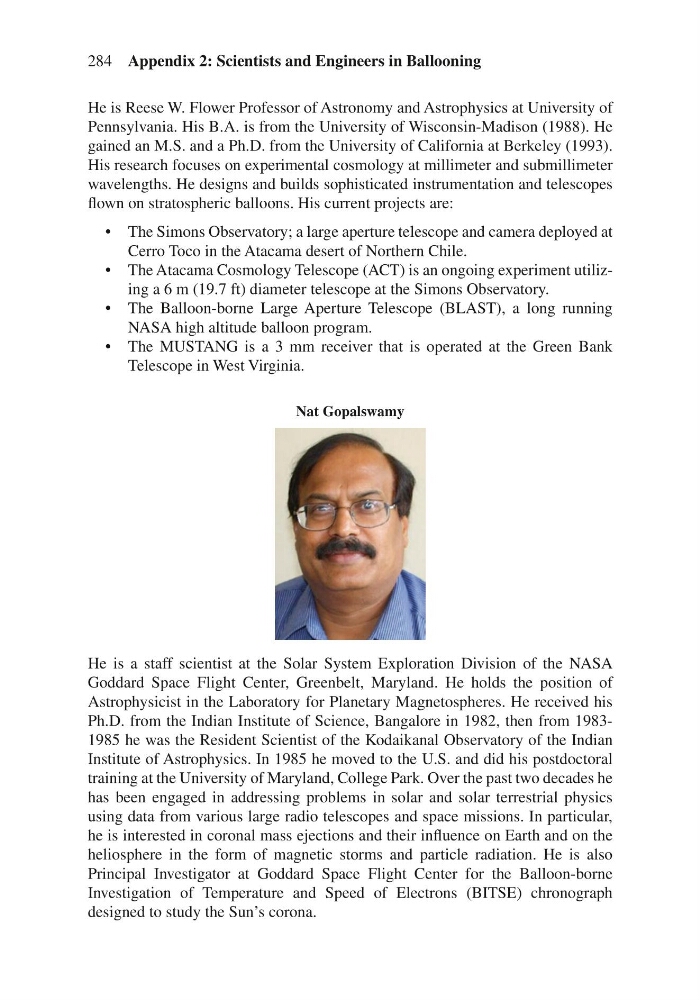
Nat Gopalswamy
He is a staff scientist at the Solar System Exploration Division of the NASA
Goddard Space Flight Center, Greenbelt, Maryland. He holds the position of
Astrophysicist in the Laboratory for Planetary Magnetospheres. He received his
Ph.D. from the Indian Institute of Science, Bangalore in 1982, then from 19831985 he was the Resident Scientist of the Kodaikanal Observatory of the Indian
Institute of Astrophysics. In 1985 he moved to the U.S. and did his postdoctoral
training at the University of Maryland, College Park. Over the past two decades he
has been engaged in addressing problems in solar and solar terrestrial physics
using data from various large radio telescopes and space missions. In particular,
he is interested in coronal mass ejections and their influence on Earth and on the
heliosphere in the form of magnetic storms and particle radiation. He is also
Principal Investigator at Goddard Space Flight Center for the Balloon-borne
Investigation of Temperature and Speed of Electrons (BITSE) chronograph
designed to study the Sun’s corona.
284 Appendix 2: Scientists and Engineers in Ballooning
Pennsylvania. His B.A. is from the University of Wisconsin-Madison (1988). He
gained an M.S. and a Ph.D. from the University of California at Berkeley (1993).
His research focuses on experimental cosmology at millimeter and submillimeter
wavelengths. He designs and builds sophisticated instrumentation and telescopes
flown on stratospheric balloons. His current projects are:
• The Simons Observatory; a large aperture telescope and camera deployed at
Cerro Toco in the Atacama desert of Northern Chile.
• The Atacama Cosmology Telescope (ACT) is an ongoing experiment utilizing a 6 m (19.7 ft) diameter telescope at the Simons Observatory.
• The Balloon-borne Large Aperture Telescope (BLAST), a long running
NASA high altitude balloon program.
• The MUSTANG is a 3 mm receiver that is operated at the Green Bank
Telescope in West Virginia.
Nat Gopalswamy
He is a staff scientist at the Solar System Exploration Division of the NASA
Goddard Space Flight Center, Greenbelt, Maryland. He holds the position of
Astrophysicist in the Laboratory for Planetary Magnetospheres. He received his
Ph.D. from the Indian Institute of Science, Bangalore in 1982, then from 19831985 he was the Resident Scientist of the Kodaikanal Observatory of the Indian
Institute of Astrophysics. In 1985 he moved to the U.S. and did his postdoctoral
training at the University of Maryland, College Park. Over the past two decades he
has been engaged in addressing problems in solar and solar terrestrial physics
using data from various large radio telescopes and space missions. In particular,
he is interested in coronal mass ejections and their influence on Earth and on the
heliosphere in the form of magnetic storms and particle radiation. He is also
Principal Investigator at Goddard Space Flight Center for the Balloon-borne
Investigation of Temperature and Speed of Electrons (BITSE) chronograph
designed to study the Sun’s corona.
284 Appendix 2: Scientists and Engineers in Ballooning