

On April 28, 2010, there was an attempt to launch a balloon carrying the Nuclear
Compton Telescope, but it failed. The HERO telescope was successfully launched
and recovered in April 2011. The site was idle until 2015, when a Japanese Space
Agency (JAXA) team, in cooperation with the New South Wales University and
the Commonwealth Scientific and Industrial Research Organisation (CSIRO) of
Canberra, launched the first of several Gamma-Ray Astro-Imager with Nuclear
Emulsion (GRAINE) experiments that were managed by Nagoya University and
Kobe University. Three balloons were launched from Alice Springs in 2017 and
two in 2018, but none since.
6.1.5 McMurdo Station, Antarctica
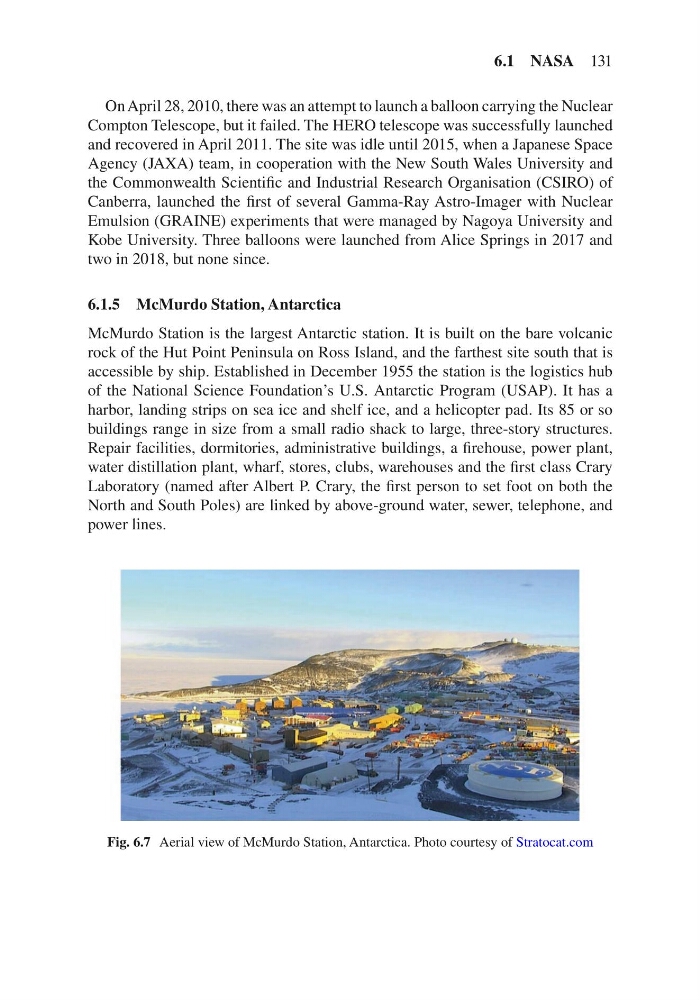
McMurdo Station is the largest Antarctic station. It is built on the bare volcanic
rock of the Hut Point Peninsula on Ross Island, and the farthest site south that is
accessible by ship. Established in December 1955 the station is the logistics hub
of the National Science Foundation’s U.S. Antarctic Program (USAP). It has a
harbor, landing strips on sea ice and shelf ice, and a helicopter pad. Its 85 or so
buildings range in size from a small radio shack to large, three-story structures.
Repair facilities, dormitories, administrative buildings, a firehouse, power plant,
water distillation plant, wharf, stores, clubs, warehouses and the first class Crary
Laboratory (named after Albert P. Crary, the first person to set foot on both the
North and South Poles) are linked by above-ground water, sewer, telephone, and
power lines.
Fig. 6.7 Aerial view of McMurdo Station, Antarctica. Photo courtesy of Stratocat.com
6.1 NASA 131
Compton Telescope, but it failed. The HERO telescope was successfully launched
and recovered in April 2011. The site was idle until 2015, when a Japanese Space
Agency (JAXA) team, in cooperation with the New South Wales University and
the Commonwealth Scientific and Industrial Research Organisation (CSIRO) of
Canberra, launched the first of several Gamma-Ray Astro-Imager with Nuclear
Emulsion (GRAINE) experiments that were managed by Nagoya University and
Kobe University. Three balloons were launched from Alice Springs in 2017 and
two in 2018, but none since.
6.1.5 McMurdo Station, Antarctica
McMurdo Station is the largest Antarctic station. It is built on the bare volcanic
rock of the Hut Point Peninsula on Ross Island, and the farthest site south that is
accessible by ship. Established in December 1955 the station is the logistics hub
of the National Science Foundation’s U.S. Antarctic Program (USAP). It has a
harbor, landing strips on sea ice and shelf ice, and a helicopter pad. Its 85 or so
buildings range in size from a small radio shack to large, three-story structures.
Repair facilities, dormitories, administrative buildings, a firehouse, power plant,
water distillation plant, wharf, stores, clubs, warehouses and the first class Crary
Laboratory (named after Albert P. Crary, the first person to set foot on both the
North and South Poles) are linked by above-ground water, sewer, telephone, and
power lines.
Fig. 6.7 Aerial view of McMurdo Station, Antarctica. Photo courtesy of Stratocat.com
6.1 NASA 131