

In 1983, NASA took over the Balloon Program and managed the flights out of
Alice Springs. Some of the launch equipment was moved from Mildura but the
site was in need of an upgrade. It was adequate to handle balloons with volumes
up to 1.3 million m
3
(46 million ft
3
) and payloads of 1.81 tonnes (2 tons). It had
line of sight hardware including receivers for downlink telemetry channels and
transmitters. The uplink system was composed of a 50 watt transmitter allowing
reliable control of the payload in flight. Two downrange stations were used, one
located west in Newman and the other east in Longreach, each covering a radius
of 700 km (435 mi). There were good telephone links available between the two
stations and Alice Spring, giving the possibility of data transfer of up to 9.6 kbs.
Tracking of the balloons was performed visually from aircraft. Almost real-time
positional data was also available by Omega receivers or Argos transmitters. At
the end of a flight, termination was initiated from an aircraft which had a direct
view of the balloon. Owing to the rough desert terrain in Australia, the recovery
crews used four-wheel drive vehicles and helicopters.
Following its renewal of the agreement with the Australian government in
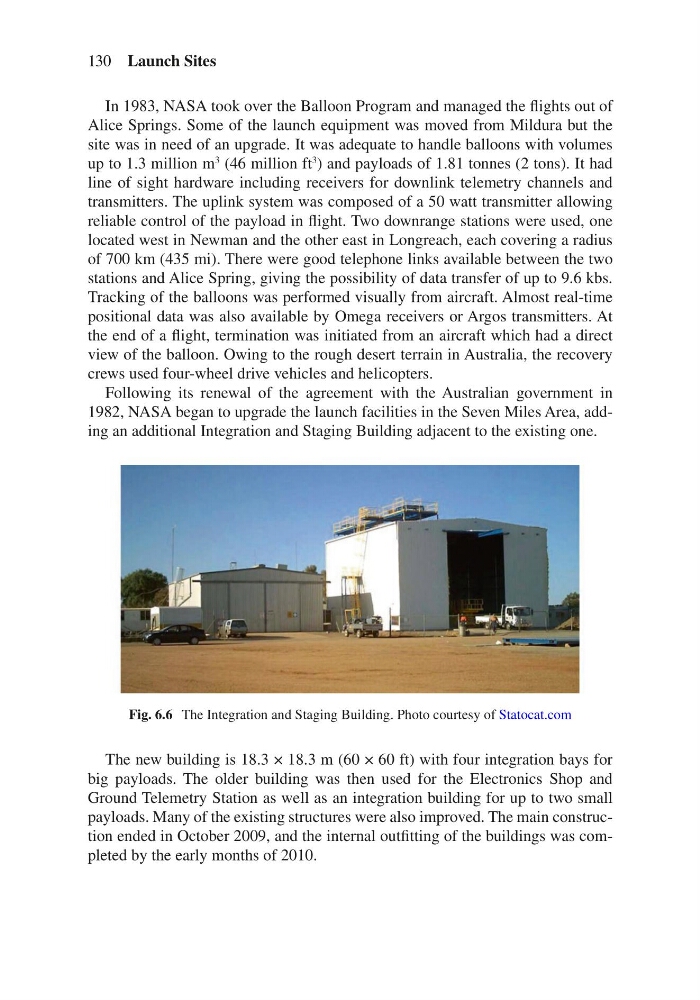
1982, NASA began to upgrade the launch facilities in the Seven Miles Area, adding an additional Integration and Staging Building adjacent to the existing one.
The new building is 18.3 × 18.3 m (60 × 60 ft) with four integration bays for
big payloads. The older building was then used for the Electronics Shop and
Ground Telemetry Station as well as an integration building for up to two small
payloads. Many of the existing structures were also improved. The main construction ended in October 2009, and the internal outfitting of the buildings was completed by the early months of 2010.
Fig. 6.6 The Integration and Staging Building. Photo courtesy of Statocat.com
130 Launch Sites
Alice Springs. Some of the launch equipment was moved from Mildura but the
site was in need of an upgrade. It was adequate to handle balloons with volumes
up to 1.3 million m
3
(46 million ft
3
) and payloads of 1.81 tonnes (2 tons). It had
line of sight hardware including receivers for downlink telemetry channels and
transmitters. The uplink system was composed of a 50 watt transmitter allowing
reliable control of the payload in flight. Two downrange stations were used, one
located west in Newman and the other east in Longreach, each covering a radius
of 700 km (435 mi). There were good telephone links available between the two
stations and Alice Spring, giving the possibility of data transfer of up to 9.6 kbs.
Tracking of the balloons was performed visually from aircraft. Almost real-time
positional data was also available by Omega receivers or Argos transmitters. At
the end of a flight, termination was initiated from an aircraft which had a direct
view of the balloon. Owing to the rough desert terrain in Australia, the recovery
crews used four-wheel drive vehicles and helicopters.
Following its renewal of the agreement with the Australian government in
1982, NASA began to upgrade the launch facilities in the Seven Miles Area, adding an additional Integration and Staging Building adjacent to the existing one.
The new building is 18.3 × 18.3 m (60 × 60 ft) with four integration bays for
big payloads. The older building was then used for the Electronics Shop and
Ground Telemetry Station as well as an integration building for up to two small
payloads. Many of the existing structures were also improved. The main construction ended in October 2009, and the internal outfitting of the buildings was completed by the early months of 2010.
Fig. 6.6 The Integration and Staging Building. Photo courtesy of Statocat.com
130 Launch Sites