

As the largest community in Antarctica, McMurdo is capable of supporting
over 1,200 residents in summer and 300 in winter. All personnel and cargo heading to, or returning from the Amundsen-Scott South Pole Station must first pass
through McMurdo. The monthly average temperatures there range from 27°F in
January to –18°F in August. The lowest and highest recorded values are –58°F to
+46°F. Drifting snow can accumulate about 1 m (4 ft) per annum, but the station
can be snow-free in summer. The average wind is about 18 km (11 mi) per hour.
A gust ten times that speed was recorded in July 1968.
The research disciplines at McMurdo include astronomy, atmospheric sciences,
biology, Earth science, the environment, geology, glaciology, marine biology,
oceanography, climate studies, and geophysics.
The NSF manages the U.S. Antarctic Program, and provides logistic support
for all U.S. scientific operations in Antarctica including the NASA Balloon
Program. The launch operations are conducted by the Columbia Scientific Balloon
Facility in Palestine, TX. Initially, it was supported and managed by the Physical
Science Laboratory at New Mexico State University (PSL-NMSU). Today that
contractor is Northrup Grumman.
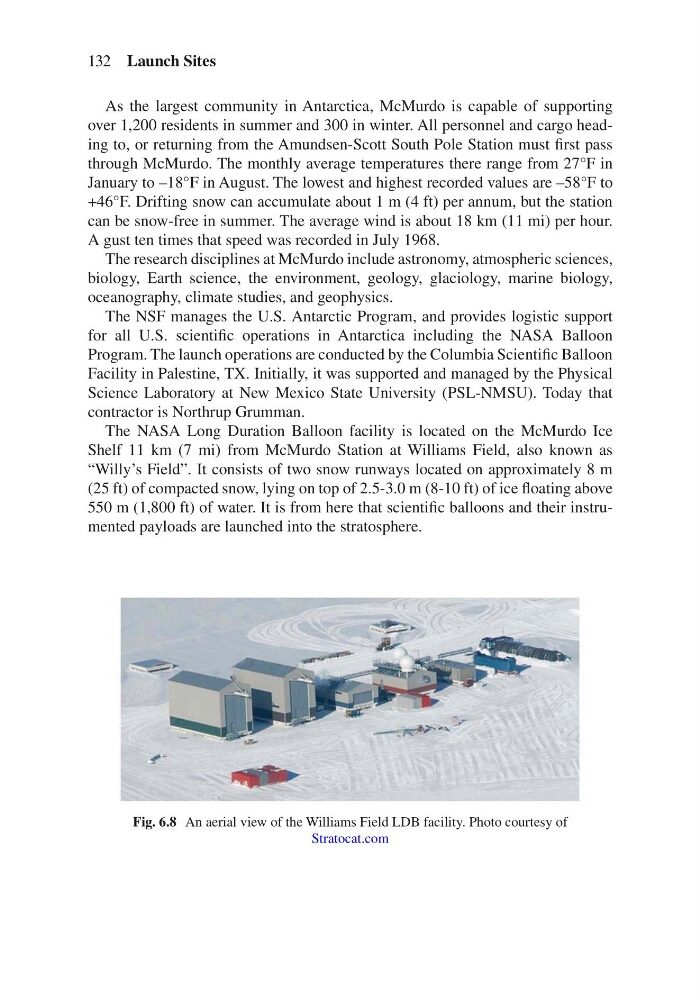
The NASA Long Duration Balloon facility is located on the McMurdo Ice
Shelf 11 km (7 mi) from McMurdo Station at Williams Field, also known as
“Willy’s Field”. It consists of two snow runways located on approximately 8 m
(25 ft) of compacted snow, lying on top of 2.5-3.0 m (8-10 ft) of ice floating above
550 m (1,800 ft) of water. It is from here that scientific balloons and their instrumented payloads are launched into the stratosphere.
Fig. 6.8 An aerial view of the Williams Field LDB facility. Photo courtesy of
Stratocat.com
132 Launch Sites
over 1,200 residents in summer and 300 in winter. All personnel and cargo heading to, or returning from the Amundsen-Scott South Pole Station must first pass
through McMurdo. The monthly average temperatures there range from 27°F in
January to –18°F in August. The lowest and highest recorded values are –58°F to
+46°F. Drifting snow can accumulate about 1 m (4 ft) per annum, but the station
can be snow-free in summer. The average wind is about 18 km (11 mi) per hour.
A gust ten times that speed was recorded in July 1968.
The research disciplines at McMurdo include astronomy, atmospheric sciences,
biology, Earth science, the environment, geology, glaciology, marine biology,
oceanography, climate studies, and geophysics.
The NSF manages the U.S. Antarctic Program, and provides logistic support
for all U.S. scientific operations in Antarctica including the NASA Balloon
Program. The launch operations are conducted by the Columbia Scientific Balloon
Facility in Palestine, TX. Initially, it was supported and managed by the Physical
Science Laboratory at New Mexico State University (PSL-NMSU). Today that
contractor is Northrup Grumman.
The NASA Long Duration Balloon facility is located on the McMurdo Ice
Shelf 11 km (7 mi) from McMurdo Station at Williams Field, also known as
“Willy’s Field”. It consists of two snow runways located on approximately 8 m
(25 ft) of compacted snow, lying on top of 2.5-3.0 m (8-10 ft) of ice floating above
550 m (1,800 ft) of water. It is from here that scientific balloons and their instrumented payloads are launched into the stratosphere.
Fig. 6.8 An aerial view of the Williams Field LDB facility. Photo courtesy of
Stratocat.com
132 Launch Sites