

91
Many citizen groups endeavor to address this issue of re-maintaining satoyama
woodland as an urban productive landscape. Coppice Club, satoyama-friendly
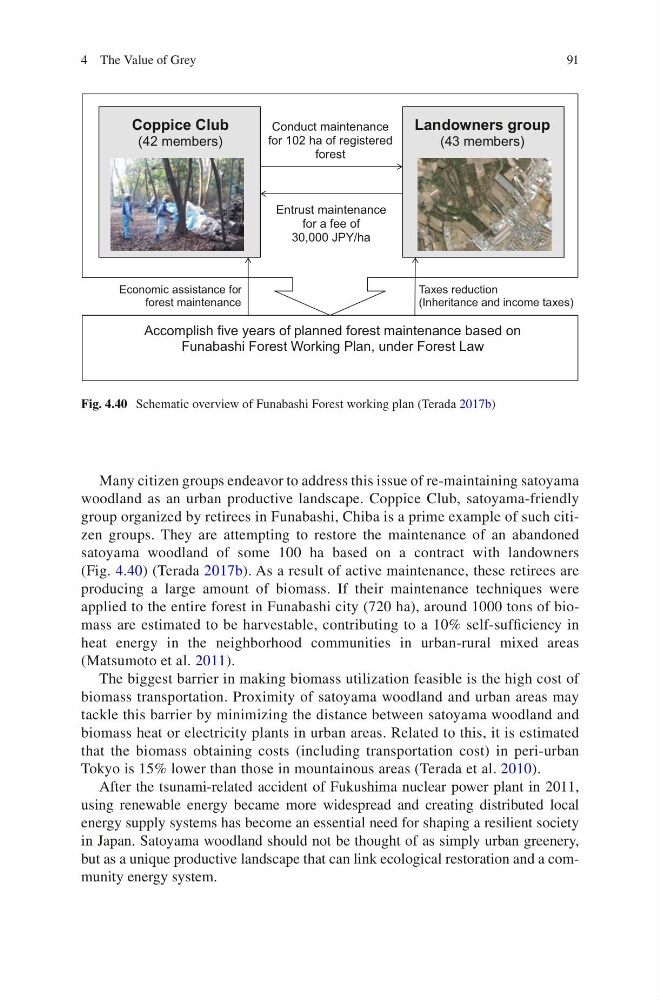
group organized by retirees in Funabashi, Chiba is a prime example of such citizen groups. They are attempting to restore the maintenance of an abandoned
satoyama woodland of some 100 ha based on a contract with landowners
(Fig. 4.40) (Terada 2017b). As a result of active maintenance, these retirees are
producing a large amount of biomass. If their maintenance techniques were
applied to the entire forest in Funabashi city (720 ha), around 1000 tons of biomass are estimated to be harvestable, contributing to a 10% self-sufficiency in
heat energy in the neighborhood communities in urban-rural mixed areas
(Matsumoto et al. 2011).
The biggest barrier in making biomass utilization feasible is the high cost of
biomass transportation. Proximity of satoyama woodland and urban areas may
tackle this barrier by minimizing the distance between satoyama woodland and
biomass heat or electricity plants in urban areas. Related to this, it is estimated
that the biomass obtaining costs (including transportation cost) in peri-urban
Tokyo is 15% lower than those in mountainous areas (Terada et al. 2010).
After the tsunami-related accident of Fukushima nuclear power plant in 2011,
using renewable energy became more widespread and creating distributed local
energy supply systems has become an essential need for shaping a resilient society
in Japan. Satoyama woodland should not be thought of as simply urban greenery,
but as a unique productive landscape that can link ecological restoration and a community energy system.
Conduct maintenance
for 102 ha of registered
forest
Entrust maintenance
for a fee of
30,000 JPY/ha
Coppice Club
(42 members)
Landowners group
(43 members)
Accomplish five years of planned forest maintenance based on
Funabashi Forest Working Plan, under Forest Law
Taxes reduction
(Inheritance and income taxes)
Economic assistance for
forest maintenance
Fig. 4.40 Schematic overview of Funabashi Forest working plan (Terada 2017b)
4 The Value of Grey
Many citizen groups endeavor to address this issue of re-maintaining satoyama
woodland as an urban productive landscape. Coppice Club, satoyama-friendly
group organized by retirees in Funabashi, Chiba is a prime example of such citizen groups. They are attempting to restore the maintenance of an abandoned
satoyama woodland of some 100 ha based on a contract with landowners
(Fig. 4.40) (Terada 2017b). As a result of active maintenance, these retirees are
producing a large amount of biomass. If their maintenance techniques were
applied to the entire forest in Funabashi city (720 ha), around 1000 tons of biomass are estimated to be harvestable, contributing to a 10% self-sufficiency in
heat energy in the neighborhood communities in urban-rural mixed areas
(Matsumoto et al. 2011).
The biggest barrier in making biomass utilization feasible is the high cost of
biomass transportation. Proximity of satoyama woodland and urban areas may
tackle this barrier by minimizing the distance between satoyama woodland and
biomass heat or electricity plants in urban areas. Related to this, it is estimated
that the biomass obtaining costs (including transportation cost) in peri-urban
Tokyo is 15% lower than those in mountainous areas (Terada et al. 2010).
After the tsunami-related accident of Fukushima nuclear power plant in 2011,
using renewable energy became more widespread and creating distributed local
energy supply systems has become an essential need for shaping a resilient society
in Japan. Satoyama woodland should not be thought of as simply urban greenery,
but as a unique productive landscape that can link ecological restoration and a community energy system.
Conduct maintenance
for 102 ha of registered
forest
Entrust maintenance
for a fee of
30,000 JPY/ha
Coppice Club
(42 members)
Landowners group
(43 members)
Accomplish five years of planned forest maintenance based on
Funabashi Forest Working Plan, under Forest Law
Taxes reduction
(Inheritance and income taxes)
Economic assistance for
forest maintenance
Fig. 4.40 Schematic overview of Funabashi Forest working plan (Terada 2017b)
4 The Value of Grey