

90
4.6.3 Satoyama Woodland as Community Biomass Energy
Source
Forest is also one agricultural land use. Tokyo suburbs used to be rural areas,
thus existing forests in Tokyo’s present-day suburbs were historically maintained
by the agricultural community. Such forest is called satoyama woodland.
Satoyama is a word coined by combining village (sato) and mountain (yama).
Satoyama woodland is the woodland that rural communities historically maintained for harvesting fuelwood or other organic materials to sustain their livelihood. Traditional management practices create habitats for diverse flora and
fauna that can survive only under human disturbance. Satoyama woodland is a
biodiversity-rich semi-natural ecosystem that benefits both human and nature
(Takeuchi et al. 2012).
The widespread use of fossil fuels in today’s world has caused many satoyama
woodlands to lose their role of producing biomass fuels. Most satoyama woodlands
today are abandoned because of the loss of economic value. This leads to changes
in the ecosystem that had been maintained by human disturbance. Declining biodiversity in satoyama woodland is regarded as one crisis in the National Biodiversity
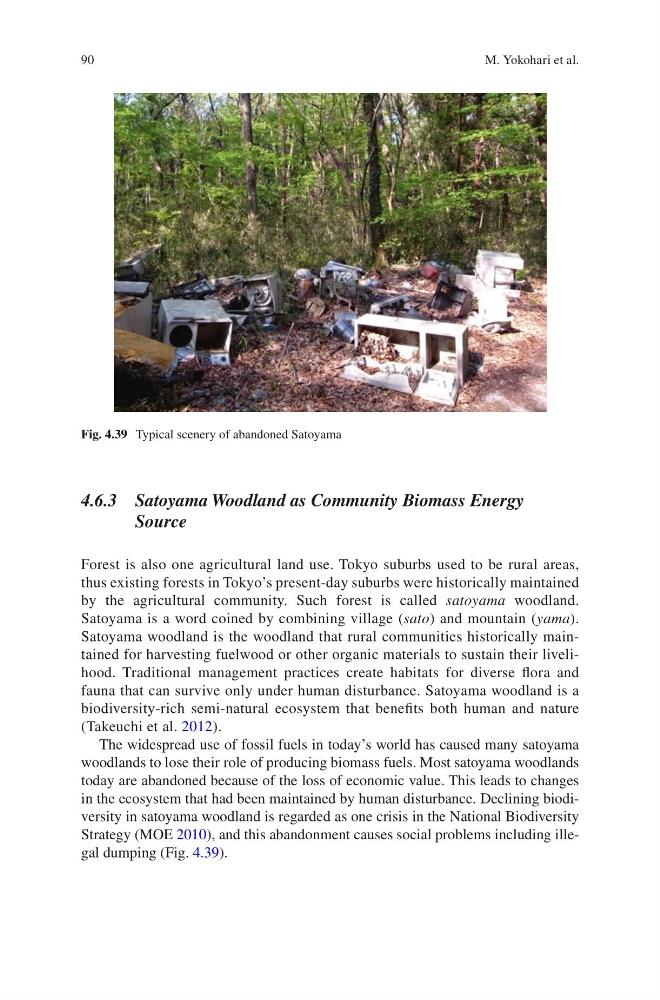
Strategy (MOE 2010), and this abandonment causes social problems including illegal dumping (Fig. 4.39).
Fig. 4.39 Typical scenery of abandoned Satoyama
M. Yokohari et al.
4.6.3 Satoyama Woodland as Community Biomass Energy
Source
Forest is also one agricultural land use. Tokyo suburbs used to be rural areas,
thus existing forests in Tokyo’s present-day suburbs were historically maintained
by the agricultural community. Such forest is called satoyama woodland.
Satoyama is a word coined by combining village (sato) and mountain (yama).
Satoyama woodland is the woodland that rural communities historically maintained for harvesting fuelwood or other organic materials to sustain their livelihood. Traditional management practices create habitats for diverse flora and
fauna that can survive only under human disturbance. Satoyama woodland is a
biodiversity-rich semi-natural ecosystem that benefits both human and nature
(Takeuchi et al. 2012).
The widespread use of fossil fuels in today’s world has caused many satoyama
woodlands to lose their role of producing biomass fuels. Most satoyama woodlands
today are abandoned because of the loss of economic value. This leads to changes
in the ecosystem that had been maintained by human disturbance. Declining biodiversity in satoyama woodland is regarded as one crisis in the National Biodiversity
Strategy (MOE 2010), and this abandonment causes social problems including illegal dumping (Fig. 4.39).
Fig. 4.39 Typical scenery of abandoned Satoyama
M. Yokohari et al.