

89
Such farmer guidance improves the yield and stability of guided-type hobby
farms. Compared to the current amount of average vegetable consumption per
person (89 kg/year) (MAFF 2016), guided-type hobby farms can produce three
times more. The non-guided type can produce only two times on average. Simply
speaking, at least both garden types can produce enough vegetables for self-consumption for the hobby farmers themselves; and in most cases, they can share
their excess with family or neighbors.
Japanese allotment gardens are vegetable-oriented. When considering food
security in cities, allotment gardens can contribute to producing emergency food
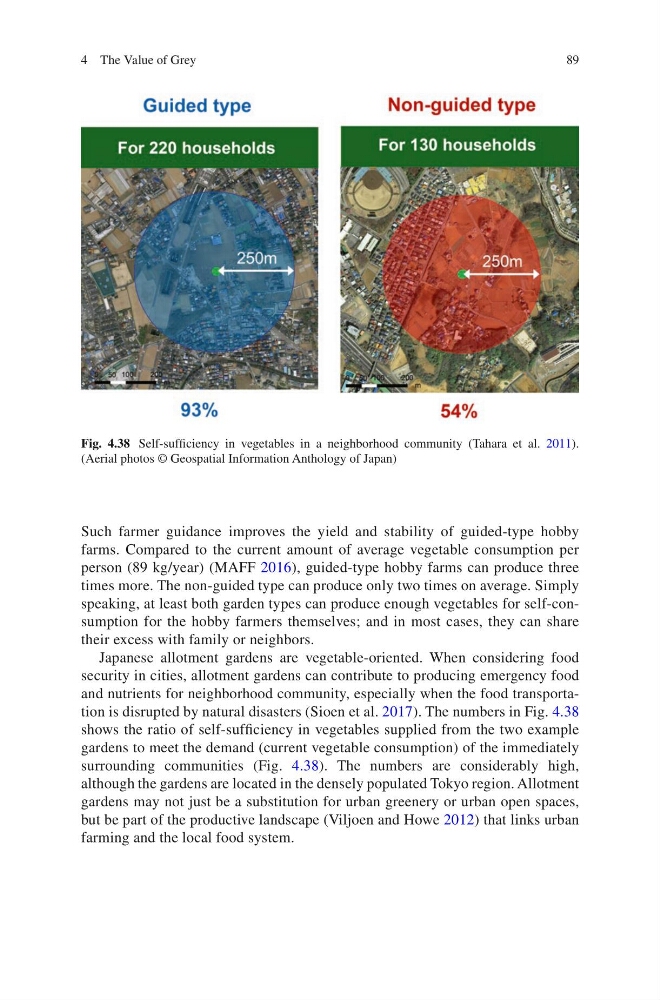
and nutrients for neighborhood community, especially when the food transportation is disrupted by natural disasters (Sioen et al. 2017). The numbers in Fig. 4.38
shows the ratio of self-sufficiency in vegetables supplied from the two example
gardens to meet the demand (current vegetable consumption) of the immediately
surrounding communities (Fig. 4.38). The numbers are considerably high,
although the gardens are located in the densely populated Tokyo region. Allotment
gardens may not just be a substitution for urban greenery or urban open spaces,
but be part of the productive landscape (Viljoen and Howe 2012) that links urban
farming and the local food system.
Fig. 4.38 Self-sufficiency in vegetables in a neighborhood community (Tahara et al. 2011).
(Aerial photos © Geospatial Information Anthology of Japan)
4 The Value of Grey
Such farmer guidance improves the yield and stability of guided-type hobby
farms. Compared to the current amount of average vegetable consumption per
person (89 kg/year) (MAFF 2016), guided-type hobby farms can produce three
times more. The non-guided type can produce only two times on average. Simply
speaking, at least both garden types can produce enough vegetables for self-consumption for the hobby farmers themselves; and in most cases, they can share
their excess with family or neighbors.
Japanese allotment gardens are vegetable-oriented. When considering food
security in cities, allotment gardens can contribute to producing emergency food
and nutrients for neighborhood community, especially when the food transportation is disrupted by natural disasters (Sioen et al. 2017). The numbers in Fig. 4.38
shows the ratio of self-sufficiency in vegetables supplied from the two example
gardens to meet the demand (current vegetable consumption) of the immediately
surrounding communities (Fig. 4.38). The numbers are considerably high,
although the gardens are located in the densely populated Tokyo region. Allotment
gardens may not just be a substitution for urban greenery or urban open spaces,
but be part of the productive landscape (Viljoen and Howe 2012) that links urban
farming and the local food system.
Fig. 4.38 Self-sufficiency in vegetables in a neighborhood community (Tahara et al. 2011).
(Aerial photos © Geospatial Information Anthology of Japan)
4 The Value of Grey