

39
little regeneration during a long-distance drive, it consumes fuel just like a normal
gasoline car.
Also, as the plug-in hybrid car (PHV) has a larger battery than the HV, it can be
recharged not only by regenerative energy but also from an external power source.
Therefore, it can run for several tens of kilometers without gasoline like electric
vehicles (EV).
3.2.3 Car Energy Efficiency Increases Eightfold
How far can a car increase energy efficiency? Until a while ago, there were two
choices, gasoline or diesel, but now a variety of cars are running on the market. EVs
without engine are thought to be only light cars or compact cars, but recently, sedan
type EVs or sports type EVs have appeared.
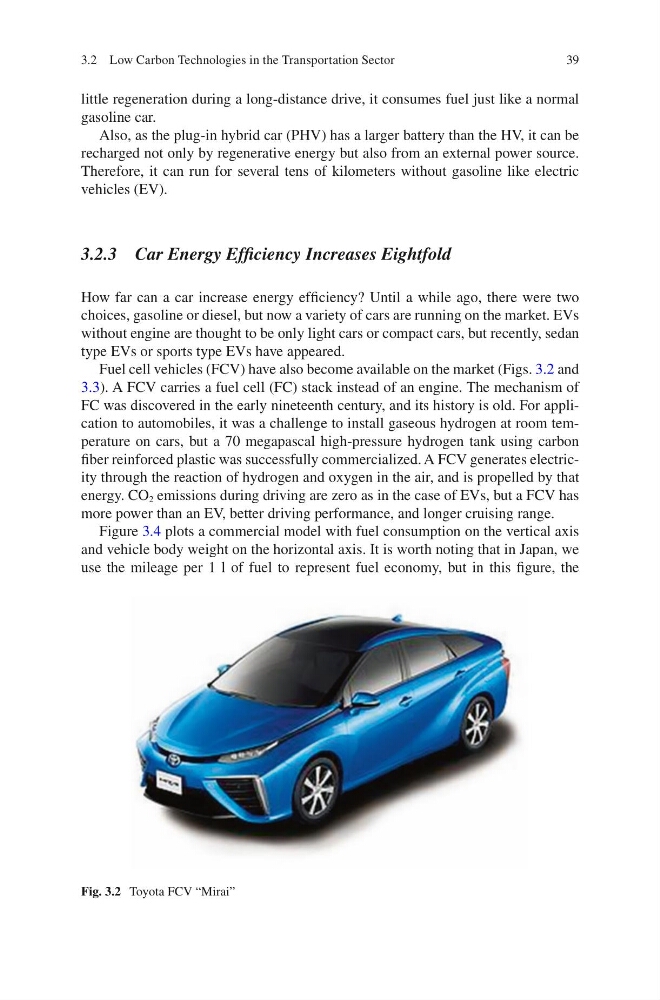
Fuel cell vehicles (FCV) have also become available on the market (Figs. 3.2 and
3.3). A FCV carries a fuel cell (FC) stack instead of an engine. The mechanism of
FC was discovered in the early nineteenth century, and its history is old. For application to automobiles, it was a challenge to install gaseous hydrogen at room temperature on cars, but a 70 megapascal high-pressure hydrogen tank using carbon
fiber reinforced plastic was successfully commercialized. A FCV generates electricity through the reaction of hydrogen and oxygen in the air, and is propelled by that
energy. CO 2 emissions during driving are zero as in the case of EVs, but a FCV has
more power than an EV, better driving performance, and longer cruising range.
Figure 3.4 plots a commercial model with fuel consumption on the vertical axis
and vehicle body weight on the horizontal axis. It is worth noting that in Japan, we
use the mileage per 1 l of fuel to represent fuel economy, but in this figure, the
Fig. 3.2 Toyota FCV “Mirai”
3.2 Low Carbon Technologies in the Transportation Sector
little regeneration during a long-distance drive, it consumes fuel just like a normal
gasoline car.
Also, as the plug-in hybrid car (PHV) has a larger battery than the HV, it can be
recharged not only by regenerative energy but also from an external power source.
Therefore, it can run for several tens of kilometers without gasoline like electric
vehicles (EV).
3.2.3 Car Energy Efficiency Increases Eightfold
How far can a car increase energy efficiency? Until a while ago, there were two
choices, gasoline or diesel, but now a variety of cars are running on the market. EVs
without engine are thought to be only light cars or compact cars, but recently, sedan
type EVs or sports type EVs have appeared.
Fuel cell vehicles (FCV) have also become available on the market (Figs. 3.2 and
3.3). A FCV carries a fuel cell (FC) stack instead of an engine. The mechanism of
FC was discovered in the early nineteenth century, and its history is old. For application to automobiles, it was a challenge to install gaseous hydrogen at room temperature on cars, but a 70 megapascal high-pressure hydrogen tank using carbon
fiber reinforced plastic was successfully commercialized. A FCV generates electricity through the reaction of hydrogen and oxygen in the air, and is propelled by that
energy. CO 2 emissions during driving are zero as in the case of EVs, but a FCV has
more power than an EV, better driving performance, and longer cruising range.
Figure 3.4 plots a commercial model with fuel consumption on the vertical axis
and vehicle body weight on the horizontal axis. It is worth noting that in Japan, we
use the mileage per 1 l of fuel to represent fuel economy, but in this figure, the
Fig. 3.2 Toyota FCV “Mirai”
3.2 Low Carbon Technologies in the Transportation Sector