

38
while running at a constant speed, but in fact energy is consumed due to friction
between the tires and the ground, and so on. If traveling at high speed, air resistance
also occurs. Depressing the brakes during deceleration or stopping is friction itself,
and even when stopping at an intersection, the engine is moving, and energy is used
here as well.
Therefore, improving the following five points is a guideline for energy conservation in automobiles.
1. The efficiency of conversion from chemical energy to work is not 100%.
2. Friction of gears, etc. accompanying the transmission of force from the engine to
the tires.
3. Friction between the tires and the ground.
4. Friction between the car body and air.
5. Friction due to braking.
One specific approach to improving efficiency is hybridization.
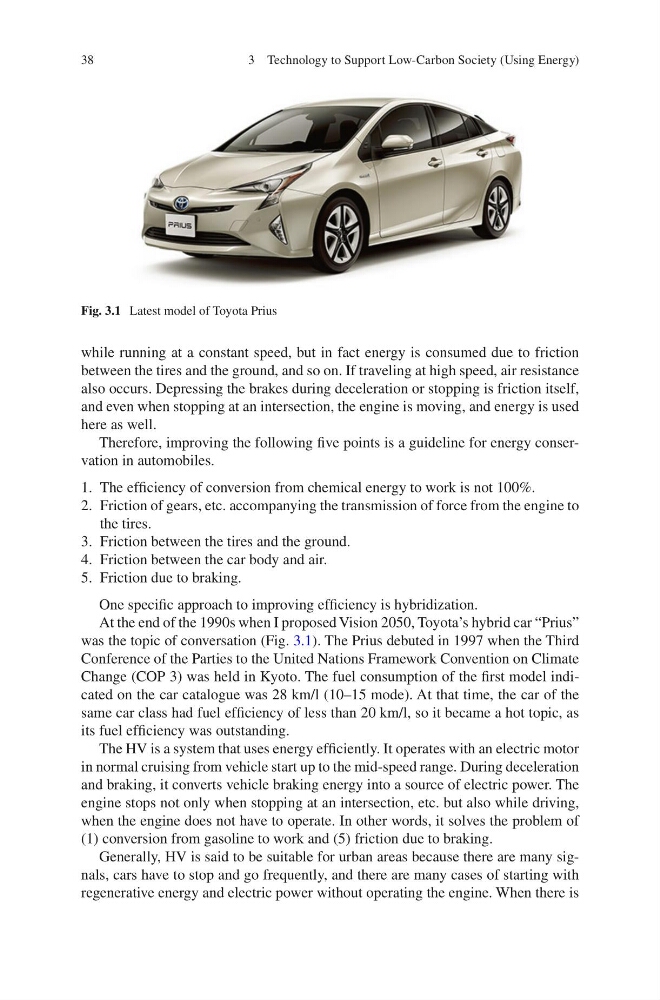
At the end of the 1990s when I proposed Vision 2050, Toyota’s hybrid car “Prius”
was the topic of conversation (Fig. 3.1). The Prius debuted in 1997 when the Third
Conference of the Parties to the United Nations Framework Convention on Climate
Change (COP 3) was held in Kyoto. The fuel consumption of the first model indicated on the car catalogue was 28 km/l (10–15 mode). At that time, the car of the
same car class had fuel efficiency of less than 20 km/l, so it became a hot topic, as
its fuel efficiency was outstanding.
The HV is a system that uses energy efficiently. It operates with an electric motor
in normal cruising from vehicle start up to the mid-speed range. During deceleration
and braking, it converts vehicle braking energy into a source of electric power. The
engine stops not only when stopping at an intersection, etc. but also while driving,
when the engine does not have to operate. In other words, it solves the problem of
(1) conversion from gasoline to work and (5) friction due to braking.
Generally, HV is said to be suitable for urban areas because there are many signals, cars have to stop and go frequently, and there are many cases of starting with
regenerative energy and electric power without operating the engine. When there is
Fig. 3.1 Latest model of Toyota Prius
3 Technology to Support Low-Carbon Society (Using Energy)
while running at a constant speed, but in fact energy is consumed due to friction
between the tires and the ground, and so on. If traveling at high speed, air resistance
also occurs. Depressing the brakes during deceleration or stopping is friction itself,
and even when stopping at an intersection, the engine is moving, and energy is used
here as well.
Therefore, improving the following five points is a guideline for energy conservation in automobiles.
1. The efficiency of conversion from chemical energy to work is not 100%.
2. Friction of gears, etc. accompanying the transmission of force from the engine to
the tires.
3. Friction between the tires and the ground.
4. Friction between the car body and air.
5. Friction due to braking.
One specific approach to improving efficiency is hybridization.
At the end of the 1990s when I proposed Vision 2050, Toyota’s hybrid car “Prius”
was the topic of conversation (Fig. 3.1). The Prius debuted in 1997 when the Third
Conference of the Parties to the United Nations Framework Convention on Climate
Change (COP 3) was held in Kyoto. The fuel consumption of the first model indicated on the car catalogue was 28 km/l (10–15 mode). At that time, the car of the
same car class had fuel efficiency of less than 20 km/l, so it became a hot topic, as
its fuel efficiency was outstanding.
The HV is a system that uses energy efficiently. It operates with an electric motor
in normal cruising from vehicle start up to the mid-speed range. During deceleration
and braking, it converts vehicle braking energy into a source of electric power. The
engine stops not only when stopping at an intersection, etc. but also while driving,
when the engine does not have to operate. In other words, it solves the problem of
(1) conversion from gasoline to work and (5) friction due to braking.
Generally, HV is said to be suitable for urban areas because there are many signals, cars have to stop and go frequently, and there are many cases of starting with
regenerative energy and electric power without operating the engine. When there is
Fig. 3.1 Latest model of Toyota Prius
3 Technology to Support Low-Carbon Society (Using Energy)