

40
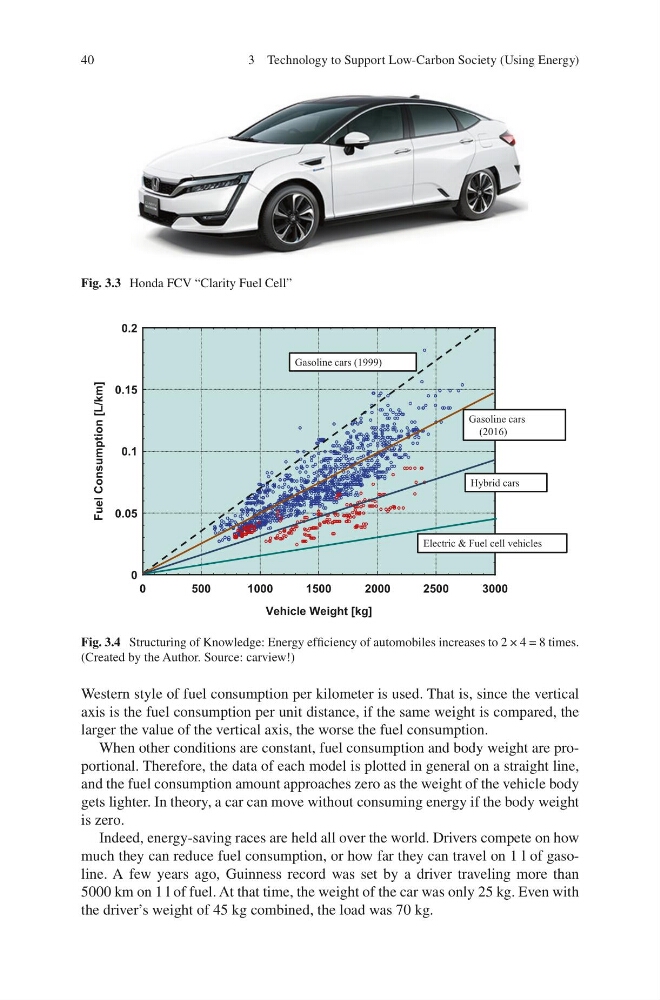
Western style of fuel consumption per kilometer is used. That is, since the vertical
axis is the fuel consumption per unit distance, if the same weight is compared, the
larger the value of the vertical axis, the worse the fuel consumption.
When other conditions are constant, fuel consumption and body weight are proportional. Therefore, the data of each model is plotted in general on a straight line,
and the fuel consumption amount approaches zero as the weight of the vehicle body
gets lighter. In theory, a car can move without consuming energy if the body weight
is zero.
Indeed, energy-saving races are held all over the world. Drivers compete on how
much they can reduce fuel consumption, or how far they can travel on 1 l of gasoline. A few years ago, Guinness record was set by a driver traveling more than
5000 km on 1 l of fuel. At that time, the weight of the car was only 25 kg. Even with
the driver’s weight of 45 kg combined, the load was 70 kg.
Fig. 3.3 Honda FCV “Clarity Fuel Cell”
0
0.05
0.1
0.15
0.2
0
5 00
1000
1500
2000
2500
3000
Vehicle Weight [kg]
Fuel Consumption [L/km]
Gasoline cars (1999)
Hybrid cars
Electric & Fuel cell vehicles
Gasoline cars
(2016)
Fig. 3.4 Structuring of Knowledge: Energy efficiency of automobiles increases to 2 × 4 = 8 times.
(Created by the Author. Source: carview!)
3 Technology to Support Low-Carbon Society (Using Energy)
Western style of fuel consumption per kilometer is used. That is, since the vertical
axis is the fuel consumption per unit distance, if the same weight is compared, the
larger the value of the vertical axis, the worse the fuel consumption.
When other conditions are constant, fuel consumption and body weight are proportional. Therefore, the data of each model is plotted in general on a straight line,
and the fuel consumption amount approaches zero as the weight of the vehicle body
gets lighter. In theory, a car can move without consuming energy if the body weight
is zero.
Indeed, energy-saving races are held all over the world. Drivers compete on how
much they can reduce fuel consumption, or how far they can travel on 1 l of gasoline. A few years ago, Guinness record was set by a driver traveling more than
5000 km on 1 l of fuel. At that time, the weight of the car was only 25 kg. Even with
the driver’s weight of 45 kg combined, the load was 70 kg.
Fig. 3.3 Honda FCV “Clarity Fuel Cell”
0
0.05
0.1
0.15
0.2
0
5 00
1000
1500
2000
2500
3000
Vehicle Weight [kg]
Fuel Consumption [L/km]
Gasoline cars (1999)
Hybrid cars
Electric & Fuel cell vehicles
Gasoline cars
(2016)
Fig. 3.4 Structuring of Knowledge: Energy efficiency of automobiles increases to 2 × 4 = 8 times.
(Created by the Author. Source: carview!)
3 Technology to Support Low-Carbon Society (Using Energy)