

32
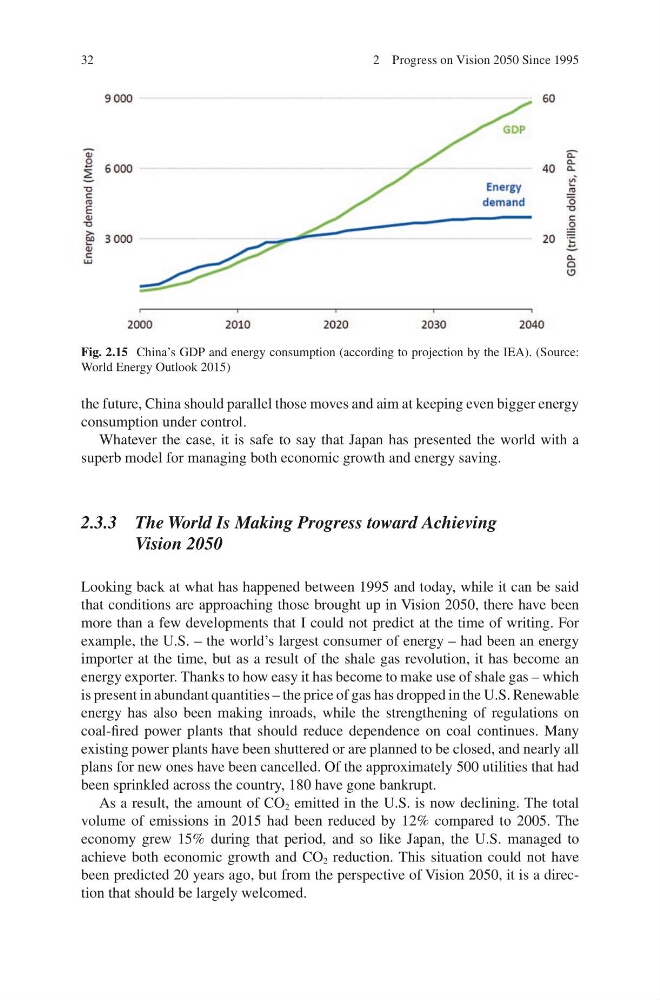
the future, China should parallel those moves and aim at keeping even bigger energy
consumption under control.
Whatever the case, it is safe to say that Japan has presented the world with a
superb model for managing both economic growth and energy saving.
2.3.3 The World Is Making Progress toward Achieving
Vision 2050
Looking back at what has happened between 1995 and today, while it can be said
that conditions are approaching those brought up in Vision 2050, there have been
more than a few developments that I could not predict at the time of writing. For
example, the U.S. – the world’s largest consumer of energy – had been an energy
importer at the time, but as a result of the shale gas revolution, it has become an
energy exporter. Thanks to how easy it has become to make use of shale gas – which
is present in abundant quantities – the price of gas has dropped in the U.S. Renewable
energy has also been making inroads, while the strengthening of regulations on
coal-fired power plants that should reduce dependence on coal continues. Many
existing power plants have been shuttered or are planned to be closed, and nearly all
plans for new ones have been cancelled. Of the approximately 500 utilities that had
been sprinkled across the country, 180 have gone bankrupt.
As a result, the amount of CO 2 emitted in the U.S. is now declining. The total
volume of emissions in 2015 had been reduced by 12% compared to 2005. The
economy grew 15% during that period, and so like Japan, the U.S. managed to
achieve both economic growth and CO 2 reduction. This situation could not have
been predicted 20 years ago, but from the perspective of Vision 2050, it is a direction that should be largely welcomed.
Fig. 2.15 China’s GDP and energy consumption (according to projection by the IEA). (Source:
World Energy Outlook 2015)
2 Progress on Vision 2050 Since 1995
the future, China should parallel those moves and aim at keeping even bigger energy
consumption under control.
Whatever the case, it is safe to say that Japan has presented the world with a
superb model for managing both economic growth and energy saving.
2.3.3 The World Is Making Progress toward Achieving
Vision 2050
Looking back at what has happened between 1995 and today, while it can be said
that conditions are approaching those brought up in Vision 2050, there have been
more than a few developments that I could not predict at the time of writing. For
example, the U.S. – the world’s largest consumer of energy – had been an energy
importer at the time, but as a result of the shale gas revolution, it has become an
energy exporter. Thanks to how easy it has become to make use of shale gas – which
is present in abundant quantities – the price of gas has dropped in the U.S. Renewable
energy has also been making inroads, while the strengthening of regulations on
coal-fired power plants that should reduce dependence on coal continues. Many
existing power plants have been shuttered or are planned to be closed, and nearly all
plans for new ones have been cancelled. Of the approximately 500 utilities that had
been sprinkled across the country, 180 have gone bankrupt.
As a result, the amount of CO 2 emitted in the U.S. is now declining. The total
volume of emissions in 2015 had been reduced by 12% compared to 2005. The
economy grew 15% during that period, and so like Japan, the U.S. managed to
achieve both economic growth and CO 2 reduction. This situation could not have
been predicted 20 years ago, but from the perspective of Vision 2050, it is a direction that should be largely welcomed.
Fig. 2.15 China’s GDP and energy consumption (according to projection by the IEA). (Source:
World Energy Outlook 2015)
2 Progress on Vision 2050 Since 1995