

30
chemical industries) at the core. The first energy crisis occurred in 1973. The cost of
petroleum rose sharply and all at once to 10–20 times its previous level. That dealt
a direct blow to a global economy that was dependent on inexpensive petroleum,
and delivered a heavy blow to Japanese industries in particular. However, Japan’s
core industries of the day – steel, chemicals, ceramics, and paper pulp – pushed
forward vigorously on reducing power use and succeeded at converting a crisis into
an opportunity. In other words, it succeeded in creating one of the best industries for
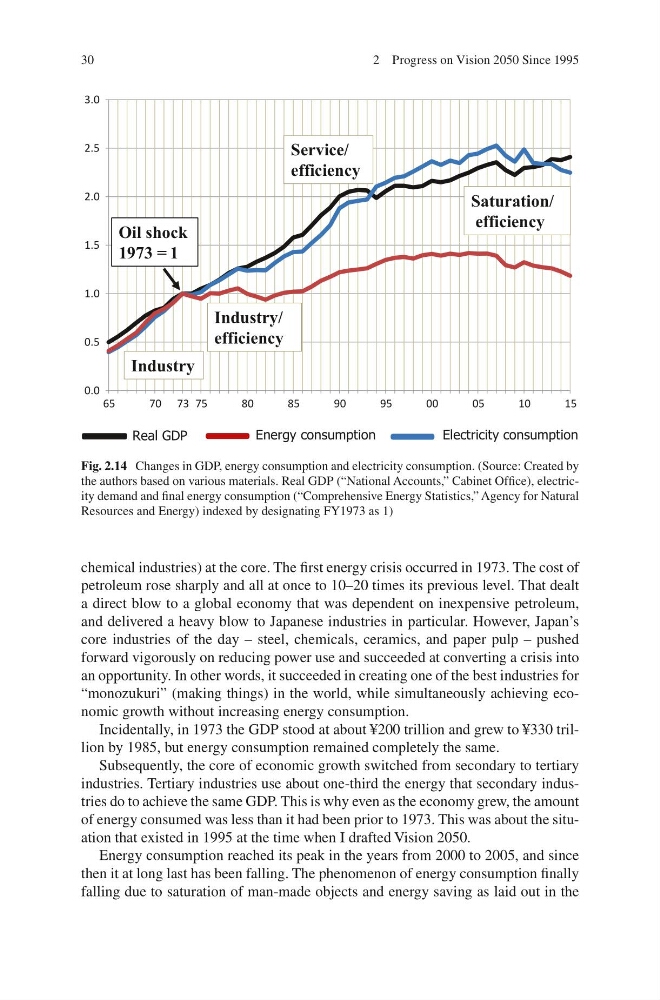
“monozukuri” (making things) in the world, while simultaneously achieving economic growth without increasing energy consumption.
Incidentally, in 1973 the GDP stood at about ¥200 trillion and grew to ¥330 trillion by 1985, but energy consumption remained completely the same.
Subsequently, the core of economic growth switched from secondary to tertiary
industries. Tertiary industries use about one-third the energy that secondary industries do to achieve the same GDP. This is why even as the economy grew, the amount
of energy consumed was less than it had been prior to 1973. This was about the situation that existed in 1995 at the time when I drafted Vision 2050.
Energy consumption reached its peak in the years from 2000 to 2005, and since
then it at long last has been falling. The phenomenon of energy consumption finally
falling due to saturation of man-made objects and energy saving as laid out in the
Real GDP
Electricity consumption
Energy consumption
0.0
0.5
1.0
1.5
2.0
2.5
3.0
65
70 73 75
80
85
90
95
00
05
10
15
Service/
efficiency
Saturation/
efficiency
Industry/
efficiency
Industry
Oil shock
1973 = 1
Fig. 2.14 Changes in GDP, energy consumption and electricity consumption. (Source: Created by
the authors based on various materials. Real GDP (“National Accounts,” Cabinet Office), electricity demand and final energy consumption (“Comprehensive Energy Statistics,” Agency for Natural
Resources and Energy) indexed by designating FY1973 as 1)
2 Progress on Vision 2050 Since 1995
chemical industries) at the core. The first energy crisis occurred in 1973. The cost of
petroleum rose sharply and all at once to 10–20 times its previous level. That dealt
a direct blow to a global economy that was dependent on inexpensive petroleum,
and delivered a heavy blow to Japanese industries in particular. However, Japan’s
core industries of the day – steel, chemicals, ceramics, and paper pulp – pushed
forward vigorously on reducing power use and succeeded at converting a crisis into
an opportunity. In other words, it succeeded in creating one of the best industries for
“monozukuri” (making things) in the world, while simultaneously achieving economic growth without increasing energy consumption.
Incidentally, in 1973 the GDP stood at about ¥200 trillion and grew to ¥330 trillion by 1985, but energy consumption remained completely the same.
Subsequently, the core of economic growth switched from secondary to tertiary
industries. Tertiary industries use about one-third the energy that secondary industries do to achieve the same GDP. This is why even as the economy grew, the amount
of energy consumed was less than it had been prior to 1973. This was about the situation that existed in 1995 at the time when I drafted Vision 2050.
Energy consumption reached its peak in the years from 2000 to 2005, and since
then it at long last has been falling. The phenomenon of energy consumption finally
falling due to saturation of man-made objects and energy saving as laid out in the
Real GDP
Electricity consumption
Energy consumption
0.0
0.5
1.0
1.5
2.0
2.5
3.0
65
70 73 75
80
85
90
95
00
05
10
15
Service/
efficiency
Saturation/
efficiency
Industry/
efficiency
Industry
Oil shock
1973 = 1
Fig. 2.14 Changes in GDP, energy consumption and electricity consumption. (Source: Created by
the authors based on various materials. Real GDP (“National Accounts,” Cabinet Office), electricity demand and final energy consumption (“Comprehensive Energy Statistics,” Agency for Natural
Resources and Energy) indexed by designating FY1973 as 1)
2 Progress on Vision 2050 Since 1995