

6
progress of global warming will require even greater efforts than just improving
efficiency.
In Vision 2050, I proposed increasing the ratio of renewable energy. The amount
of energy use based on non-fossil resources in the benchmark year converted to
carbon stood at approximately 1.5 billion tons. If this figure could be doubled, then
the amount of fossil resources used in 2050 would end up at 4.5 billion tons. That is
to say, if we could triple energy use efficiency and double our use of renewable
energy we could keep the amount of fossil resources used down to three-quarters of
the amount in the benchmark year. If Vision 2050 could be achieved and further
progress is made in the latter half of the twenty-first century on improving energy
use efficiency and expanding the use of renewables, then it might be possible to
achieve a scenario in which the amount of fossil resources used is kept even further
down.
What effect would that have on the CO 2 concentrations in the atmosphere?
In the benchmark year, the concentrations stood at 369 ppm. We have seen the
atmospheric CO 2 concentrations rise in proportion to the volume of anthropogenic
CO 2 emissions. The amount was increasing by 2 ppm annually as of the late 1990s.
If it continues at that pace, the concentration will have risen 100 ppm in 50 years to
exceed 469 ppm in 2050.
Meanwhile, if as noted earlier developing countries have attained a living standard on par with developed countries by 2050, and there is no change to either
energy use efficiency or the proportion of renewables used, then the amount of fossil
resources consumed annually will reach 22 billion tons. Calculations show that the
CO 2 concentrations would reach 600 ppm at this point (see Fig. 1.3b). That figure
would be far more than double the CO 2 concentration present before the Industrial
Revolution.
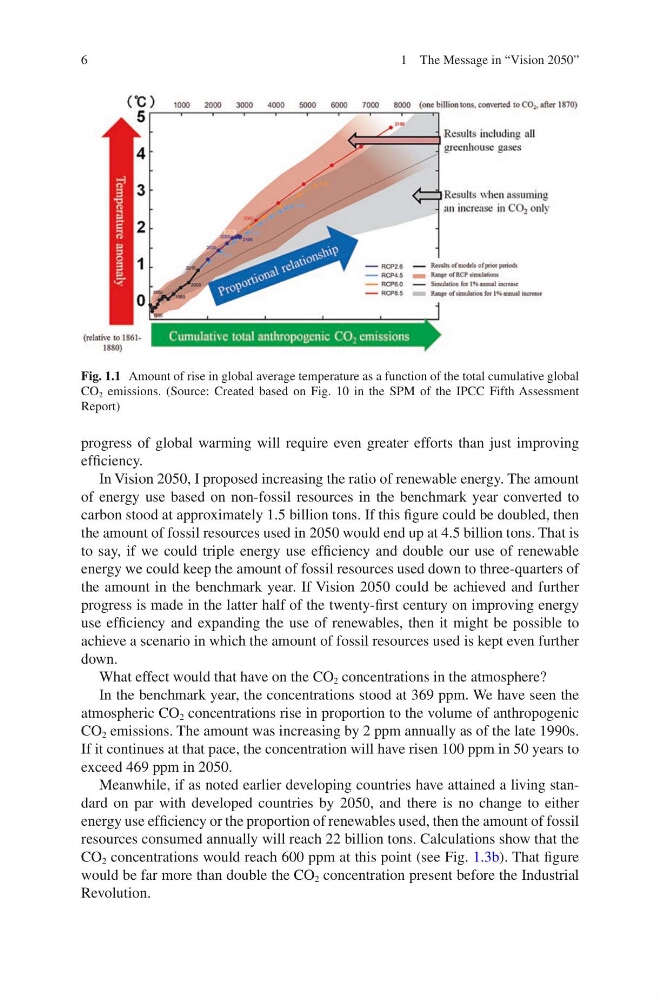
Fig. 1.1 Amount of rise in global average temperature as a function of the total cumulative global
CO 2 emissions. (Source: Created based on Fig. 10 in the SPM of the IPCC Fifth Assessment
Report)
1 The Message in “Vision 2050”
progress of global warming will require even greater efforts than just improving
efficiency.
In Vision 2050, I proposed increasing the ratio of renewable energy. The amount
of energy use based on non-fossil resources in the benchmark year converted to
carbon stood at approximately 1.5 billion tons. If this figure could be doubled, then
the amount of fossil resources used in 2050 would end up at 4.5 billion tons. That is
to say, if we could triple energy use efficiency and double our use of renewable
energy we could keep the amount of fossil resources used down to three-quarters of
the amount in the benchmark year. If Vision 2050 could be achieved and further
progress is made in the latter half of the twenty-first century on improving energy
use efficiency and expanding the use of renewables, then it might be possible to
achieve a scenario in which the amount of fossil resources used is kept even further
down.
What effect would that have on the CO 2 concentrations in the atmosphere?
In the benchmark year, the concentrations stood at 369 ppm. We have seen the
atmospheric CO 2 concentrations rise in proportion to the volume of anthropogenic
CO 2 emissions. The amount was increasing by 2 ppm annually as of the late 1990s.
If it continues at that pace, the concentration will have risen 100 ppm in 50 years to
exceed 469 ppm in 2050.
Meanwhile, if as noted earlier developing countries have attained a living standard on par with developed countries by 2050, and there is no change to either
energy use efficiency or the proportion of renewables used, then the amount of fossil
resources consumed annually will reach 22 billion tons. Calculations show that the
CO 2 concentrations would reach 600 ppm at this point (see Fig. 1.3b). That figure
would be far more than double the CO 2 concentration present before the Industrial
Revolution.
Fig. 1.1 Amount of rise in global average temperature as a function of the total cumulative global
CO 2 emissions. (Source: Created based on Fig. 10 in the SPM of the IPCC Fifth Assessment
Report)
1 The Message in “Vision 2050”