

86
With regard to power generation efficiency (2), solar power generation that will
be used in large quantities in the future is expected to have an efficiency of 30%,
which is 1.5 times the present value. Even with natural gas power generation, under
combined power generation in which fuel cells work together from the same heat
source, the power generation efficiency may be nearly 70%, or more than 1.2 times
the present value. Regarding (3), natural gas has a low CO 2 emission level of about
50% that of coal, and there is room to increase its usage. However, in a society in
which reduction of CO 2 emissions by 80% will be achieved, natural gas will not
become the main power source. With regard to CCS in (4), there are difficulties in
the uptake of the technology such as economic restrictions and restrictions on site
conditions, but there is a possibility that it will be carried out in the future, and it is
worth considering. In terms of nuclear power (6), the situation is such that it will not
become the main power supply under the current circumstances of low public
support.
Considering the above, renewable energy (5), which is expressly stated in Vision
2050, is the option that seems most promising in the future. In the next section, we
will discuss the establishment of a power supply sector incorporating a large amount
of renewable energy.
5.1.2 80% Reduction and Power Generation Costs
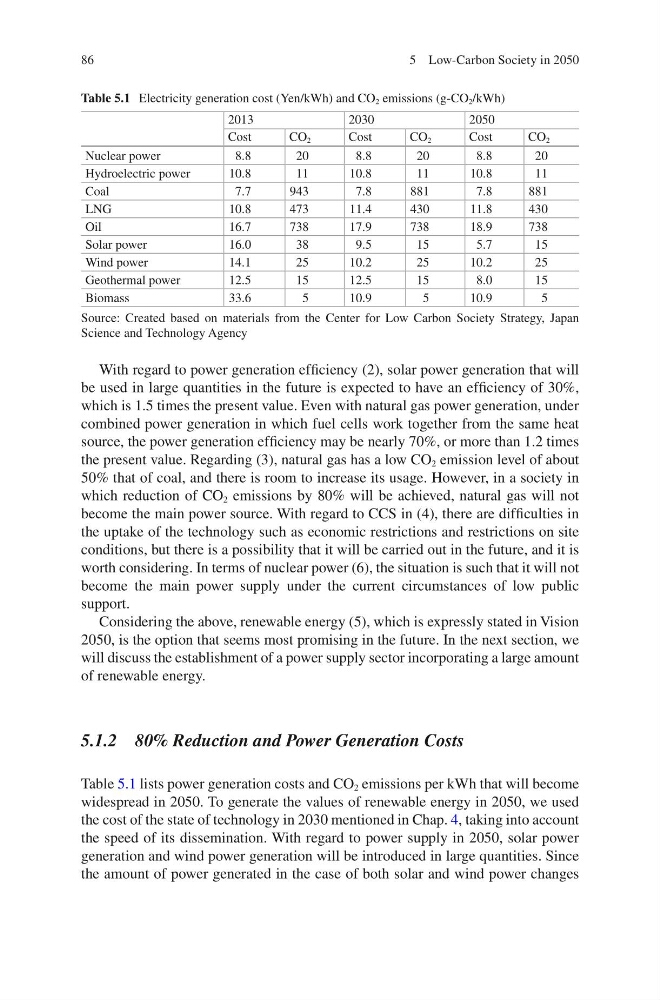
Table 5.1 lists power generation costs and CO 2 emissions per kWh that will become
widespread in 2050. To generate the values of renewable energy in 2050, we used
the cost of the state of technology in 2030 mentioned in Chap. 4, taking into account
the speed of its dissemination. With regard to power supply in 2050, solar power
generation and wind power generation will be introduced in large quantities. Since
the amount of power generated in the case of both solar and wind power changes
Table 5.1 Electricity generation cost (Yen/kWh) and CO 2 emissions (g-CO 2 /kWh)
2013
2030
2050
Cost
CO 2
Cost
CO 2
Cost
CO 2
Nuclear power
8.8
20
8.8
20
8.8
20
Hydroelectric power
10.8
11
10.8
11
10.8
11
Coal
7.7
943
7.8
881
7.8
881
LNG
10.8
473
11.4
430
11.8
430
Oil
16.7
738
17.9
738
18.9
738
Solar power
16.0
38
9.5
15
5.7
15
Wind power
14.1
25
10.2
25
10.2
25
Geothermal power
12.5
15
12.5
15
8.0
15
Biomass
33.6
5
10.9
5
10.9
5
Source: Created based on materials from the Center for Low Carbon Society Strategy, Japan
Science and Technology Agency
5 Low-Carbon Society in 2050
With regard to power generation efficiency (2), solar power generation that will
be used in large quantities in the future is expected to have an efficiency of 30%,
which is 1.5 times the present value. Even with natural gas power generation, under
combined power generation in which fuel cells work together from the same heat
source, the power generation efficiency may be nearly 70%, or more than 1.2 times
the present value. Regarding (3), natural gas has a low CO 2 emission level of about
50% that of coal, and there is room to increase its usage. However, in a society in
which reduction of CO 2 emissions by 80% will be achieved, natural gas will not
become the main power source. With regard to CCS in (4), there are difficulties in
the uptake of the technology such as economic restrictions and restrictions on site
conditions, but there is a possibility that it will be carried out in the future, and it is
worth considering. In terms of nuclear power (6), the situation is such that it will not
become the main power supply under the current circumstances of low public
support.
Considering the above, renewable energy (5), which is expressly stated in Vision
2050, is the option that seems most promising in the future. In the next section, we
will discuss the establishment of a power supply sector incorporating a large amount
of renewable energy.
5.1.2 80% Reduction and Power Generation Costs
Table 5.1 lists power generation costs and CO 2 emissions per kWh that will become
widespread in 2050. To generate the values of renewable energy in 2050, we used
the cost of the state of technology in 2030 mentioned in Chap. 4, taking into account
the speed of its dissemination. With regard to power supply in 2050, solar power
generation and wind power generation will be introduced in large quantities. Since
the amount of power generated in the case of both solar and wind power changes
Table 5.1 Electricity generation cost (Yen/kWh) and CO 2 emissions (g-CO 2 /kWh)
2013
2030
2050
Cost
CO 2
Cost
CO 2
Cost
CO 2
Nuclear power
8.8
20
8.8
20
8.8
20
Hydroelectric power
10.8
11
10.8
11
10.8
11
Coal
7.7
943
7.8
881
7.8
881
LNG
10.8
473
11.4
430
11.8
430
Oil
16.7
738
17.9
738
18.9
738
Solar power
16.0
38
9.5
15
5.7
15
Wind power
14.1
25
10.2
25
10.2
25
Geothermal power
12.5
15
12.5
15
8.0
15
Biomass
33.6
5
10.9
5
10.9
5
Source: Created based on materials from the Center for Low Carbon Society Strategy, Japan
Science and Technology Agency
5 Low-Carbon Society in 2050