

56
3 Phenomenology of the Massive Dark Photon
[GeV]
A'
m
3
−
10
2
−
10
1
−
10
1
ε
7
−
10
6
−
10
5
−
10
4
−
10
3
−
10
2
−
10
-1
BelleII 20 fb
K L E V E R
PADME @ BTF
L D M X @
S L A C
L D M X @
C E R N
(e )
++
N A 64
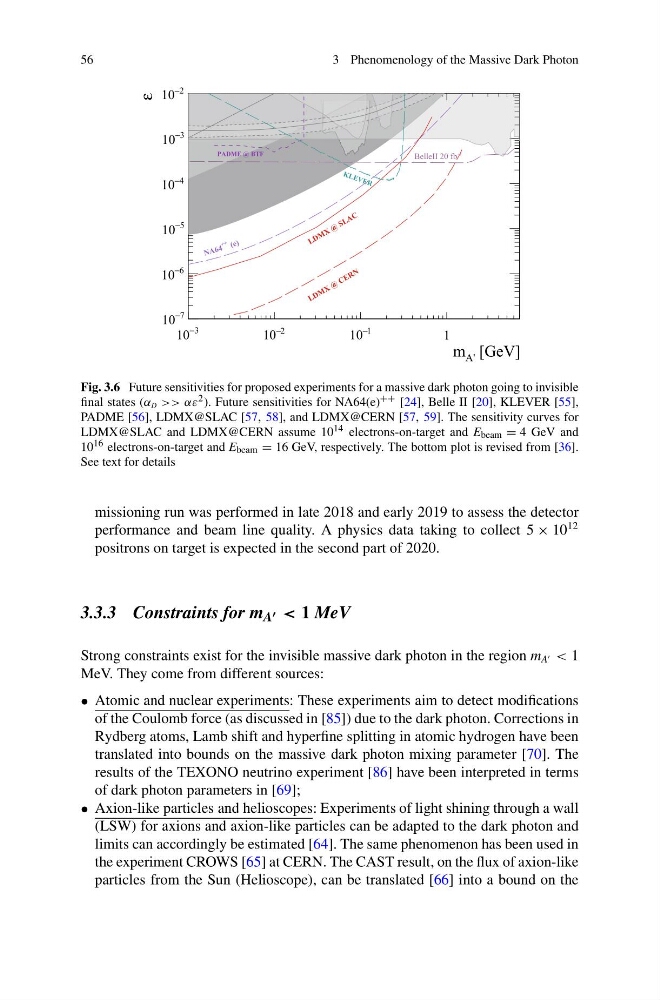
Fig. 3.6 Future sensitivities for proposed experiments for a massive dark photon going to invisible
final states (α D >> αε 2 ). Future sensitivities for NA64(e) ++ [24], Belle II [20], KLEVER [55],
PADME [56], LDMX@SLAC [57, 58], and LDMX@CERN [57, 59]. The sensitivity curves for
LDMX@SLAC and LDMX@CERN assume 10 14 electrons-on-target and E beam = 4 GeV and
10 16 electrons-on-target and E beam = 16 GeV, respectively. The bottom plot is revised from [36].
See text for details
missioning run was performed in late 2018 and early 2019 to assess the detector
performance and beam line quality. A physics data taking to collect 5 × 10
12
positrons on target is expected in the second part of 2020.
3.3.3 Constraints for m A < 1 MeV
Strong constraints exist for the invisible massive dark photon in the region m A < 1
MeV. They come from different sources:
• Atomic and nuclear experiments: These experiments aim to detect modifications
of the Coulomb force (as discussed in [85]) due to the dark photon. Corrections in
Rydberg atoms, Lamb shift and hyperfine splitting in atomic hydrogen have been
translated into bounds on the massive dark photon mixing parameter [70]. The
results of the TEXONO neutrino experiment [86] have been interpreted in terms
of dark photon parameters in [69];
• Axion-like particles and helioscopes: Experiments of light shining through a wall
(LSW) for axions and axion-like particles can be adapted to the dark photon and
limits can accordingly be estimated [64]. The same phenomenon has been used in
the experiment CROWS [65] at CERN. The CAST result, on the flux of axion-like
particles from the Sun (Helioscope), can be translated [66] into a bound on the
3 Phenomenology of the Massive Dark Photon
[GeV]
A'
m
3
−
10
2
−
10
1
−
10
1
ε
7
−
10
6
−
10
5
−
10
4
−
10
3
−
10
2
−
10
-1
BelleII 20 fb
K L E V E R
PADME @ BTF
L D M X @
S L A C
L D M X @
C E R N
(e )
++
N A 64
Fig. 3.6 Future sensitivities for proposed experiments for a massive dark photon going to invisible
final states (α D >> αε 2 ). Future sensitivities for NA64(e) ++ [24], Belle II [20], KLEVER [55],
PADME [56], LDMX@SLAC [57, 58], and LDMX@CERN [57, 59]. The sensitivity curves for
LDMX@SLAC and LDMX@CERN assume 10 14 electrons-on-target and E beam = 4 GeV and
10 16 electrons-on-target and E beam = 16 GeV, respectively. The bottom plot is revised from [36].
See text for details
missioning run was performed in late 2018 and early 2019 to assess the detector
performance and beam line quality. A physics data taking to collect 5 × 10
12
positrons on target is expected in the second part of 2020.
3.3.3 Constraints for m A < 1 MeV
Strong constraints exist for the invisible massive dark photon in the region m A < 1
MeV. They come from different sources:
• Atomic and nuclear experiments: These experiments aim to detect modifications
of the Coulomb force (as discussed in [85]) due to the dark photon. Corrections in
Rydberg atoms, Lamb shift and hyperfine splitting in atomic hydrogen have been
translated into bounds on the massive dark photon mixing parameter [70]. The
results of the TEXONO neutrino experiment [86] have been interpreted in terms
of dark photon parameters in [69];
• Axion-like particles and helioscopes: Experiments of light shining through a wall
(LSW) for axions and axion-like particles can be adapted to the dark photon and
limits can accordingly be estimated [64]. The same phenomenon has been used in
the experiment CROWS [65] at CERN. The CAST result, on the flux of axion-like
particles from the Sun (Helioscope), can be translated [66] into a bound on the