

3.3 Limits on the Parameters ε and m A
57
[MeV]
A'
m
20
−
10
18
−
10
16
−
10
14
−
10
12
−
10
10
−
10
8
−
10
6
−
10
4
−
10
2
−
10
1
ε
17
−
10
16
−
10
15
−
10
14
−
10
13
−
10
12
−
10
11
−
10
10
−
10
9
−
10
8
−
10
7
−
10
6
−
10
5
−
10
4
−
10
3
−
10
2
−
10
D a rk M a tt e r
SUN-T
S U N - L
X E N O N 1 0
S H I P S
C A S T
HB RG
COBE/FIRAS
C o u l o m b
CROWS
Rydberg
atomic spectra
TEXONO
eot
10
NA64, 4.3 10
eot
12
NA64, 4.0 10
LSW
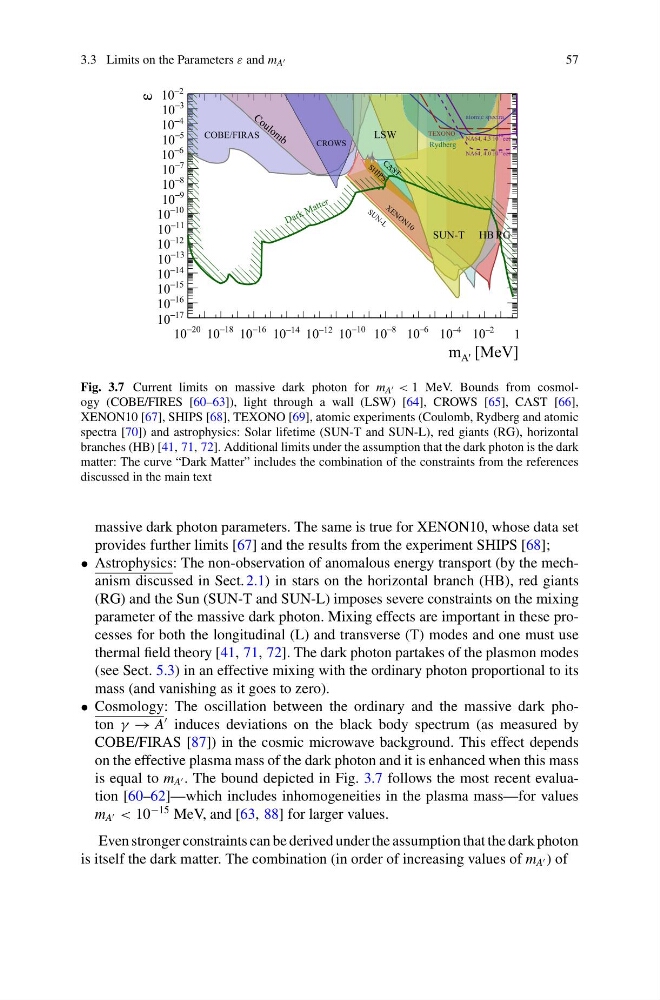
Fig. 3.7 Current limits on massive dark photon for m A < 1 MeV. Bounds from cosmology (COBE/FIRES [60–63]), light through a wall (LSW) [64], CROWS [65], CAST [66],
XENON10 [67], SHIPS [68], TEXONO [69], atomic experiments (Coulomb, Rydberg and atomic
spectra [70]) and astrophysics: Solar lifetime (SUN-T and SUN-L), red giants (RG), horizontal
branches (HB) [41, 71, 72]. Additional limits under the assumption that the dark photon is the dark
matter: The curve “Dark Matter” includes the combination of the constraints from the references
discussed in the main text
massive dark photon parameters. The same is true for XENON10, whose data set
provides further limits [67] and the results from the experiment SHIPS [68];
• Astrophysics: The non-observation of anomalous energy transport (by the mechanism discussed in Sect. 2.1) in stars on the horizontal branch (HB), red giants
(RG) and the Sun (SUN-T and SUN-L) imposes severe constraints on the mixing
parameter of the massive dark photon. Mixing effects are important in these processes for both the longitudinal (L) and transverse (T) modes and one must use
thermal field theory [41, 71, 72]. The dark photon partakes of the plasmon modes
(see Sect. 5.3) in an effective mixing with the ordinary photon proportional to its
mass (and vanishing as it goes to zero).
• Cosmology: The oscillation between the ordinary and the massive dark photon γ → A
induces deviations on the black body spectrum (as measured by
COBE/FIRAS [87]) in the cosmic microwave background. This effect depends
on the effective plasma mass of the dark photon and it is enhanced when this mass
is equal to m A . The bound depicted in Fig. 3.7 follows the most recent evaluation [60–62]—which includes inhomogeneities in the plasma mass—for values
m A < 10
−15 MeV, and [63, 88] for larger values.
Even stronger constraints can be derived under the assumption that the dark photon
is itself the dark matter. The combination (in order of increasing values of m A ) of
57
[MeV]
A'
m
20
−
10
18
−
10
16
−
10
14
−
10
12
−
10
10
−
10
8
−
10
6
−
10
4
−
10
2
−
10
1
ε
17
−
10
16
−
10
15
−
10
14
−
10
13
−
10
12
−
10
11
−
10
10
−
10
9
−
10
8
−
10
7
−
10
6
−
10
5
−
10
4
−
10
3
−
10
2
−
10
D a rk M a tt e r
SUN-T
S U N - L
X E N O N 1 0
S H I P S
C A S T
HB RG
COBE/FIRAS
C o u l o m b
CROWS
Rydberg
atomic spectra
TEXONO
eot
10
NA64, 4.3 10
eot
12
NA64, 4.0 10
LSW
Fig. 3.7 Current limits on massive dark photon for m A < 1 MeV. Bounds from cosmology (COBE/FIRES [60–63]), light through a wall (LSW) [64], CROWS [65], CAST [66],
XENON10 [67], SHIPS [68], TEXONO [69], atomic experiments (Coulomb, Rydberg and atomic
spectra [70]) and astrophysics: Solar lifetime (SUN-T and SUN-L), red giants (RG), horizontal
branches (HB) [41, 71, 72]. Additional limits under the assumption that the dark photon is the dark
matter: The curve “Dark Matter” includes the combination of the constraints from the references
discussed in the main text
massive dark photon parameters. The same is true for XENON10, whose data set
provides further limits [67] and the results from the experiment SHIPS [68];
• Astrophysics: The non-observation of anomalous energy transport (by the mechanism discussed in Sect. 2.1) in stars on the horizontal branch (HB), red giants
(RG) and the Sun (SUN-T and SUN-L) imposes severe constraints on the mixing
parameter of the massive dark photon. Mixing effects are important in these processes for both the longitudinal (L) and transverse (T) modes and one must use
thermal field theory [41, 71, 72]. The dark photon partakes of the plasmon modes
(see Sect. 5.3) in an effective mixing with the ordinary photon proportional to its
mass (and vanishing as it goes to zero).
• Cosmology: The oscillation between the ordinary and the massive dark photon γ → A
induces deviations on the black body spectrum (as measured by
COBE/FIRAS [87]) in the cosmic microwave background. This effect depends
on the effective plasma mass of the dark photon and it is enhanced when this mass
is equal to m A . The bound depicted in Fig. 3.7 follows the most recent evaluation [60–62]—which includes inhomogeneities in the plasma mass—for values
m A < 10
−15 MeV, and [63, 88] for larger values.
Even stronger constraints can be derived under the assumption that the dark photon
is itself the dark matter. The combination (in order of increasing values of m A ) of