

3.3 Limits on the Parameters ε and m A
55
[GeV]
A'
m
3
−
10
2
−
10
1
−
10
1
ε
7
−
10
6
−
10
5
−
10
4
−
10
3
−
10
2
−
10
BaBar (2017)
NA62 (2019)
e
(g -2 )
E949
N A 64 (2 01 9)
(favored)
σ
5
±
μ
(g-2)
at o m ic sp ec tr a
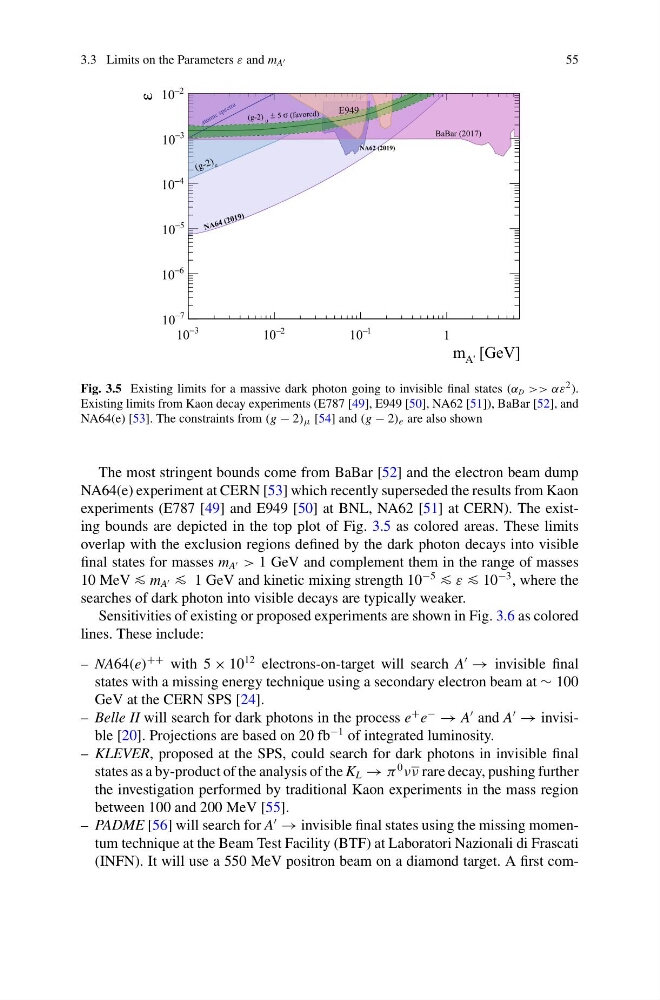
Fig. 3.5 Existing limits for a massive dark photon going to invisible final states (α D >> αε 2 ).
Existing limits from Kaon decay experiments (E787 [49], E949 [50], NA62 [51]), BaBar [52], and
NA64(e) [53]. The constraints from (g − 2) μ [54] and (g − 2) e are also shown
The most stringent bounds come from BaBar [52] and the electron beam dump
NA64(e) experiment at CERN [53] which recently superseded the results from Kaon
experiments (E787 [49] and E949 [50] at BNL, NA62 [51] at CERN). The existing bounds are depicted in the top plot of Fig. 3.5 as colored areas. These limits
overlap with the exclusion regions defined by the dark photon decays into visible
final states for masses m A > 1 GeV and complement them in the range of masses
10 MeV ∼ < m A ∼ < 1 GeV and kinetic mixing strength 10
−5 ∼ < ε ∼ < 10
−3 , where the
searches of dark photon into visible decays are typically weaker.
Sensitivities of existing or proposed experiments are shown in Fig. 3.6 as colored
lines. These include:
– NA64(e)
++ with 5 × 10
12 electrons-on-target will search A
→ invisible final
states with a missing energy technique using a secondary electron beam at ∼ 100
GeV at the CERN SPS [24].
– Belle II will search for dark photons in the process e
+ e
−
→ A
and A
→ invisible [20]. Projections are based on 20 fb
−1 of integrated luminosity.
– KLEVER, proposed at the SPS, could search for dark photons in invisible final
states as a by-product of the analysis of the K L → π
0
νν rare decay, pushing further
the investigation performed by traditional Kaon experiments in the mass region
between 100 and 200 MeV [55].
– PADME [56] will search for A
→ invisible final states using the missing momentum technique at the Beam Test Facility (BTF) at Laboratori Nazionali di Frascati
(INFN). It will use a 550 MeV positron beam on a diamond target. A first com-
55
[GeV]
A'
m
3
−
10
2
−
10
1
−
10
1
ε
7
−
10
6
−
10
5
−
10
4
−
10
3
−
10
2
−
10
BaBar (2017)
NA62 (2019)
e
(g -2 )
E949
N A 64 (2 01 9)
(favored)
σ
5
±
μ
(g-2)
at o m ic sp ec tr a
Fig. 3.5 Existing limits for a massive dark photon going to invisible final states (α D >> αε 2 ).
Existing limits from Kaon decay experiments (E787 [49], E949 [50], NA62 [51]), BaBar [52], and
NA64(e) [53]. The constraints from (g − 2) μ [54] and (g − 2) e are also shown
The most stringent bounds come from BaBar [52] and the electron beam dump
NA64(e) experiment at CERN [53] which recently superseded the results from Kaon
experiments (E787 [49] and E949 [50] at BNL, NA62 [51] at CERN). The existing bounds are depicted in the top plot of Fig. 3.5 as colored areas. These limits
overlap with the exclusion regions defined by the dark photon decays into visible
final states for masses m A > 1 GeV and complement them in the range of masses
10 MeV ∼ < m A ∼ < 1 GeV and kinetic mixing strength 10
−5 ∼ < ε ∼ < 10
−3 , where the
searches of dark photon into visible decays are typically weaker.
Sensitivities of existing or proposed experiments are shown in Fig. 3.6 as colored
lines. These include:
– NA64(e)
++ with 5 × 10
12 electrons-on-target will search A
→ invisible final
states with a missing energy technique using a secondary electron beam at ∼ 100
GeV at the CERN SPS [24].
– Belle II will search for dark photons in the process e
+ e
−
→ A
and A
→ invisible [20]. Projections are based on 20 fb
−1 of integrated luminosity.
– KLEVER, proposed at the SPS, could search for dark photons in invisible final
states as a by-product of the analysis of the K L → π
0
νν rare decay, pushing further
the investigation performed by traditional Kaon experiments in the mass region
between 100 and 200 MeV [55].
– PADME [56] will search for A
→ invisible final states using the missing momentum technique at the Beam Test Facility (BTF) at Laboratori Nazionali di Frascati
(INFN). It will use a 550 MeV positron beam on a diamond target. A first com-