

2.3 A Minimal Model of the Dark Sector
37
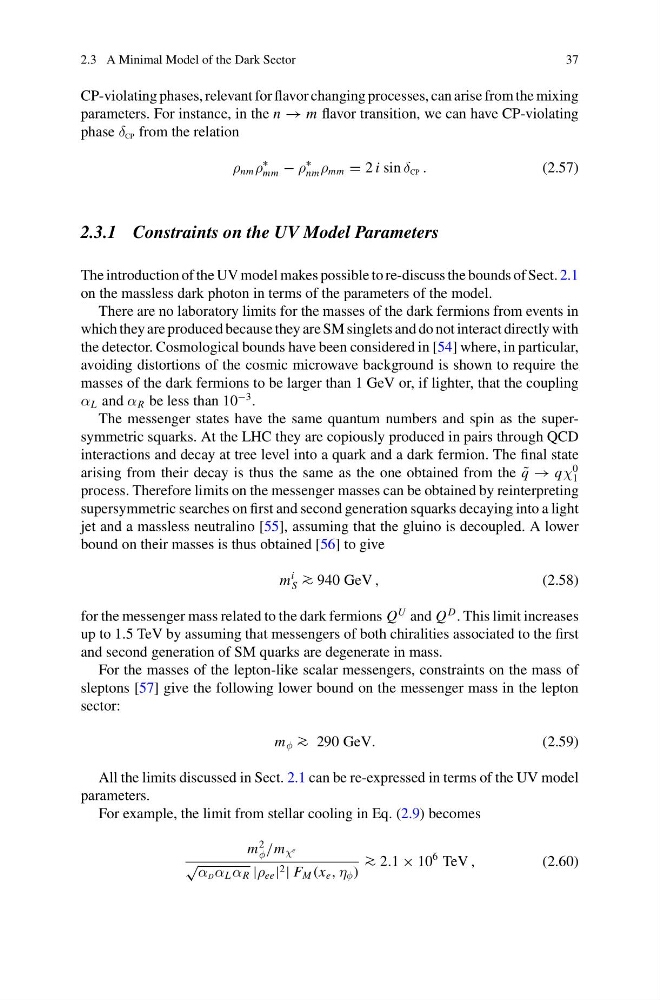
CP-violating phases, relevant for flavor changing processes, can arise from the mixing
parameters. For instance, in the n → m flavor transition, we can have CP-violating
phase δ CP from the relation
ρ nm ρ
∗
mm − ρ
∗
nm ρ mm = 2 i sin δ CP .
(2.57)
2.3.1 Constraints on the UV Model Parameters
The introduction of the UV model makes possible to re-discuss the bounds of Sect. 2.1
on the massless dark photon in terms of the parameters of the model.
There are no laboratory limits for the masses of the dark fermions from events in
which they are produced because they are SM singlets and do not interact directly with
the detector. Cosmological bounds have been considered in [54] where, in particular,
avoiding distortions of the cosmic microwave background is shown to require the
masses of the dark fermions to be larger than 1 GeV or, if lighter, that the coupling
α L and α R be less than 10
−3 .
The messenger states have the same quantum numbers and spin as the supersymmetric squarks. At the LHC they are copiously produced in pairs through QCD
interactions and decay at tree level into a quark and a dark fermion. The final state
arising from their decay is thus the same as the one obtained from the ˜
q → qχ
0
1
process. Therefore limits on the messenger masses can be obtained by reinterpreting
supersymmetric searches on first and second generation squarks decaying into a light
jet and a massless neutralino [55], assuming that the gluino is decoupled. A lower
bound on their masses is thus obtained [56] to give
m
i
S ∼ > 940 GeV ,
(2.58)
for the messenger mass related to the dark fermions Q
U and Q
D . This limit increases
up to 1.5 TeV by assuming that messengers of both chiralities associated to the first
and second generation of SM quarks are degenerate in mass.
For the masses of the lepton-like scalar messengers, constraints on the mass of
sleptons [57] give the following lower bound on the messenger mass in the lepton
sector:
m φ ∼ > 290 GeV.
(2.59)
All the limits discussed in Sect. 2.1 can be re-expressed in terms of the UV model
parameters.
For example, the limit from stellar cooling in Eq. (2.9) becomes
m
2
φ /m χ e
√
α D α L α R |ρ ee | 2 | F M (x e , η φ )
∼ > 2.1 × 10
6 TeV ,
(2.60)
37
CP-violating phases, relevant for flavor changing processes, can arise from the mixing
parameters. For instance, in the n → m flavor transition, we can have CP-violating
phase δ CP from the relation
ρ nm ρ
∗
mm − ρ
∗
nm ρ mm = 2 i sin δ CP .
(2.57)
2.3.1 Constraints on the UV Model Parameters
The introduction of the UV model makes possible to re-discuss the bounds of Sect. 2.1
on the massless dark photon in terms of the parameters of the model.
There are no laboratory limits for the masses of the dark fermions from events in
which they are produced because they are SM singlets and do not interact directly with
the detector. Cosmological bounds have been considered in [54] where, in particular,
avoiding distortions of the cosmic microwave background is shown to require the
masses of the dark fermions to be larger than 1 GeV or, if lighter, that the coupling
α L and α R be less than 10
−3 .
The messenger states have the same quantum numbers and spin as the supersymmetric squarks. At the LHC they are copiously produced in pairs through QCD
interactions and decay at tree level into a quark and a dark fermion. The final state
arising from their decay is thus the same as the one obtained from the ˜
q → qχ
0
1
process. Therefore limits on the messenger masses can be obtained by reinterpreting
supersymmetric searches on first and second generation squarks decaying into a light
jet and a massless neutralino [55], assuming that the gluino is decoupled. A lower
bound on their masses is thus obtained [56] to give
m
i
S ∼ > 940 GeV ,
(2.58)
for the messenger mass related to the dark fermions Q
U and Q
D . This limit increases
up to 1.5 TeV by assuming that messengers of both chiralities associated to the first
and second generation of SM quarks are degenerate in mass.
For the masses of the lepton-like scalar messengers, constraints on the mass of
sleptons [57] give the following lower bound on the messenger mass in the lepton
sector:
m φ ∼ > 290 GeV.
(2.59)
All the limits discussed in Sect. 2.1 can be re-expressed in terms of the UV model
parameters.
For example, the limit from stellar cooling in Eq. (2.9) becomes
m
2
φ /m χ e
√
α D α L α R |ρ ee | 2 | F M (x e , η φ )
∼ > 2.1 × 10
6 TeV ,
(2.60)