

38
2 Phenomenology of the Massless Dark Photon
where x e = m
2
φ /m
2
χ e , with m χ e the dark fermion mass associated to the electron,
and η φ the corresponding mixing parameter in the colorless messengers sector, and
the loop function F M (x, y) is given in Eq. (2.55). This limit, which is obtained by
rescaling the right-hand side of Eq. (2.9) for 1/(4πv h ), applies specifically to the
Yukawa coupling of electrons and the corresponding messenger state.
For a quick estimate of the bound above and those that follow, the loop function
F M (x, y) can be considered a coefficient of order O(10
−1
) as long as η φ is not too
small. For instance, for x 1 and y 0.5, the loop function F M 0.09.
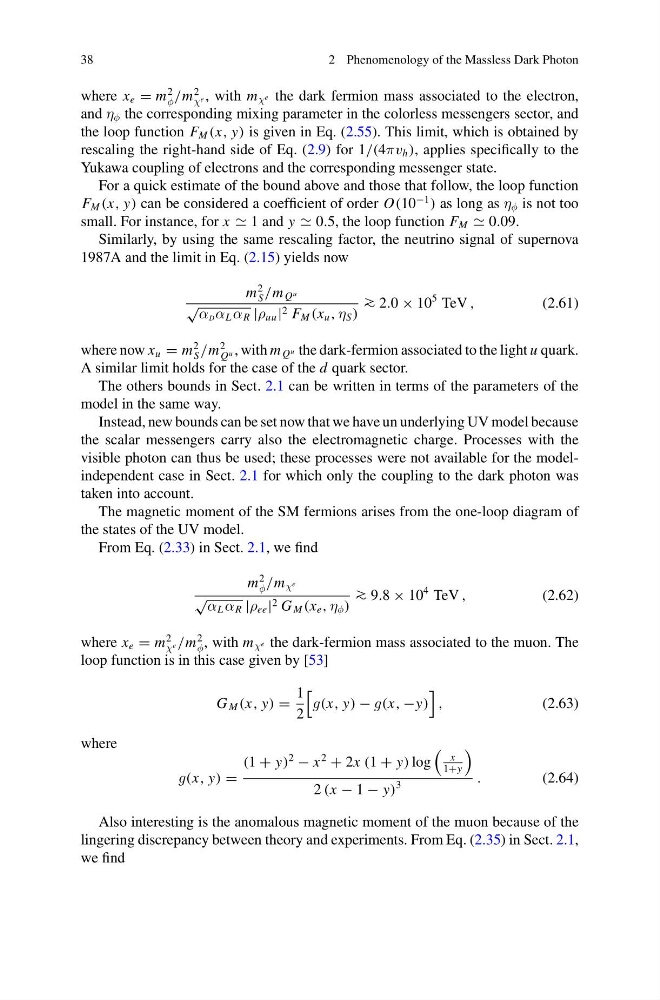
Similarly, by using the same rescaling factor, the neutrino signal of supernova
1987A and the limit in Eq. (2.15) yields now
m
2
S /m Q u
√ α D α L α R |ρ uu | 2 F M (x u , η S )
∼ > 2.0 × 10
5 TeV ,
(2.61)
where now x u = m
2
S /m
2
Q u , with m Q u the dark-fermion associated to the light u quark.
A similar limit holds for the case of the d quark sector.
The others bounds in Sect. 2.1 can be written in terms of the parameters of the
model in the same way.
Instead, new bounds can be set now that we have un underlying UV model because
the scalar messengers carry also the electromagnetic charge. Processes with the
visible photon can thus be used; these processes were not available for the modelindependent case in Sect. 2.1 for which only the coupling to the dark photon was
taken into account.
The magnetic moment of the SM fermions arises from the one-loop diagram of
the states of the UV model.
From Eq. (2.33) in Sect. 2.1, we find
m
2
φ /m χ e
√
α L α R |ρ ee | 2 G M (x e , η φ )
∼ > 9.8 × 10
4 TeV ,
(2.62)
where x e = m
2
χ e /m
2
φ , with m χ e the dark-fermion mass associated to the muon. The
loop function is in this case given by [53]
G M (x, y) =
1
2
g(x, y) − g(x, −y)
,
(2.63)
where
g(x, y) =
(1 + y)
2
− x
2
+ 2x (1 + y) log
x
1+y
2 (x − 1 − y)
3
.
(2.64)
Also interesting is the anomalous magnetic moment of the muon because of the
lingering discrepancy between theory and experiments. From Eq. (2.35) in Sect. 2.1,
we find
2 Phenomenology of the Massless Dark Photon
where x e = m
2
φ /m
2
χ e , with m χ e the dark fermion mass associated to the electron,
and η φ the corresponding mixing parameter in the colorless messengers sector, and
the loop function F M (x, y) is given in Eq. (2.55). This limit, which is obtained by
rescaling the right-hand side of Eq. (2.9) for 1/(4πv h ), applies specifically to the
Yukawa coupling of electrons and the corresponding messenger state.
For a quick estimate of the bound above and those that follow, the loop function
F M (x, y) can be considered a coefficient of order O(10
−1
) as long as η φ is not too
small. For instance, for x 1 and y 0.5, the loop function F M 0.09.
Similarly, by using the same rescaling factor, the neutrino signal of supernova
1987A and the limit in Eq. (2.15) yields now
m
2
S /m Q u
√ α D α L α R |ρ uu | 2 F M (x u , η S )
∼ > 2.0 × 10
5 TeV ,
(2.61)
where now x u = m
2
S /m
2
Q u , with m Q u the dark-fermion associated to the light u quark.
A similar limit holds for the case of the d quark sector.
The others bounds in Sect. 2.1 can be written in terms of the parameters of the
model in the same way.
Instead, new bounds can be set now that we have un underlying UV model because
the scalar messengers carry also the electromagnetic charge. Processes with the
visible photon can thus be used; these processes were not available for the modelindependent case in Sect. 2.1 for which only the coupling to the dark photon was
taken into account.
The magnetic moment of the SM fermions arises from the one-loop diagram of
the states of the UV model.
From Eq. (2.33) in Sect. 2.1, we find
m
2
φ /m χ e
√
α L α R |ρ ee | 2 G M (x e , η φ )
∼ > 9.8 × 10
4 TeV ,
(2.62)
where x e = m
2
χ e /m
2
φ , with m χ e the dark-fermion mass associated to the muon. The
loop function is in this case given by [53]
G M (x, y) =
1
2
g(x, y) − g(x, −y)
,
(2.63)
where
g(x, y) =
(1 + y)
2
− x
2
+ 2x (1 + y) log
x
1+y
2 (x − 1 − y)
3
.
(2.64)
Also interesting is the anomalous magnetic moment of the muon because of the
lingering discrepancy between theory and experiments. From Eq. (2.35) in Sect. 2.1,
we find