

36
2 Phenomenology of the Massless Dark Photon
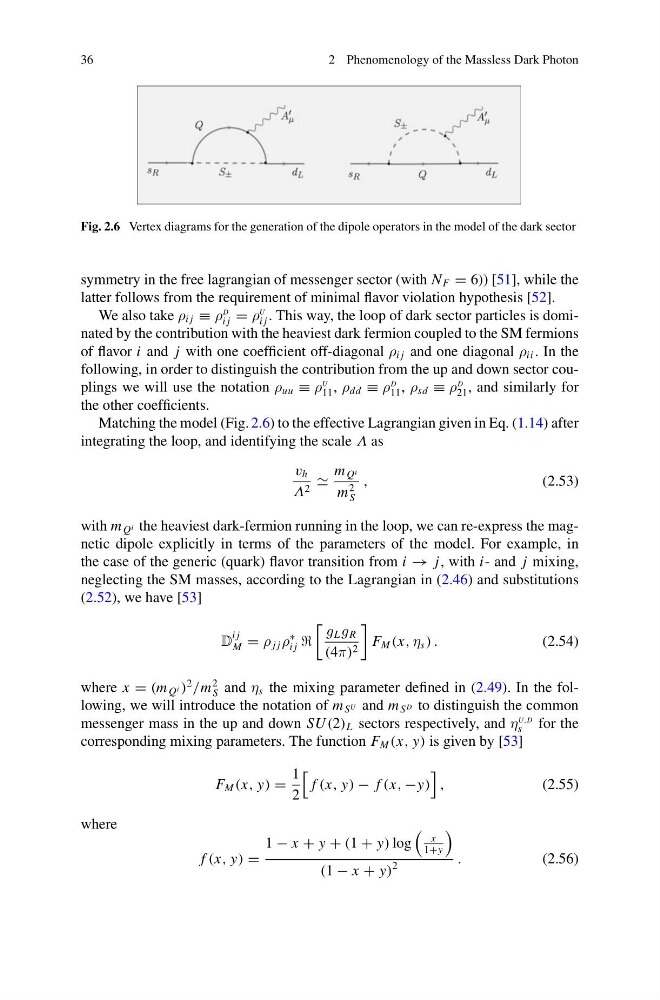
Fig. 2.6 Vertex diagrams for the generation of the dipole operators in the model of the dark sector
symmetry in the free lagrangian of messenger sector (with N F = 6)) [51], while the
latter follows from the requirement of minimal flavor violation hypothesis [52].
We also take ρ i j ≡ ρ
D
i j = ρ
U
i j . This way, the loop of dark sector particles is dominated by the contribution with the heaviest dark fermion coupled to the SM fermions
of flavor i and j with one coefficient off-diagonal ρ i j and one diagonal ρ ii . In the
following, in order to distinguish the contribution from the up and down sector couplings we will use the notation ρ uu ≡ ρ
U
11 , ρ dd ≡ ρ
D
11 , ρ sd ≡ ρ
D
21 , and similarly for
the other coefficients.
Matching the model (Fig. 2.6) to the effective Lagrangian given in Eq. (1.14) after
integrating the loop, and identifying the scale Λ as
v h
Λ 2
m Q i
m
2
S
,
(2.53)
with m Q i the heaviest dark-fermion running in the loop, we can re-express the magnetic dipole explicitly in terms of the parameters of the model. For example, in
the case of the generic (quark) flavor transition from i → j, with i- and j mixing,
neglecting the SM masses, according to the Lagrangian in (2.46) and substitutions
(2.52), we have [53]
D
i j
M = ρ j j ρ
∗
i j
g L g R
(4π) 2
F M (x, η s ) .
(2.54)
where x = (m Q i )
2
/m
2
S and η s the mixing parameter defined in (2.49). In the following, we will introduce the notation of m S U and m S D to distinguish the common
messenger mass in the up and down SU (2) L sectors respectively, and η
U,D
s
for the
corresponding mixing parameters. The function F M (x, y) is given by [53]
F M (x, y) =
1
2
f (x, y) − f (x, −y)
,
(2.55)
where
f (x, y) =
1 − x + y + (1 + y) log
x
1+y
(1 − x + y)
2
.
(2.56)
2 Phenomenology of the Massless Dark Photon
Fig. 2.6 Vertex diagrams for the generation of the dipole operators in the model of the dark sector
symmetry in the free lagrangian of messenger sector (with N F = 6)) [51], while the
latter follows from the requirement of minimal flavor violation hypothesis [52].
We also take ρ i j ≡ ρ
D
i j = ρ
U
i j . This way, the loop of dark sector particles is dominated by the contribution with the heaviest dark fermion coupled to the SM fermions
of flavor i and j with one coefficient off-diagonal ρ i j and one diagonal ρ ii . In the
following, in order to distinguish the contribution from the up and down sector couplings we will use the notation ρ uu ≡ ρ
U
11 , ρ dd ≡ ρ
D
11 , ρ sd ≡ ρ
D
21 , and similarly for
the other coefficients.
Matching the model (Fig. 2.6) to the effective Lagrangian given in Eq. (1.14) after
integrating the loop, and identifying the scale Λ as
v h
Λ 2
m Q i
m
2
S
,
(2.53)
with m Q i the heaviest dark-fermion running in the loop, we can re-express the magnetic dipole explicitly in terms of the parameters of the model. For example, in
the case of the generic (quark) flavor transition from i → j, with i- and j mixing,
neglecting the SM masses, according to the Lagrangian in (2.46) and substitutions
(2.52), we have [53]
D
i j
M = ρ j j ρ
∗
i j
g L g R
(4π) 2
F M (x, η s ) .
(2.54)
where x = (m Q i )
2
/m
2
S and η s the mixing parameter defined in (2.49). In the following, we will introduce the notation of m S U and m S D to distinguish the common
messenger mass in the up and down SU (2) L sectors respectively, and η
U,D
s
for the
corresponding mixing parameters. The function F M (x, y) is given by [53]
F M (x, y) =
1
2
f (x, y) − f (x, −y)
,
(2.55)
where
f (x, y) =
1 − x + y + (1 + y) log
x
1+y
(1 − x + y)
2
.
(2.56)