

2.3 A Minimal Model of the Dark Sector
35
η φ,S ≡
λ s μ φ,S v h
m
2
S
.
(2.49)
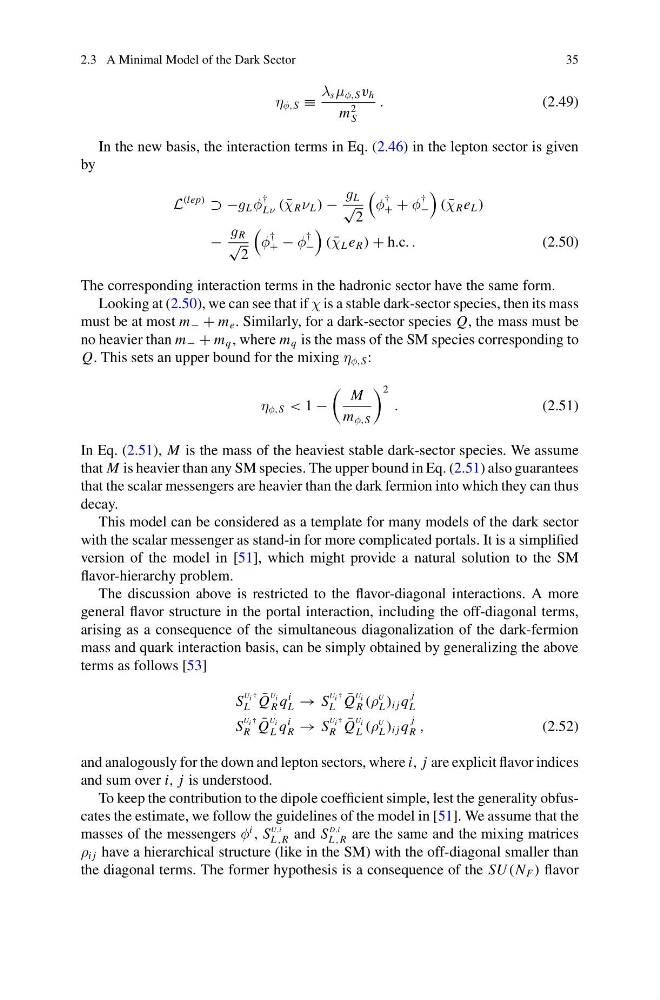
In the new basis, the interaction terms in Eq. (2.46) in the lepton sector is given
by
L
(lep)
⊃ −g L φ
†
Lν ( ¯
χ R ν L ) −
g L
√
2
φ
†
+ + φ
†
−
( ¯
χ R e L )
−
g R
√
2
φ
†
+ − φ
†
−
( ¯
χ L e R ) + h.c. .
(2.50)
The corresponding interaction terms in the hadronic sector have the same form.
Looking at (2.50), we can see that if χ is a stable dark-sector species, then its mass
must be at most m − + m e . Similarly, for a dark-sector species Q, the mass must be
no heavier than m − + m q , where m q is the mass of the SM species corresponding to
Q. This sets an upper bound for the mixing η φ,S :
η φ,S < 1 −
M
m φ,S
2
.
(2.51)
In Eq. (2.51), M is the mass of the heaviest stable dark-sector species. We assume
that M is heavier than any SM species. The upper bound in Eq. (2.51) also guarantees
that the scalar messengers are heavier than the dark fermion into which they can thus
decay.
This model can be considered as a template for many models of the dark sector
with the scalar messenger as stand-in for more complicated portals. It is a simplified
version of the model in [51], which might provide a natural solution to the SM
flavor-hierarchy problem.
The discussion above is restricted to the flavor-diagonal interactions. A more
general flavor structure in the portal interaction, including the off-diagonal terms,
arising as a consequence of the simultaneous diagonalization of the dark-fermion
mass and quark interaction basis, can be simply obtained by generalizing the above
terms as follows [53]
S
U i †
L
¯
Q
U i
R q
i
L → S
U i †
L
¯
Q
U i
R (ρ
U
L ) i j q
j
L
S
U i †
R
¯
Q
U i
L q
i
R → S
U i †
R
¯
Q
U i
L (ρ
U
L ) i j q
j
R ,
(2.52)
and analogously for the down and lepton sectors, where i, j are explicit flavor indices
and sum over i, j is understood.
To keep the contribution to the dipole coefficient simple, lest the generality obfuscates the estimate, we follow the guidelines of the model in [51]. We assume that the
masses of the messengers φ
i , S
U,i
L ,R and S
D,i
L ,R are the same and the mixing matrices
ρ i j have a hierarchical structure (like in the SM) with the off-diagonal smaller than
the diagonal terms. The former hypothesis is a consequence of the SU (N F ) flavor
35
η φ,S ≡
λ s μ φ,S v h
m
2
S
.
(2.49)
In the new basis, the interaction terms in Eq. (2.46) in the lepton sector is given
by
L
(lep)
⊃ −g L φ
†
Lν ( ¯
χ R ν L ) −
g L
√
2
φ
†
+ + φ
†
−
( ¯
χ R e L )
−
g R
√
2
φ
†
+ − φ
†
−
( ¯
χ L e R ) + h.c. .
(2.50)
The corresponding interaction terms in the hadronic sector have the same form.
Looking at (2.50), we can see that if χ is a stable dark-sector species, then its mass
must be at most m − + m e . Similarly, for a dark-sector species Q, the mass must be
no heavier than m − + m q , where m q is the mass of the SM species corresponding to
Q. This sets an upper bound for the mixing η φ,S :
η φ,S < 1 −
M
m φ,S
2
.
(2.51)
In Eq. (2.51), M is the mass of the heaviest stable dark-sector species. We assume
that M is heavier than any SM species. The upper bound in Eq. (2.51) also guarantees
that the scalar messengers are heavier than the dark fermion into which they can thus
decay.
This model can be considered as a template for many models of the dark sector
with the scalar messenger as stand-in for more complicated portals. It is a simplified
version of the model in [51], which might provide a natural solution to the SM
flavor-hierarchy problem.
The discussion above is restricted to the flavor-diagonal interactions. A more
general flavor structure in the portal interaction, including the off-diagonal terms,
arising as a consequence of the simultaneous diagonalization of the dark-fermion
mass and quark interaction basis, can be simply obtained by generalizing the above
terms as follows [53]
S
U i †
L
¯
Q
U i
R q
i
L → S
U i †
L
¯
Q
U i
R (ρ
U
L ) i j q
j
L
S
U i †
R
¯
Q
U i
L q
i
R → S
U i †
R
¯
Q
U i
L (ρ
U
L ) i j q
j
R ,
(2.52)
and analogously for the down and lepton sectors, where i, j are explicit flavor indices
and sum over i, j is understood.
To keep the contribution to the dipole coefficient simple, lest the generality obfuscates the estimate, we follow the guidelines of the model in [51]. We assume that the
masses of the messengers φ
i , S
U,i
L ,R and S
D,i
L ,R are the same and the mixing matrices
ρ i j have a hierarchical structure (like in the SM) with the off-diagonal smaller than
the diagonal terms. The former hypothesis is a consequence of the SU (N F ) flavor