

2.1 Limits on the Dark Dipole Scale d M /Λ 2
27
n A =
2ζ(3)
π 2 T
3
.
(2.21)
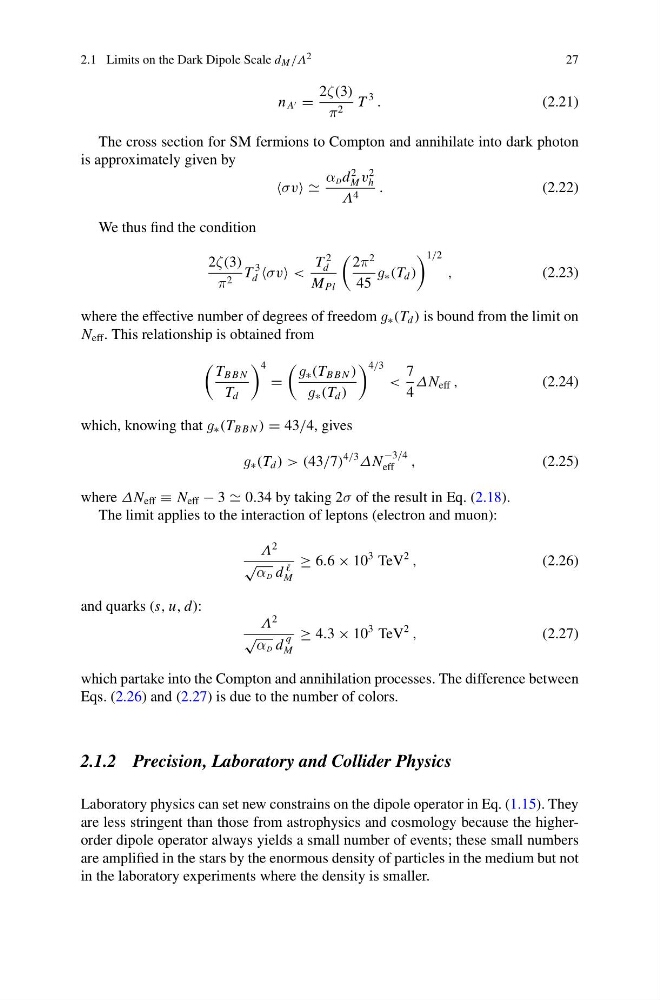
The cross section for SM fermions to Compton and annihilate into dark photon
is approximately given by
σv
α D d
2
M v
2
h
Λ 4 .
(2.22)
We thus find the condition
2ζ(3)
π 2 T
3
d σv <
T
2
d
M Pl
2π
2
45
g ∗ (T d )
1/2
,
(2.23)
where the effective number of degrees of freedom g ∗ (T d ) is bound from the limit on
N eff . This relationship is obtained from
T B B N
T d
4
=
g ∗ (T B B N )
g ∗ (T d )
4/3
<
7
4
ΔN eff ,
(2.24)
which, knowing that g ∗ (T B B N ) = 43/4, gives
g ∗ (T d ) > (43/7)
4/3
ΔN
−3/4
eff
,
(2.25)
where ΔN eff ≡ N eff − 3 0.34 by taking 2σ of the result in Eq. (2.18).
The limit applies to the interaction of leptons (electron and muon):
Λ
2
√ α D d
M
≥ 6.6 × 10
3 TeV
2
,
(2.26)
and quarks (s, u, d):
Λ
2
√ α D d
q
M
≥ 4.3 × 10
3 TeV
2
,
(2.27)
which partake into the Compton and annihilation processes. The difference between
Eqs. (2.26) and (2.27) is due to the number of colors.
2.1.2 Precision, Laboratory and Collider Physics
Laboratory physics can set new constrains on the dipole operator in Eq. (1.15). They
are less stringent than those from astrophysics and cosmology because the higherorder dipole operator always yields a small number of events; these small numbers
are amplified in the stars by the enormous density of particles in the medium but not
in the laboratory experiments where the density is smaller.
27
n A =
2ζ(3)
π 2 T
3
.
(2.21)
The cross section for SM fermions to Compton and annihilate into dark photon
is approximately given by
σv
α D d
2
M v
2
h
Λ 4 .
(2.22)
We thus find the condition
2ζ(3)
π 2 T
3
d σv <
T
2
d
M Pl
2π
2
45
g ∗ (T d )
1/2
,
(2.23)
where the effective number of degrees of freedom g ∗ (T d ) is bound from the limit on
N eff . This relationship is obtained from
T B B N
T d
4
=
g ∗ (T B B N )
g ∗ (T d )
4/3
<
7
4
ΔN eff ,
(2.24)
which, knowing that g ∗ (T B B N ) = 43/4, gives
g ∗ (T d ) > (43/7)
4/3
ΔN
−3/4
eff
,
(2.25)
where ΔN eff ≡ N eff − 3 0.34 by taking 2σ of the result in Eq. (2.18).
The limit applies to the interaction of leptons (electron and muon):
Λ
2
√ α D d
M
≥ 6.6 × 10
3 TeV
2
,
(2.26)
and quarks (s, u, d):
Λ
2
√ α D d
q
M
≥ 4.3 × 10
3 TeV
2
,
(2.27)
which partake into the Compton and annihilation processes. The difference between
Eqs. (2.26) and (2.27) is due to the number of colors.
2.1.2 Precision, Laboratory and Collider Physics
Laboratory physics can set new constrains on the dipole operator in Eq. (1.15). They
are less stringent than those from astrophysics and cosmology because the higherorder dipole operator always yields a small number of events; these small numbers
are amplified in the stars by the enormous density of particles in the medium but not
in the laboratory experiments where the density is smaller.