

26
2 Phenomenology of the Massless Dark Photon
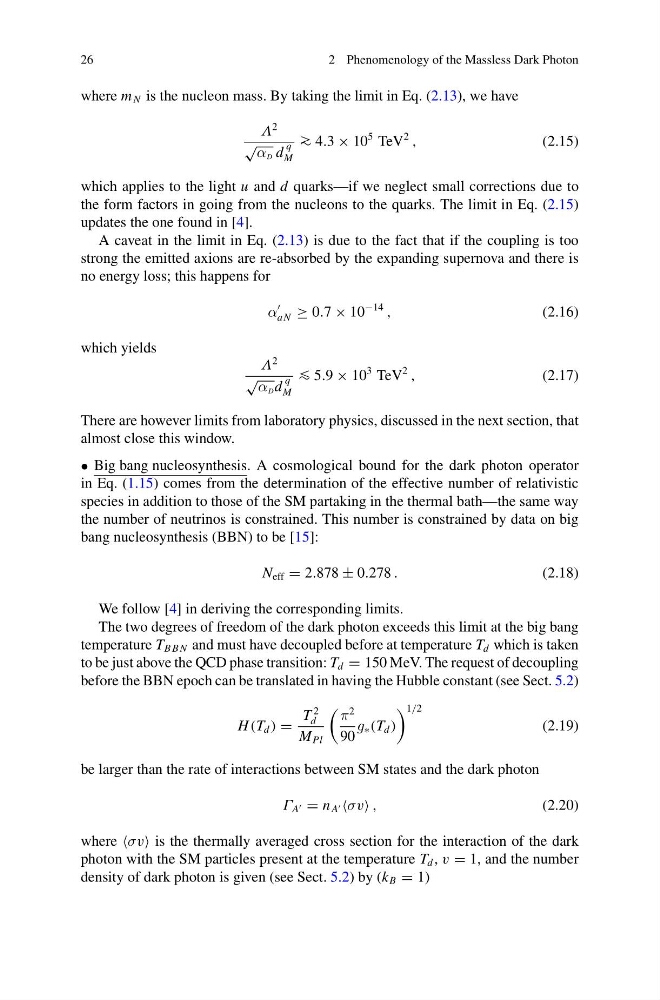
where m N is the nucleon mass. By taking the limit in Eq. (2.13), we have
Λ
2
√
α D d
q
M
∼ > 4.3 × 10
5 TeV
2
,
(2.15)
which applies to the light u and d quarks—if we neglect small corrections due to
the form factors in going from the nucleons to the quarks. The limit in Eq. (2.15)
updates the one found in [4].
A caveat in the limit in Eq. (2.13) is due to the fact that if the coupling is too
strong the emitted axions are re-absorbed by the expanding supernova and there is
no energy loss; this happens for
α
aN ≥ 0.7 × 10
−14
,
(2.16)
which yields
Λ
2
√
α D d
q
M
∼ < 5.9 × 10
3 TeV
2
,
(2.17)
There are however limits from laboratory physics, discussed in the next section, that
almost close this window.
• Big bang nucleosynthesis. A cosmological bound for the dark photon operator
in Eq. (1.15) comes from the determination of the effective number of relativistic
species in addition to those of the SM partaking in the thermal bath—the same way
the number of neutrinos is constrained. This number is constrained by data on big
bang nucleosynthesis (BBN) to be [15]:
N eff = 2.878 ± 0.278 .
(2.18)
We follow [4] in deriving the corresponding limits.
The two degrees of freedom of the dark photon exceeds this limit at the big bang
temperature T B B N and must have decoupled before at temperature T d which is taken
to be just above the QCD phase transition: T d = 150 MeV. The request of decoupling
before the BBN epoch can be translated in having the Hubble constant (see Sect. 5.2)
H (T d ) =
T
2
d
M Pl
π
2
90
g ∗ (T d )
1/2
(2.19)
be larger than the rate of interactions between SM states and the dark photon
Γ A = n A σv ,
(2.20)
where σv is the thermally averaged cross section for the interaction of the dark
photon with the SM particles present at the temperature T d , v = 1, and the number
density of dark photon is given (see Sect. 5.2) by (k B = 1)
2 Phenomenology of the Massless Dark Photon
where m N is the nucleon mass. By taking the limit in Eq. (2.13), we have
Λ
2
√
α D d
q
M
∼ > 4.3 × 10
5 TeV
2
,
(2.15)
which applies to the light u and d quarks—if we neglect small corrections due to
the form factors in going from the nucleons to the quarks. The limit in Eq. (2.15)
updates the one found in [4].
A caveat in the limit in Eq. (2.13) is due to the fact that if the coupling is too
strong the emitted axions are re-absorbed by the expanding supernova and there is
no energy loss; this happens for
α
aN ≥ 0.7 × 10
−14
,
(2.16)
which yields
Λ
2
√
α D d
q
M
∼ < 5.9 × 10
3 TeV
2
,
(2.17)
There are however limits from laboratory physics, discussed in the next section, that
almost close this window.
• Big bang nucleosynthesis. A cosmological bound for the dark photon operator
in Eq. (1.15) comes from the determination of the effective number of relativistic
species in addition to those of the SM partaking in the thermal bath—the same way
the number of neutrinos is constrained. This number is constrained by data on big
bang nucleosynthesis (BBN) to be [15]:
N eff = 2.878 ± 0.278 .
(2.18)
We follow [4] in deriving the corresponding limits.
The two degrees of freedom of the dark photon exceeds this limit at the big bang
temperature T B B N and must have decoupled before at temperature T d which is taken
to be just above the QCD phase transition: T d = 150 MeV. The request of decoupling
before the BBN epoch can be translated in having the Hubble constant (see Sect. 5.2)
H (T d ) =
T
2
d
M Pl
π
2
90
g ∗ (T d )
1/2
(2.19)
be larger than the rate of interactions between SM states and the dark photon
Γ A = n A σv ,
(2.20)
where σv is the thermally averaged cross section for the interaction of the dark
photon with the SM particles present at the temperature T d , v = 1, and the number
density of dark photon is given (see Sect. 5.2) by (k B = 1)