

28
2 Phenomenology of the Massless Dark Photon
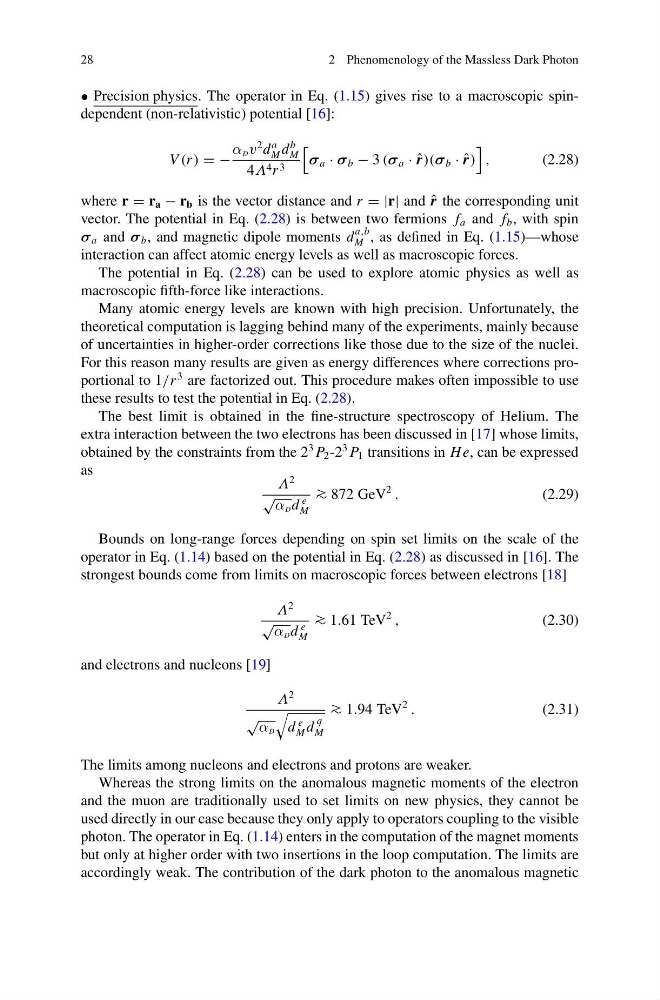
• Precision physics. The operator in Eq. (1.15) gives rise to a macroscopic spindependent (non-relativistic) potential [16]:
V (r ) = −
α D v
2 d
a
M d
b
M
4Λ 4 r 3
σ a · σ b − 3 (σ a · ˆ
r)(σ b · ˆ
r)
,
(2.28)
where r = r a − r b is the vector distance and r = |r| and ˆ
r the corresponding unit
vector. The potential in Eq. (2.28) is between two fermions f a and f b , with spin
σ a and σ b , and magnetic dipole moments d
a,b
M , as defined in Eq. (1.15)—whose
interaction can affect atomic energy levels as well as macroscopic forces.
The potential in Eq. (2.28) can be used to explore atomic physics as well as
macroscopic fifth-force like interactions.
Many atomic energy levels are known with high precision. Unfortunately, the
theoretical computation is lagging behind many of the experiments, mainly because
of uncertainties in higher-order corrections like those due to the size of the nuclei.
For this reason many results are given as energy differences where corrections proportional to 1/r
3 are factorized out. This procedure makes often impossible to use
these results to test the potential in Eq. (2.28).
The best limit is obtained in the fine-structure spectroscopy of Helium. The
extra interaction between the two electrons has been discussed in [17] whose limits,
obtained by the constraints from the 2
3 P 2 -2
3 P 1 transitions in He, can be expressed
as
Λ
2
√
α D d
e
M
∼ > 872 GeV
2
.
(2.29)
Bounds on long-range forces depending on spin set limits on the scale of the
operator in Eq. (1.14) based on the potential in Eq. (2.28) as discussed in [16]. The
strongest bounds come from limits on macroscopic forces between electrons [18]
Λ
2
√ α D d
e
M
∼ > 1.61 TeV
2
,
(2.30)
and electrons and nucleons [19]
Λ
2
√ α D
d
e
M d
q
M
∼ > 1.94 TeV
2
.
(2.31)
The limits among nucleons and electrons and protons are weaker.
Whereas the strong limits on the anomalous magnetic moments of the electron
and the muon are traditionally used to set limits on new physics, they cannot be
used directly in our case because they only apply to operators coupling to the visible
photon. The operator in Eq. (1.14) enters in the computation of the magnet moments
but only at higher order with two insertions in the loop computation. The limits are
accordingly weak. The contribution of the dark photon to the anomalous magnetic
2 Phenomenology of the Massless Dark Photon
• Precision physics. The operator in Eq. (1.15) gives rise to a macroscopic spindependent (non-relativistic) potential [16]:
V (r ) = −
α D v
2 d
a
M d
b
M
4Λ 4 r 3
σ a · σ b − 3 (σ a · ˆ
r)(σ b · ˆ
r)
,
(2.28)
where r = r a − r b is the vector distance and r = |r| and ˆ
r the corresponding unit
vector. The potential in Eq. (2.28) is between two fermions f a and f b , with spin
σ a and σ b , and magnetic dipole moments d
a,b
M , as defined in Eq. (1.15)—whose
interaction can affect atomic energy levels as well as macroscopic forces.
The potential in Eq. (2.28) can be used to explore atomic physics as well as
macroscopic fifth-force like interactions.
Many atomic energy levels are known with high precision. Unfortunately, the
theoretical computation is lagging behind many of the experiments, mainly because
of uncertainties in higher-order corrections like those due to the size of the nuclei.
For this reason many results are given as energy differences where corrections proportional to 1/r
3 are factorized out. This procedure makes often impossible to use
these results to test the potential in Eq. (2.28).
The best limit is obtained in the fine-structure spectroscopy of Helium. The
extra interaction between the two electrons has been discussed in [17] whose limits,
obtained by the constraints from the 2
3 P 2 -2
3 P 1 transitions in He, can be expressed
as
Λ
2
√
α D d
e
M
∼ > 872 GeV
2
.
(2.29)
Bounds on long-range forces depending on spin set limits on the scale of the
operator in Eq. (1.14) based on the potential in Eq. (2.28) as discussed in [16]. The
strongest bounds come from limits on macroscopic forces between electrons [18]
Λ
2
√ α D d
e
M
∼ > 1.61 TeV
2
,
(2.30)
and electrons and nucleons [19]
Λ
2
√ α D
d
e
M d
q
M
∼ > 1.94 TeV
2
.
(2.31)
The limits among nucleons and electrons and protons are weaker.
Whereas the strong limits on the anomalous magnetic moments of the electron
and the muon are traditionally used to set limits on new physics, they cannot be
used directly in our case because they only apply to operators coupling to the visible
photon. The operator in Eq. (1.14) enters in the computation of the magnet moments
but only at higher order with two insertions in the loop computation. The limits are
accordingly weak. The contribution of the dark photon to the anomalous magnetic