

2.1 Limits on the Dark Dipole Scale d M /Λ 2
23
[TeV]
Λ
2
4
6
8
10
12
3
10
×
q
M
d
5
−
10
4
−
10
3
−
10
2
−
10
1
−
10
1
10
2
10
3
10
4
10
5
10
6
10
1 TeV
10 TeV
= 0.01
D
α
= 0.1
D
α
LH C (u ,d )
BB N (u ,d ,s)
SN (u ,d )
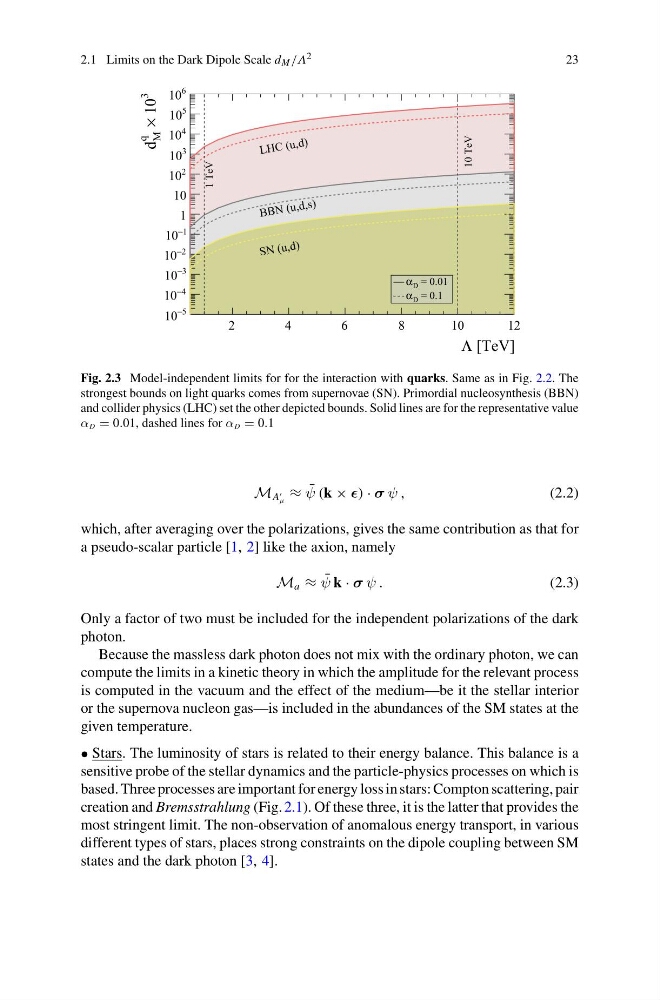
Fig. 2.3 Model-independent limits for for the interaction with quarks. Same as in Fig. 2.2. The
strongest bounds on light quarks comes from supernovae (SN). Primordial nucleosynthesis (BBN)
and collider physics (LHC) set the other depicted bounds. Solid lines are for the representative value
α D = 0.01, dashed lines for α D = 0.1
M A μ ≈ ¯
ψ (k × · σ ψ ,
(2.2)
which, after averaging over the polarizations, gives the same contribution as that for
a pseudo-scalar particle [1, 2] like the axion, namely
M a ≈ ¯
ψ k · σ ψ .
(2.3)
Only a factor of two must be included for the independent polarizations of the dark
photon.
Because the massless dark photon does not mix with the ordinary photon, we can
compute the limits in a kinetic theory in which the amplitude for the relevant process
is computed in the vacuum and the effect of the medium—be it the stellar interior
or the supernova nucleon gas—is included in the abundances of the SM states at the
given temperature.
• Stars. The luminosity of stars is related to their energy balance. This balance is a
sensitive probe of the stellar dynamics and the particle-physics processes on which is
based. Three processes are important for energy loss in stars: Compton scattering, pair
creation and Bremsstrahlung (Fig. 2.1). Of these three, it is the latter that provides the
most stringent limit. The non-observation of anomalous energy transport, in various
different types of stars, places strong constraints on the dipole coupling between SM
states and the dark photon [3, 4].
23
[TeV]
Λ
2
4
6
8
10
12
3
10
×
q
M
d
5
−
10
4
−
10
3
−
10
2
−
10
1
−
10
1
10
2
10
3
10
4
10
5
10
6
10
1 TeV
10 TeV
= 0.01
D
α
= 0.1
D
α
LH C (u ,d )
BB N (u ,d ,s)
SN (u ,d )
Fig. 2.3 Model-independent limits for for the interaction with quarks. Same as in Fig. 2.2. The
strongest bounds on light quarks comes from supernovae (SN). Primordial nucleosynthesis (BBN)
and collider physics (LHC) set the other depicted bounds. Solid lines are for the representative value
α D = 0.01, dashed lines for α D = 0.1
M A μ ≈ ¯
ψ (k × · σ ψ ,
(2.2)
which, after averaging over the polarizations, gives the same contribution as that for
a pseudo-scalar particle [1, 2] like the axion, namely
M a ≈ ¯
ψ k · σ ψ .
(2.3)
Only a factor of two must be included for the independent polarizations of the dark
photon.
Because the massless dark photon does not mix with the ordinary photon, we can
compute the limits in a kinetic theory in which the amplitude for the relevant process
is computed in the vacuum and the effect of the medium—be it the stellar interior
or the supernova nucleon gas—is included in the abundances of the SM states at the
given temperature.
• Stars. The luminosity of stars is related to their energy balance. This balance is a
sensitive probe of the stellar dynamics and the particle-physics processes on which is
based. Three processes are important for energy loss in stars: Compton scattering, pair
creation and Bremsstrahlung (Fig. 2.1). Of these three, it is the latter that provides the
most stringent limit. The non-observation of anomalous energy transport, in various
different types of stars, places strong constraints on the dipole coupling between SM
states and the dark photon [3, 4].