

24
2 Phenomenology of the Massless Dark Photon
The quantity we need is the energy loss due to the emission of the extra particle.
The energy loss per unit volume Q is given in the Sect. 5.3 in terms of the squared
amplitude of the process of emitting, in our case, an axion.
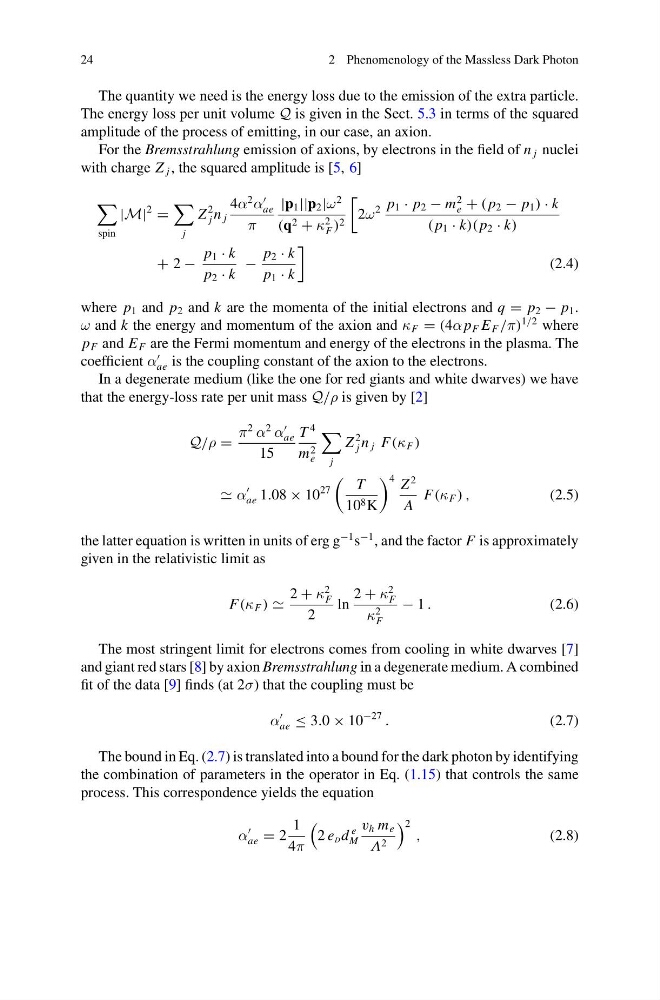
For the Bremsstrahlung emission of axions, by electrons in the field of n j nuclei
with charge Z j , the squared amplitude is [5, 6]
spin
|M|
2
=
j
Z
2
j n j
4α
2
α
ae
π
|p 1 ||p 2 |ω
2
(q 2 + κ
2
F ) 2
2ω
2 p 1 · p 2 − m
2
e + ( p 2 − p 1 ) · k
( p 1 · k)( p 2 · k)
+ 2 −
p 1 · k
p 2 · k
−
p 2 · k
p 1 · k
(2.4)
where p 1 and p 2 and k are the momenta of the initial electrons and q = p 2 − p 1 .
ω and k the energy and momentum of the axion and κ F = (4α p F E F /π)
1/2 where
p F and E F are the Fermi momentum and energy of the electrons in the plasma. The
coefficient α
ae is the coupling constant of the axion to the electrons.
In a degenerate medium (like the one for red giants and white dwarves) we have
that the energy-loss rate per unit mass Q/ρ is given by [2]
Q/ρ =
π
2
α
2
α
ae
15
T
4
m 2
e
j
Z
2
j n j F(κ F )
α
ae 1.08 × 10
27
T
10 8 K
4 Z
2
A
F(κ F ) ,
(2.5)
the latter equation is written in units of erg g
−1 s
−1 , and the factor F is approximately
given in the relativistic limit as
F(κ F )
2 + κ
2
F
2
ln
2 + κ
2
F
κ
2
F
− 1 .
(2.6)
The most stringent limit for electrons comes from cooling in white dwarves [7]
and giant red stars [8] by axion Bremsstrahlung in a degenerate medium. A combined
fit of the data [9] finds (at 2σ) that the coupling must be
α
ae ≤ 3.0 × 10
−27
.
(2.7)
The bound in Eq. (2.7) is translated into a bound for the dark photon by identifying
the combination of parameters in the operator in Eq. (1.15) that controls the same
process. This correspondence yields the equation
α
ae = 2
1
4π
2 e D d
e
M
v h m e
Λ 2
2 ,
(2.8)
2 Phenomenology of the Massless Dark Photon
The quantity we need is the energy loss due to the emission of the extra particle.
The energy loss per unit volume Q is given in the Sect. 5.3 in terms of the squared
amplitude of the process of emitting, in our case, an axion.
For the Bremsstrahlung emission of axions, by electrons in the field of n j nuclei
with charge Z j , the squared amplitude is [5, 6]
spin
|M|
2
=
j
Z
2
j n j
4α
2
α
ae
π
|p 1 ||p 2 |ω
2
(q 2 + κ
2
F ) 2
2ω
2 p 1 · p 2 − m
2
e + ( p 2 − p 1 ) · k
( p 1 · k)( p 2 · k)
+ 2 −
p 1 · k
p 2 · k
−
p 2 · k
p 1 · k
(2.4)
where p 1 and p 2 and k are the momenta of the initial electrons and q = p 2 − p 1 .
ω and k the energy and momentum of the axion and κ F = (4α p F E F /π)
1/2 where
p F and E F are the Fermi momentum and energy of the electrons in the plasma. The
coefficient α
ae is the coupling constant of the axion to the electrons.
In a degenerate medium (like the one for red giants and white dwarves) we have
that the energy-loss rate per unit mass Q/ρ is given by [2]
Q/ρ =
π
2
α
2
α
ae
15
T
4
m 2
e
j
Z
2
j n j F(κ F )
α
ae 1.08 × 10
27
T
10 8 K
4 Z
2
A
F(κ F ) ,
(2.5)
the latter equation is written in units of erg g
−1 s
−1 , and the factor F is approximately
given in the relativistic limit as
F(κ F )
2 + κ
2
F
2
ln
2 + κ
2
F
κ
2
F
− 1 .
(2.6)
The most stringent limit for electrons comes from cooling in white dwarves [7]
and giant red stars [8] by axion Bremsstrahlung in a degenerate medium. A combined
fit of the data [9] finds (at 2σ) that the coupling must be
α
ae ≤ 3.0 × 10
−27
.
(2.7)
The bound in Eq. (2.7) is translated into a bound for the dark photon by identifying
the combination of parameters in the operator in Eq. (1.15) that controls the same
process. This correspondence yields the equation
α
ae = 2
1
4π
2 e D d
e
M
v h m e
Λ 2
2 ,
(2.8)