

1.3 Dark Matter and the Dark Photon
13
χ ¯
χ → A
→ ¯
f f
(1.24)
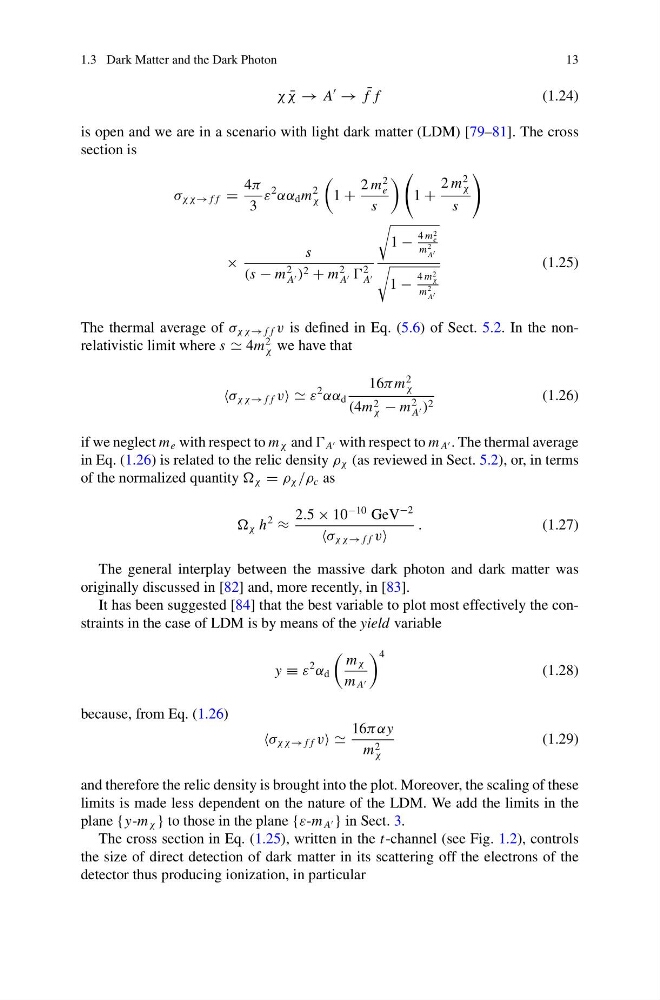
is open and we are in a scenario with light dark matter (LDM) [79–81]. The cross
section is
σ χχ→ f f =
4π
3
ε
2
αα d m
2
χ
1 +
2 m
2
e
s
1 +
2 m
2
χ
s
×
s
(s − m
2
A ) 2 + m
2
A
2
A
1 −
4 m 2
e
m
2
A
1 −
4 m 2
χ
m
2
A
(1.25)
The thermal average of σ χχ→ f f v is defined in Eq. (5.6) of Sect. 5.2. In the nonrelativistic limit where s 4m
2
χ we have that
σ χχ→ f f v ε
2
αα d
16π m
2
χ
(4m 2
χ − m
2
A ) 2
(1.26)
if we neglect m e with respect to m χ and A with respect to m A . The thermal average
in Eq. (1.26) is related to the relic density ρ χ (as reviewed in Sect. 5.2), or, in terms
of the normalized quantity χ = ρ χ /ρ c as
χ h
2
≈
2.5 × 10
−10 GeV
−2
σ χχ→ f f v
.
(1.27)
The general interplay between the massive dark photon and dark matter was
originally discussed in [82] and, more recently, in [83].
It has been suggested [84] that the best variable to plot most effectively the constraints in the case of LDM is by means of the yield variable
y ≡ ε
2
α d
m χ
m A
4
(1.28)
because, from Eq. (1.26)
σ χχ→ f f v
16παy
m 2
χ
(1.29)
and therefore the relic density is brought into the plot. Moreover, the scaling of these
limits is made less dependent on the nature of the LDM. We add the limits in the
plane {y-m χ } to those in the plane {ε-m A } in Sect. 3.
The cross section in Eq. (1.25), written in the t-channel (see Fig. 1.2), controls
the size of direct detection of dark matter in its scattering off the electrons of the
detector thus producing ionization, in particular
13
χ ¯
χ → A
→ ¯
f f
(1.24)
is open and we are in a scenario with light dark matter (LDM) [79–81]. The cross
section is
σ χχ→ f f =
4π
3
ε
2
αα d m
2
χ
1 +
2 m
2
e
s
1 +
2 m
2
χ
s
×
s
(s − m
2
A ) 2 + m
2
A
2
A
1 −
4 m 2
e
m
2
A
1 −
4 m 2
χ
m
2
A
(1.25)
The thermal average of σ χχ→ f f v is defined in Eq. (5.6) of Sect. 5.2. In the nonrelativistic limit where s 4m
2
χ we have that
σ χχ→ f f v ε
2
αα d
16π m
2
χ
(4m 2
χ − m
2
A ) 2
(1.26)
if we neglect m e with respect to m χ and A with respect to m A . The thermal average
in Eq. (1.26) is related to the relic density ρ χ (as reviewed in Sect. 5.2), or, in terms
of the normalized quantity χ = ρ χ /ρ c as
χ h
2
≈
2.5 × 10
−10 GeV
−2
σ χχ→ f f v
.
(1.27)
The general interplay between the massive dark photon and dark matter was
originally discussed in [82] and, more recently, in [83].
It has been suggested [84] that the best variable to plot most effectively the constraints in the case of LDM is by means of the yield variable
y ≡ ε
2
α d
m χ
m A
4
(1.28)
because, from Eq. (1.26)
σ χχ→ f f v
16παy
m 2
χ
(1.29)
and therefore the relic density is brought into the plot. Moreover, the scaling of these
limits is made less dependent on the nature of the LDM. We add the limits in the
plane {y-m χ } to those in the plane {ε-m A } in Sect. 3.
The cross section in Eq. (1.25), written in the t-channel (see Fig. 1.2), controls
the size of direct detection of dark matter in its scattering off the electrons of the
detector thus producing ionization, in particular