

14
1 Introduction
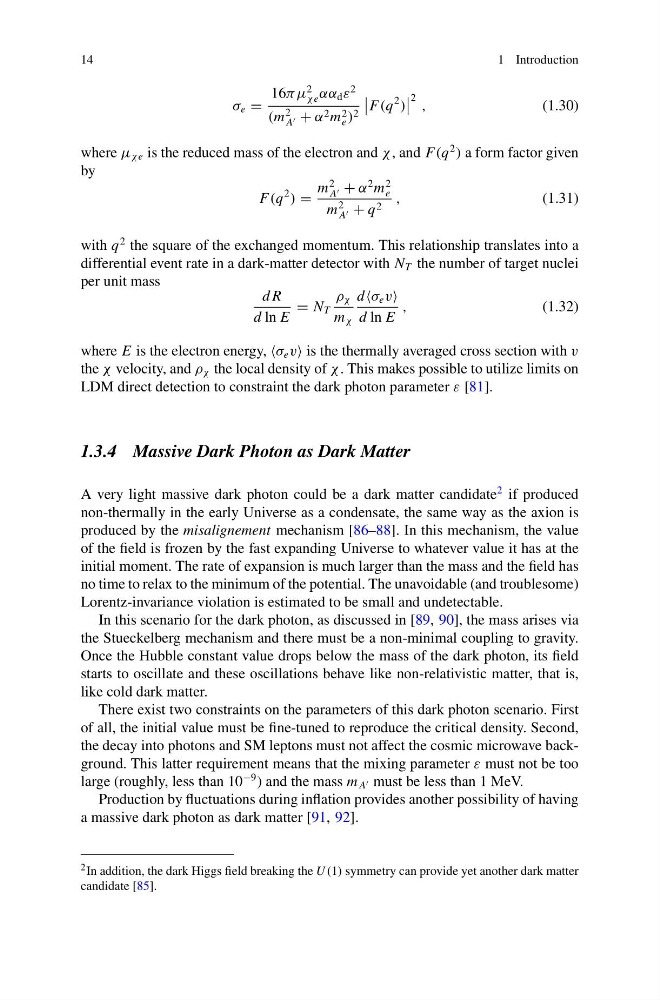
σ e =
16πμ
2
χe αα d ε
2
(m
2
A + α 2 m 2
e ) 2
F(q
2
)
2 ,
(1.30)
where μ χe is the reduced mass of the electron and χ , and F(q
2
) a form factor given
by
F(q
2
) =
m
2
A + α
2 m
2
e
m
2
A + q 2 ,
(1.31)
with q
2 the square of the exchanged momentum. This relationship translates into a
differential event rate in a dark-matter detector with N T the number of target nuclei
per unit mass
d R
d ln E
= N T
ρ χ
m χ
dσ e v
d ln E
,
(1.32)
where E is the electron energy, σ e v is the thermally averaged cross section with v
the χ velocity, and ρ χ the local density of χ . This makes possible to utilize limits on
LDM direct detection to constraint the dark photon parameter ε [81].
1.3.4 Massive Dark Photon as Dark Matter
A very light massive dark photon could be a dark matter candidate
2 if produced
non-thermally in the early Universe as a condensate, the same way as the axion is
produced by the misalignement mechanism [86–88]. In this mechanism, the value
of the field is frozen by the fast expanding Universe to whatever value it has at the
initial moment. The rate of expansion is much larger than the mass and the field has
no time to relax to the minimum of the potential. The unavoidable (and troublesome)
Lorentz-invariance violation is estimated to be small and undetectable.
In this scenario for the dark photon, as discussed in [89, 90], the mass arises via
the Stueckelberg mechanism and there must be a non-minimal coupling to gravity.
Once the Hubble constant value drops below the mass of the dark photon, its field
starts to oscillate and these oscillations behave like non-relativistic matter, that is,
like cold dark matter.
There exist two constraints on the parameters of this dark photon scenario. First
of all, the initial value must be fine-tuned to reproduce the critical density. Second,
the decay into photons and SM leptons must not affect the cosmic microwave background. This latter requirement means that the mixing parameter ε must not be too
large (roughly, less than 10
−9 ) and the mass m A must be less than 1 MeV.
Production by fluctuations during inflation provides another possibility of having
a massive dark photon as dark matter [91, 92].
2 In addition, the dark Higgs field breaking the U (1) symmetry can provide yet another dark matter
candidate [85].
1 Introduction
σ e =
16πμ
2
χe αα d ε
2
(m
2
A + α 2 m 2
e ) 2
F(q
2
)
2 ,
(1.30)
where μ χe is the reduced mass of the electron and χ , and F(q
2
) a form factor given
by
F(q
2
) =
m
2
A + α
2 m
2
e
m
2
A + q 2 ,
(1.31)
with q
2 the square of the exchanged momentum. This relationship translates into a
differential event rate in a dark-matter detector with N T the number of target nuclei
per unit mass
d R
d ln E
= N T
ρ χ
m χ
dσ e v
d ln E
,
(1.32)
where E is the electron energy, σ e v is the thermally averaged cross section with v
the χ velocity, and ρ χ the local density of χ . This makes possible to utilize limits on
LDM direct detection to constraint the dark photon parameter ε [81].
1.3.4 Massive Dark Photon as Dark Matter
A very light massive dark photon could be a dark matter candidate
2 if produced
non-thermally in the early Universe as a condensate, the same way as the axion is
produced by the misalignement mechanism [86–88]. In this mechanism, the value
of the field is frozen by the fast expanding Universe to whatever value it has at the
initial moment. The rate of expansion is much larger than the mass and the field has
no time to relax to the minimum of the potential. The unavoidable (and troublesome)
Lorentz-invariance violation is estimated to be small and undetectable.
In this scenario for the dark photon, as discussed in [89, 90], the mass arises via
the Stueckelberg mechanism and there must be a non-minimal coupling to gravity.
Once the Hubble constant value drops below the mass of the dark photon, its field
starts to oscillate and these oscillations behave like non-relativistic matter, that is,
like cold dark matter.
There exist two constraints on the parameters of this dark photon scenario. First
of all, the initial value must be fine-tuned to reproduce the critical density. Second,
the decay into photons and SM leptons must not affect the cosmic microwave background. This latter requirement means that the mixing parameter ε must not be too
large (roughly, less than 10
−9 ) and the mass m A must be less than 1 MeV.
Production by fluctuations during inflation provides another possibility of having
a massive dark photon as dark matter [91, 92].
2 In addition, the dark Higgs field breaking the U (1) symmetry can provide yet another dark matter
candidate [85].