

12
1 Introduction
Heavier dark fermions can be dark matter. The dominant annihilation for these
is not into dark photons but into SM fermions via the exchange of some messenger
field S—the details depending on the underlying UV model—and is proportional
to the corresponding coupling which we denote α L anticipating the discussion in
Sect. 2.3—with a thermally averaged cross section approximately given by
σ χχ→ f ¯
f v
2πα
2
L
m
2
S
(1.22)
instead of Eq. (1.20). The critical relic density can be reproduced if, assuming thermal
production,
2πα
2
L
10 TeV
m S
2
0.1 .
(1.23)
These dark matter fermions belonging to the dark sector are in principle detectable
through the long range exchange of the massless dark photon and its coupling to the
magnetic (o electric) dipole moment of SM matter which is induced at the one loop
level in the UV model of the dark sector. The somewhat complementary problem of
dark matter having dipole moment and interacting with nuclei through the exchange
of a photon has been discussed in [69–75] This dipole interaction is now included
within the basis of the operators in the effective field theory of dark matter detection [76–78].
1.3.3 Massive Dark Photon and Light Dark Matter
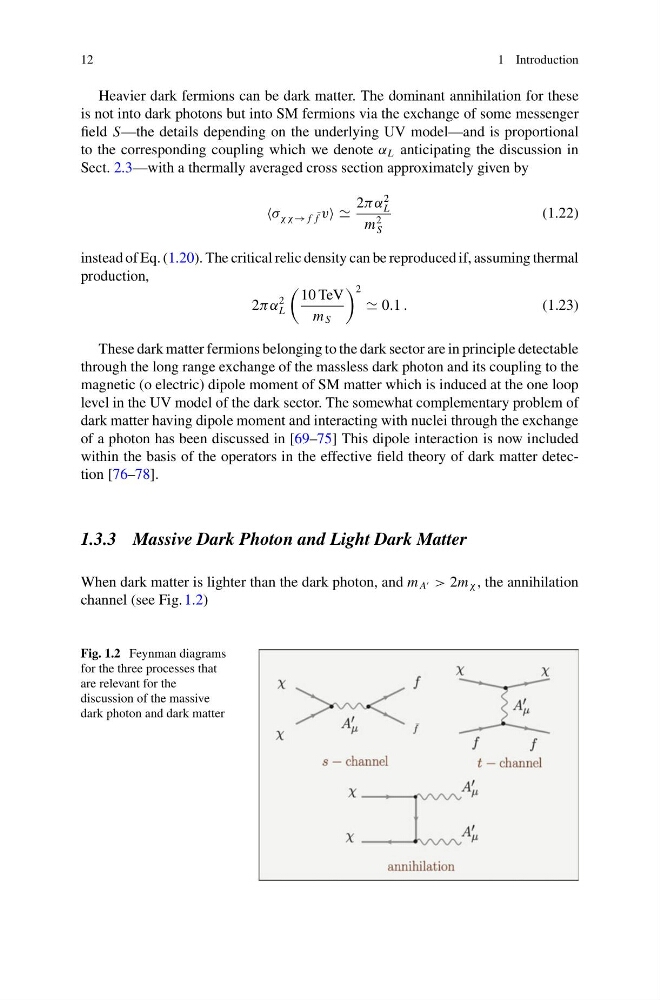
When dark matter is lighter than the dark photon, and m A > 2m χ , the annihilation
channel (see Fig. 1.2)
Fig. 1.2 Feynman diagrams
for the three processes that
are relevant for the
discussion of the massive
dark photon and dark matter
1 Introduction
Heavier dark fermions can be dark matter. The dominant annihilation for these
is not into dark photons but into SM fermions via the exchange of some messenger
field S—the details depending on the underlying UV model—and is proportional
to the corresponding coupling which we denote α L anticipating the discussion in
Sect. 2.3—with a thermally averaged cross section approximately given by
σ χχ→ f ¯
f v
2πα
2
L
m
2
S
(1.22)
instead of Eq. (1.20). The critical relic density can be reproduced if, assuming thermal
production,
2πα
2
L
10 TeV
m S
2
0.1 .
(1.23)
These dark matter fermions belonging to the dark sector are in principle detectable
through the long range exchange of the massless dark photon and its coupling to the
magnetic (o electric) dipole moment of SM matter which is induced at the one loop
level in the UV model of the dark sector. The somewhat complementary problem of
dark matter having dipole moment and interacting with nuclei through the exchange
of a photon has been discussed in [69–75] This dipole interaction is now included
within the basis of the operators in the effective field theory of dark matter detection [76–78].
1.3.3 Massive Dark Photon and Light Dark Matter
When dark matter is lighter than the dark photon, and m A > 2m χ , the annihilation
channel (see Fig. 1.2)
Fig. 1.2 Feynman diagrams
for the three processes that
are relevant for the
discussion of the massive
dark photon and dark matter