

60
P. Kumar et al.
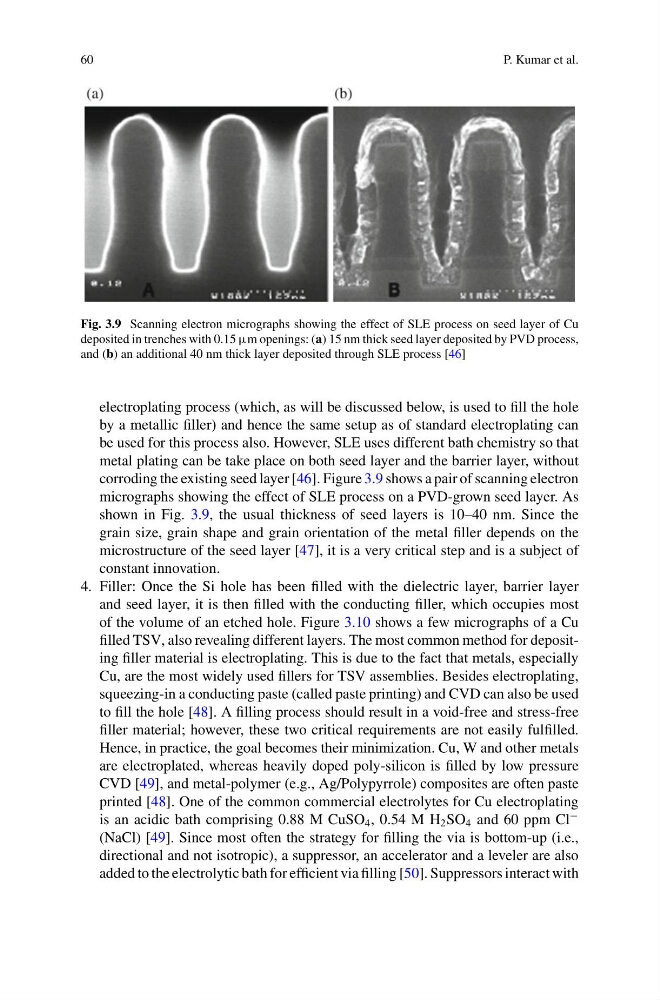
Fig. 3.9 Scanning electron micrographs showing the effect of SLE process on seed layer of Cu
deposited in trenches with 0.15 µm openings: (a) 15 nm thick seed layer deposited by PVD process,
and (b) an additional 40 nm thick layer deposited through SLE process [46]
electroplating process (which, as will be discussed below, is used to fill the hole
by a metallic filler) and hence the same setup as of standard electroplating can
be used for this process also. However, SLE uses different bath chemistry so that
metal plating can be take place on both seed layer and the barrier layer, without
corroding the existing seed layer [46]. Figure 3.9 shows a pair of scanning electron
micrographs showing the effect of SLE process on a PVD-grown seed layer. As
shown in Fig. 3.9, the usual thickness of seed layers is 10–40 nm. Since the
grain size, grain shape and grain orientation of the metal filler depends on the
microstructure of the seed layer [47], it is a very critical step and is a subject of
constant innovation.
4. Filler: Once the Si hole has been filled with the dielectric layer, barrier layer
and seed layer, it is then filled with the conducting filler, which occupies most
of the volume of an etched hole. Figure 3.10 shows a few micrographs of a Cu
filled TSV, also revealing different layers. The most common method for depositing filler material is electroplating. This is due to the fact that metals, especially
Cu, are the most widely used fillers for TSV assemblies. Besides electroplating,
squeezing-in a conducting paste (called paste printing) and CVD can also be used
to fill the hole [48]. A filling process should result in a void-free and stress-free
filler material; however, these two critical requirements are not easily fulfilled.
Hence, in practice, the goal becomes their minimization. Cu, W and other metals
are electroplated, whereas heavily doped poly-silicon is filled by low pressure
CVD [49], and metal-polymer (e.g., Ag/Polypyrrole) composites are often paste
printed [48]. One of the common commercial electrolytes for Cu electroplating
is an acidic bath comprising 0.88 M CuSO 4 , 0.54 M H 2 SO 4 and 60 ppm Cl
−
(NaCl) [49]. Since most often the strategy for filling the via is bottom-up (i.e.,
directional and not isotropic), a suppressor, an accelerator and a leveler are also
added to the electrolytic bath for efficient via filling [50]. Suppressors interact with
P. Kumar et al.
Fig. 3.9 Scanning electron micrographs showing the effect of SLE process on seed layer of Cu
deposited in trenches with 0.15 µm openings: (a) 15 nm thick seed layer deposited by PVD process,
and (b) an additional 40 nm thick layer deposited through SLE process [46]
electroplating process (which, as will be discussed below, is used to fill the hole
by a metallic filler) and hence the same setup as of standard electroplating can
be used for this process also. However, SLE uses different bath chemistry so that
metal plating can be take place on both seed layer and the barrier layer, without
corroding the existing seed layer [46]. Figure 3.9 shows a pair of scanning electron
micrographs showing the effect of SLE process on a PVD-grown seed layer. As
shown in Fig. 3.9, the usual thickness of seed layers is 10–40 nm. Since the
grain size, grain shape and grain orientation of the metal filler depends on the
microstructure of the seed layer [47], it is a very critical step and is a subject of
constant innovation.
4. Filler: Once the Si hole has been filled with the dielectric layer, barrier layer
and seed layer, it is then filled with the conducting filler, which occupies most
of the volume of an etched hole. Figure 3.10 shows a few micrographs of a Cu
filled TSV, also revealing different layers. The most common method for depositing filler material is electroplating. This is due to the fact that metals, especially
Cu, are the most widely used fillers for TSV assemblies. Besides electroplating,
squeezing-in a conducting paste (called paste printing) and CVD can also be used
to fill the hole [48]. A filling process should result in a void-free and stress-free
filler material; however, these two critical requirements are not easily fulfilled.
Hence, in practice, the goal becomes their minimization. Cu, W and other metals
are electroplated, whereas heavily doped poly-silicon is filled by low pressure
CVD [49], and metal-polymer (e.g., Ag/Polypyrrole) composites are often paste
printed [48]. One of the common commercial electrolytes for Cu electroplating
is an acidic bath comprising 0.88 M CuSO 4 , 0.54 M H 2 SO 4 and 60 ppm Cl
−
(NaCl) [49]. Since most often the strategy for filling the via is bottom-up (i.e.,
directional and not isotropic), a suppressor, an accelerator and a leveler are also
added to the electrolytic bath for efficient via filling [50]. Suppressors interact with