

612
Y. Li and D. Goyal
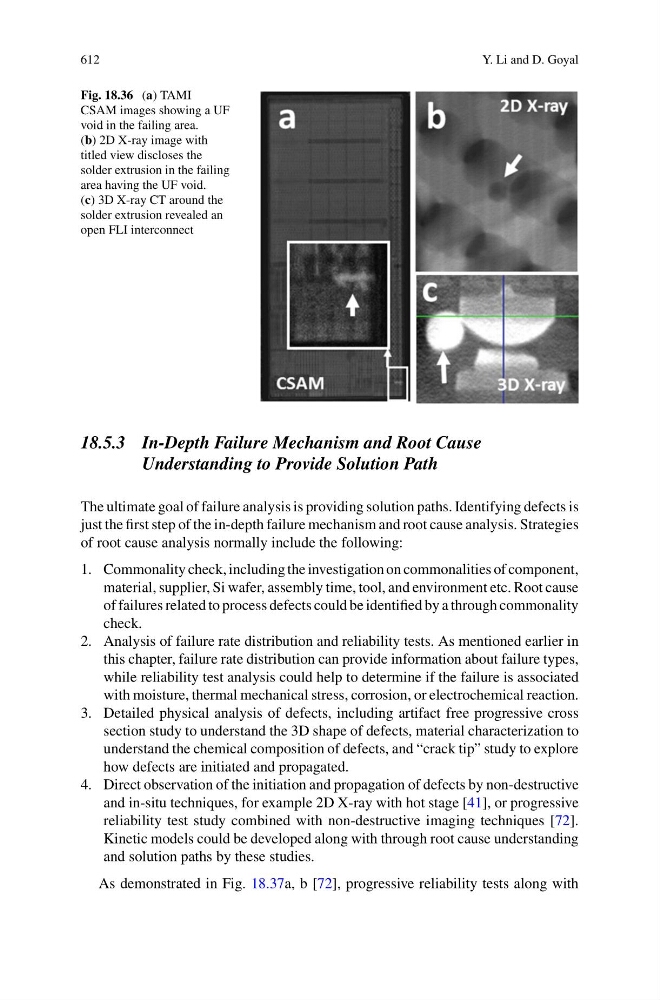
Fig. 18.36 (a) TAMI
CSAM images showing a UF
void in the failing area.
(b) 2D X-ray image with
titled view discloses the
solder extrusion in the failing
area having the UF void.
(c) 3D X-ray CT around the
solder extrusion revealed an
open FLI interconnect
18.5.3 In-Depth Failure Mechanism and Root Cause
Understanding to Provide Solution Path
The ultimate goal of failure analysis is providing solution paths. Identifying defects is
just the first step of the in-depth failure mechanism and root cause analysis. Strategies
of root cause analysis normally include the following:
1. Commonality check, including the investigation on commonalities of component,
material, supplier, Si wafer, assembly time, tool, and environment etc. Root cause
of failures related to process defects could be identified by a through commonality
check.
2. Analysis of failure rate distribution and reliability tests. As mentioned earlier in
this chapter, failure rate distribution can provide information about failure types,
while reliability test analysis could help to determine if the failure is associated
with moisture, thermal mechanical stress, corrosion, or electrochemical reaction.
3. Detailed physical analysis of defects, including artifact free progressive cross
section study to understand the 3D shape of defects, material characterization to
understand the chemical composition of defects, and “crack tip” study to explore
how defects are initiated and propagated.
4. Direct observation of the initiation and propagation of defects by non-destructive
and in-situ techniques, for example 2D X-ray with hot stage [41], or progressive
reliability test study combined with non-destructive imaging techniques [72].
Kinetic models could be developed along with through root cause understanding
and solution paths by these studies.
As demonstrated in Fig. 18.37a, b [72], progressive reliability tests along with