

18 Fault Isolation and Failure Analysis of 3D Packaging
613
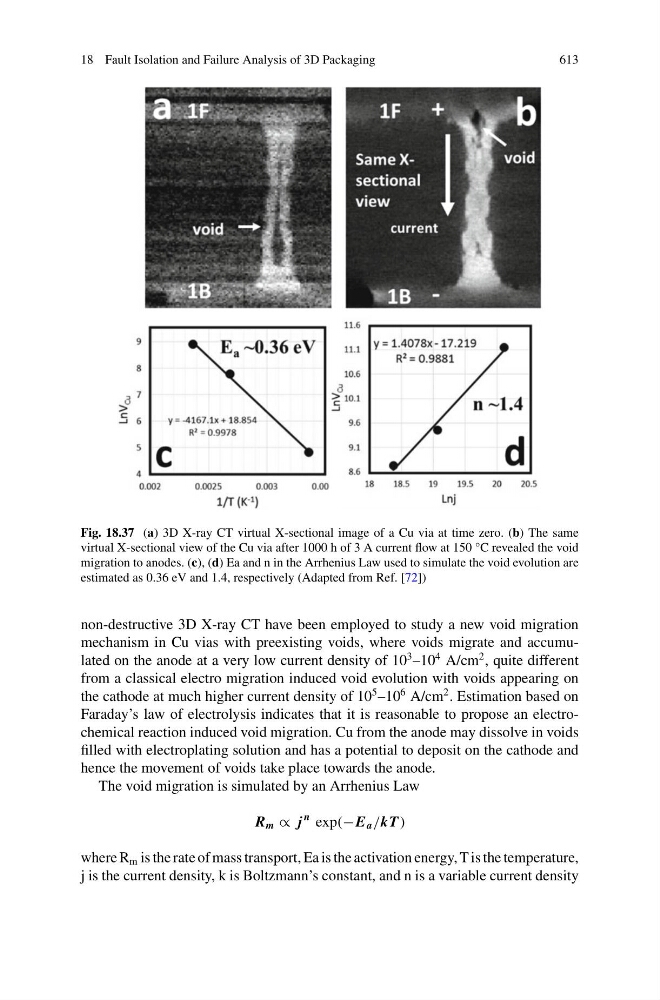
Fig. 18.37 (a) 3D X-ray CT virtual X-sectional image of a Cu via at time zero. (b) The same
virtual X-sectional view of the Cu via after 1000 h of 3 A current flow at 150 °C revealed the void
migration to anodes. (c), (d) Ea and n in the Arrhenius Law used to simulate the void evolution are
estimated as 0.36 eV and 1.4, respectively (Adapted from Ref. [72])
non-destructive 3D X-ray CT have been employed to study a new void migration
mechanism in Cu vias with preexisting voids, where voids migrate and accumulated on the anode at a very low current density of 10
3 –10
4 A/cm
2 , quite different
from a classical electro migration induced void evolution with voids appearing on
the cathode at much higher current density of 10
5 –10
6 A/cm
2 . Estimation based on
Faraday’s law of electrolysis indicates that it is reasonable to propose an electrochemical reaction induced void migration. Cu from the anode may dissolve in voids
filled with electroplating solution and has a potential to deposit on the cathode and
hence the movement of voids take place towards the anode.
The void migration is simulated by an Arrhenius Law
R m ∝ j
n exp(−E a /kT )
where R m is the rate of mass transport, Ea is the activation energy, T is the temperature,
j is the current density, k is Boltzmann’s constant, and n is a variable current density