

610
Y. Li and D. Goyal
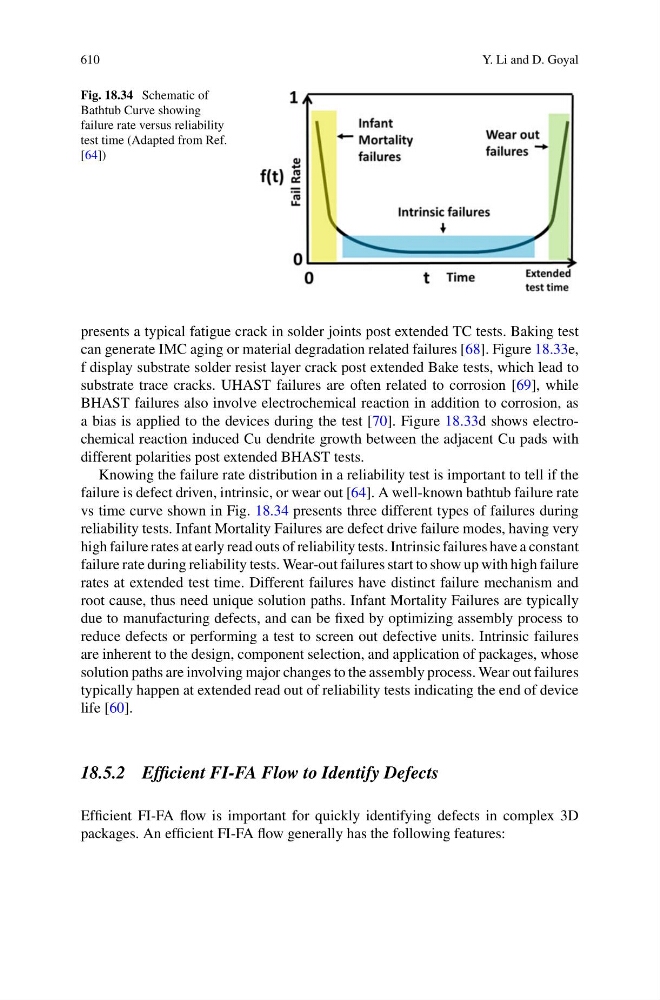
Fig. 18.34 Schematic of
Bathtub Curve showing
failure rate versus reliability
test time (Adapted from Ref.
[64])
presents a typical fatigue crack in solder joints post extended TC tests. Baking test
can generate IMC aging or material degradation related failures [68]. Figure 18.33e,
f display substrate solder resist layer crack post extended Bake tests, which lead to
substrate trace cracks. UHAST failures are often related to corrosion [69], while
BHAST failures also involve electrochemical reaction in addition to corrosion, as
a bias is applied to the devices during the test [70]. Figure 18.33d shows electrochemical reaction induced Cu dendrite growth between the adjacent Cu pads with
different polarities post extended BHAST tests.
Knowing the failure rate distribution in a reliability test is important to tell if the
failure is defect driven, intrinsic, or wear out [64]. A well-known bathtub failure rate
vs time curve shown in Fig. 18.34 presents three different types of failures during
reliability tests. Infant Mortality Failures are defect drive failure modes, having very
high failure rates at early read outs of reliability tests. Intrinsic failures have a constant
failure rate during reliability tests. Wear-out failures start to show up with high failure
rates at extended test time. Different failures have distinct failure mechanism and
root cause, thus need unique solution paths. Infant Mortality Failures are typically
due to manufacturing defects, and can be fixed by optimizing assembly process to
reduce defects or performing a test to screen out defective units. Intrinsic failures
are inherent to the design, component selection, and application of packages, whose
solution paths are involving major changes to the assembly process. Wear out failures
typically happen at extended read out of reliability tests indicating the end of device
life [60].
18.5.2 Efficient FI-FA Flow to Identify Defects
Efficient FI-FA flow is important for quickly identifying defects in complex 3D
packages. An efficient FI-FA flow generally has the following features: