

18 Fault Isolation and Failure Analysis of 3D Packaging
605
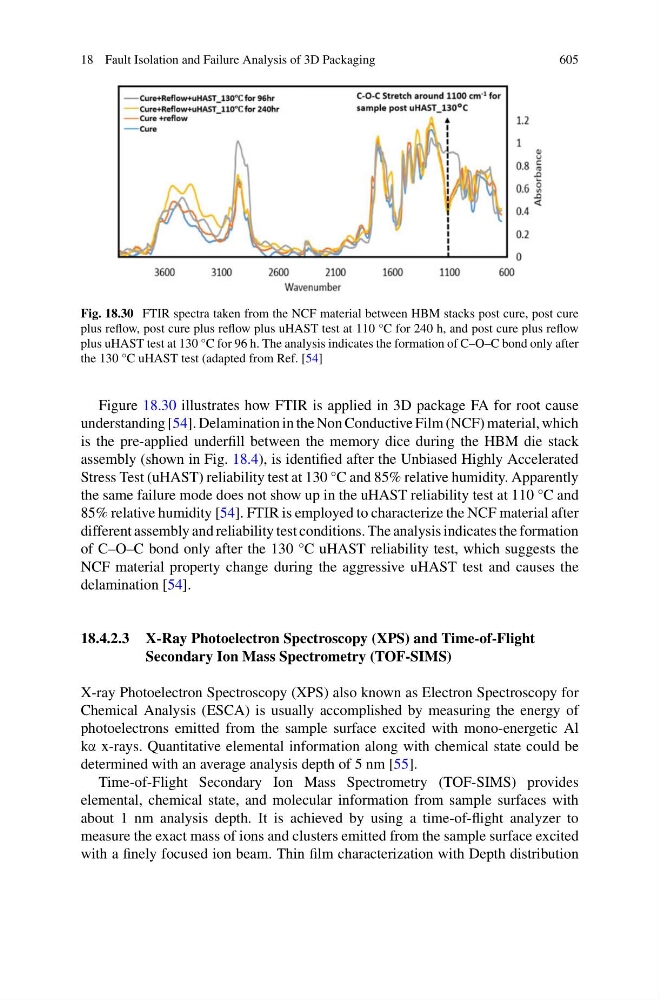
Fig. 18.30 FTIR spectra taken from the NCF material between HBM stacks post cure, post cure
plus reflow, post cure plus reflow plus uHAST test at 110 °C for 240 h, and post cure plus reflow
plus uHAST test at 130 °C for 96 h. The analysis indicates the formation of C–O–C bond only after
the 130 °C uHAST test (adapted from Ref. [54]
Figure 18.30 illustrates how FTIR is applied in 3D package FA for root cause
understanding [54]. Delamination in the Non Conductive Film (NCF) material, which
is the pre-applied underfill between the memory dice during the HBM die stack
assembly (shown in Fig. 18.4), is identified after the Unbiased Highly Accelerated
Stress Test (uHAST) reliability test at 130 °C and 85% relative humidity. Apparently
the same failure mode does not show up in the uHAST reliability test at 110 °C and
85% relative humidity [54]. FTIR is employed to characterize the NCF material after
different assembly and reliability test conditions. The analysis indicates the formation
of C–O–C bond only after the 130 °C uHAST reliability test, which suggests the
NCF material property change during the aggressive uHAST test and causes the
delamination [54].
18.4.2.3 X-Ray Photoelectron Spectroscopy (XPS) and Time-of-Flight
Secondary Ion Mass Spectrometry (TOF-SIMS)
X-ray Photoelectron Spectroscopy (XPS) also known as Electron Spectroscopy for
Chemical Analysis (ESCA) is usually accomplished by measuring the energy of
photoelectrons emitted from the sample surface excited with mono-energetic Al
kα x-rays. Quantitative elemental information along with chemical state could be
determined with an average analysis depth of 5 nm [55].
Time-of-Flight Secondary Ion Mass Spectrometry (TOF-SIMS) provides
elemental, chemical state, and molecular information from sample surfaces with
about 1 nm analysis depth. It is achieved by using a time-of-flight analyzer to
measure the exact mass of ions and clusters emitted from the sample surface excited
with a finely focused ion beam. Thin film characterization with Depth distribution