

604
Y. Li and D. Goyal
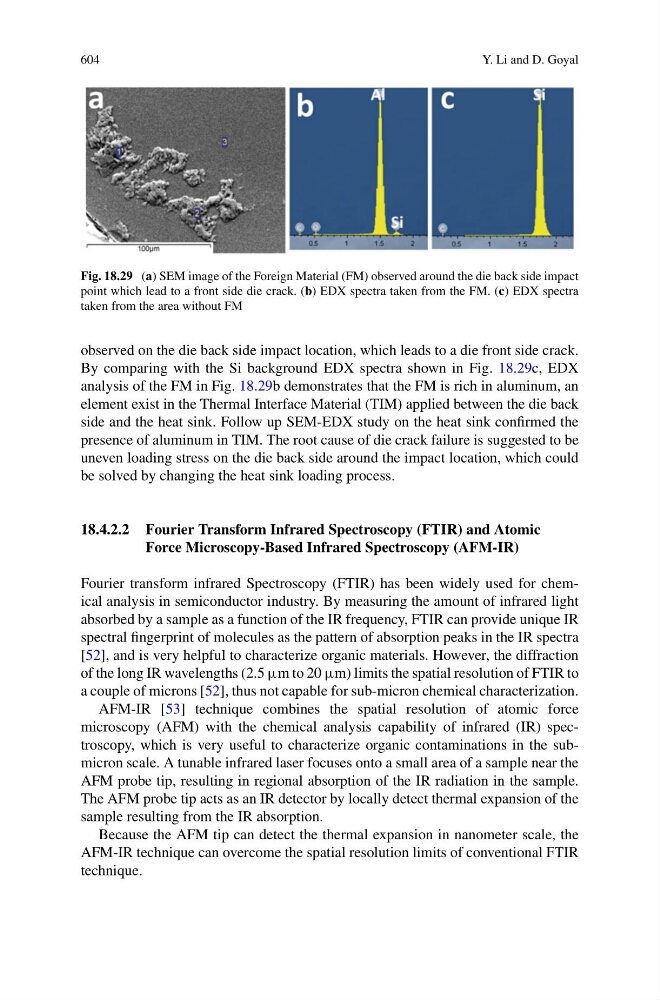
Fig. 18.29 (a) SEM image of the Foreign Material (FM) observed around the die back side impact
point which lead to a front side die crack. (b) EDX spectra taken from the FM. (c) EDX spectra
taken from the area without FM
observed on the die back side impact location, which leads to a die front side crack.
By comparing with the Si background EDX spectra shown in Fig. 18.29c, EDX
analysis of the FM in Fig. 18.29b demonstrates that the FM is rich in aluminum, an
element exist in the Thermal Interface Material (TIM) applied between the die back
side and the heat sink. Follow up SEM-EDX study on the heat sink confirmed the
presence of aluminum in TIM. The root cause of die crack failure is suggested to be
uneven loading stress on the die back side around the impact location, which could
be solved by changing the heat sink loading process.
18.4.2.2 Fourier Transform Infrared Spectroscopy (FTIR) and Atomic
Force Microscopy-Based Infrared Spectroscopy (AFM-IR)
Fourier transform infrared Spectroscopy (FTIR) has been widely used for chemical analysis in semiconductor industry. By measuring the amount of infrared light
absorbed by a sample as a function of the IR frequency, FTIR can provide unique IR
spectral fingerprint of molecules as the pattern of absorption peaks in the IR spectra
[52], and is very helpful to characterize organic materials. However, the diffraction
of the long IR wavelengths (2.5 μm to 20 μm) limits the spatial resolution of FTIR to
a couple of microns [52], thus not capable for sub-micron chemical characterization.
AFM-IR [53] technique combines the spatial resolution of atomic force
microscopy (AFM) with the chemical analysis capability of infrared (IR) spectroscopy, which is very useful to characterize organic contaminations in the submicron scale. A tunable infrared laser focuses onto a small area of a sample near the
AFM probe tip, resulting in regional absorption of the IR radiation in the sample.
The AFM probe tip acts as an IR detector by locally detect thermal expansion of the
sample resulting from the IR absorption.
Because the AFM tip can detect the thermal expansion in nanometer scale, the
AFM-IR technique can overcome the spatial resolution limits of conventional FTIR
technique.