

566
Y. Wang et al.
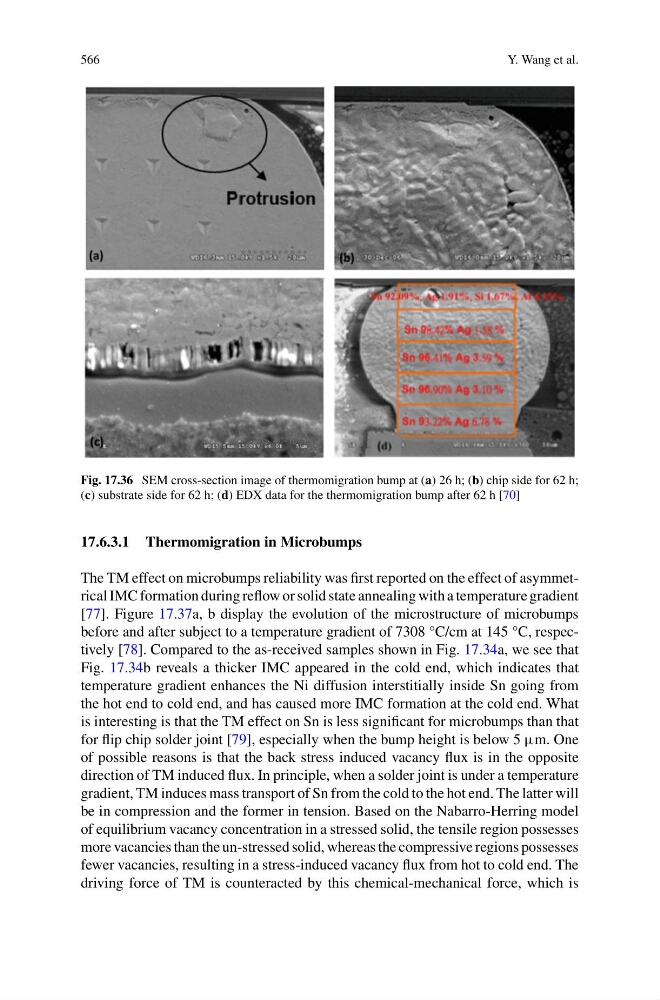
Fig. 17.36 SEM cross-section image of thermomigration bump at (a) 26 h; (b) chip side for 62 h;
(c) substrate side for 62 h; (d) EDX data for the thermomigration bump after 62 h [70]
17.6.3.1 Thermomigration in Microbumps
The TM effect on microbumps reliability was first reported on the effect of asymmetrical IMC formation during reflow or solid state annealing with a temperature gradient
[77]. Figure 17.37a, b display the evolution of the microstructure of microbumps
before and after subject to a temperature gradient of 7308 °C/cm at 145 °C, respectively [78]. Compared to the as-received samples shown in Fig. 17.34a, we see that
Fig. 17.34b reveals a thicker IMC appeared in the cold end, which indicates that
temperature gradient enhances the Ni diffusion interstitially inside Sn going from
the hot end to cold end, and has caused more IMC formation at the cold end. What
is interesting is that the TM effect on Sn is less significant for microbumps than that
for flip chip solder joint [79], especially when the bump height is below 5 μm. One
of possible reasons is that the back stress induced vacancy flux is in the opposite
direction of TM induced flux. In principle, when a solder joint is under a temperature
gradient, TM induces mass transport of Sn from the cold to the hot end. The latter will
be in compression and the former in tension. Based on the Nabarro-Herring model
of equilibrium vacancy concentration in a stressed solid, the tensile region possesses
more vacancies than the un-stressed solid, whereas the compressive regions possesses
fewer vacancies, resulting in a stress-induced vacancy flux from hot to cold end. The
driving force of TM is counteracted by this chemical-mechanical force, which is
Y. Wang et al.
Fig. 17.36 SEM cross-section image of thermomigration bump at (a) 26 h; (b) chip side for 62 h;
(c) substrate side for 62 h; (d) EDX data for the thermomigration bump after 62 h [70]
17.6.3.1 Thermomigration in Microbumps
The TM effect on microbumps reliability was first reported on the effect of asymmetrical IMC formation during reflow or solid state annealing with a temperature gradient
[77]. Figure 17.37a, b display the evolution of the microstructure of microbumps
before and after subject to a temperature gradient of 7308 °C/cm at 145 °C, respectively [78]. Compared to the as-received samples shown in Fig. 17.34a, we see that
Fig. 17.34b reveals a thicker IMC appeared in the cold end, which indicates that
temperature gradient enhances the Ni diffusion interstitially inside Sn going from
the hot end to cold end, and has caused more IMC formation at the cold end. What
is interesting is that the TM effect on Sn is less significant for microbumps than that
for flip chip solder joint [79], especially when the bump height is below 5 μm. One
of possible reasons is that the back stress induced vacancy flux is in the opposite
direction of TM induced flux. In principle, when a solder joint is under a temperature
gradient, TM induces mass transport of Sn from the cold to the hot end. The latter will
be in compression and the former in tension. Based on the Nabarro-Herring model
of equilibrium vacancy concentration in a stressed solid, the tensile region possesses
more vacancies than the un-stressed solid, whereas the compressive regions possesses
fewer vacancies, resulting in a stress-induced vacancy flux from hot to cold end. The
driving force of TM is counteracted by this chemical-mechanical force, which is