

2 3D Packaging Architectures and Assembly Process Design
37
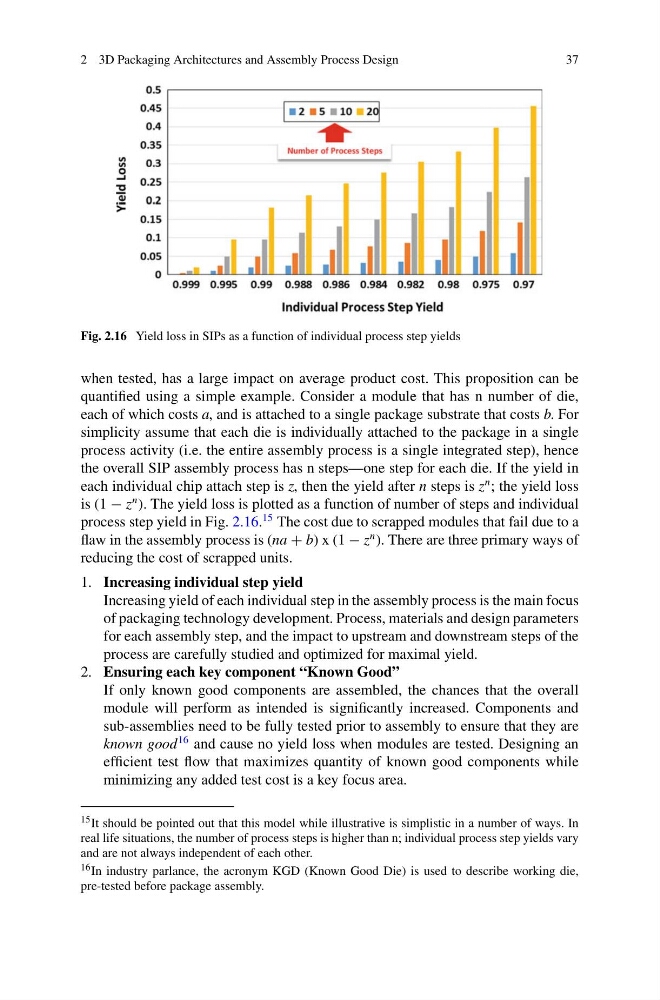
Fig. 2.16 Yield loss in SIPs as a function of individual process step yields
when tested, has a large impact on average product cost. This proposition can be
quantified using a simple example. Consider a module that has n number of die,
each of which costs a, and is attached to a single package substrate that costs b. For
simplicity assume that each die is individually attached to the package in a single
process activity (i.e. the entire assembly process is a single integrated step), hence
the overall SIP assembly process has n steps—one step for each die. If the yield in
each individual chip attach step is z, then the yield after n steps is z
n ; the yield loss
is (1 − z
n ). The yield loss is plotted as a function of number of steps and individual
process step yield in Fig. 2.16.
15 The cost due to scrapped modules that fail due to a
flaw in the assembly process is (na + b) x (1 − z
n ). There are three primary ways of
reducing the cost of scrapped units.
1. Increasing individual step yield
Increasing yield of each individual step in the assembly process is the main focus
of packaging technology development. Process, materials and design parameters
for each assembly step, and the impact to upstream and downstream steps of the
process are carefully studied and optimized for maximal yield.
2. Ensuring each key component “Known Good”
If only known good components are assembled, the chances that the overall
module will perform as intended is significantly increased. Components and
sub-assemblies need to be fully tested prior to assembly to ensure that they are
known good
16 and cause no yield loss when modules are tested. Designing an
efficient test flow that maximizes quantity of known good components while
minimizing any added test cost is a key focus area.
15 It should be pointed out that this model while illustrative is simplistic in a number of ways. In
real life situations, the number of process steps is higher than n; individual process step yields vary
and are not always independent of each other.
16 In industry parlance, the acronym KGD (Known Good Die) is used to describe working die,
pre-tested before package assembly.
37
Fig. 2.16 Yield loss in SIPs as a function of individual process step yields
when tested, has a large impact on average product cost. This proposition can be
quantified using a simple example. Consider a module that has n number of die,
each of which costs a, and is attached to a single package substrate that costs b. For
simplicity assume that each die is individually attached to the package in a single
process activity (i.e. the entire assembly process is a single integrated step), hence
the overall SIP assembly process has n steps—one step for each die. If the yield in
each individual chip attach step is z, then the yield after n steps is z
n ; the yield loss
is (1 − z
n ). The yield loss is plotted as a function of number of steps and individual
process step yield in Fig. 2.16.
15 The cost due to scrapped modules that fail due to a
flaw in the assembly process is (na + b) x (1 − z
n ). There are three primary ways of
reducing the cost of scrapped units.
1. Increasing individual step yield
Increasing yield of each individual step in the assembly process is the main focus
of packaging technology development. Process, materials and design parameters
for each assembly step, and the impact to upstream and downstream steps of the
process are carefully studied and optimized for maximal yield.
2. Ensuring each key component “Known Good”
If only known good components are assembled, the chances that the overall
module will perform as intended is significantly increased. Components and
sub-assemblies need to be fully tested prior to assembly to ensure that they are
known good
16 and cause no yield loss when modules are tested. Designing an
efficient test flow that maximizes quantity of known good components while
minimizing any added test cost is a key focus area.
15 It should be pointed out that this model while illustrative is simplistic in a number of ways. In
real life situations, the number of process steps is higher than n; individual process step yields vary
and are not always independent of each other.
16 In industry parlance, the acronym KGD (Known Good Die) is used to describe working die,
pre-tested before package assembly.