

17 Interconnect Quality and Reliability of 3D Packaging
535
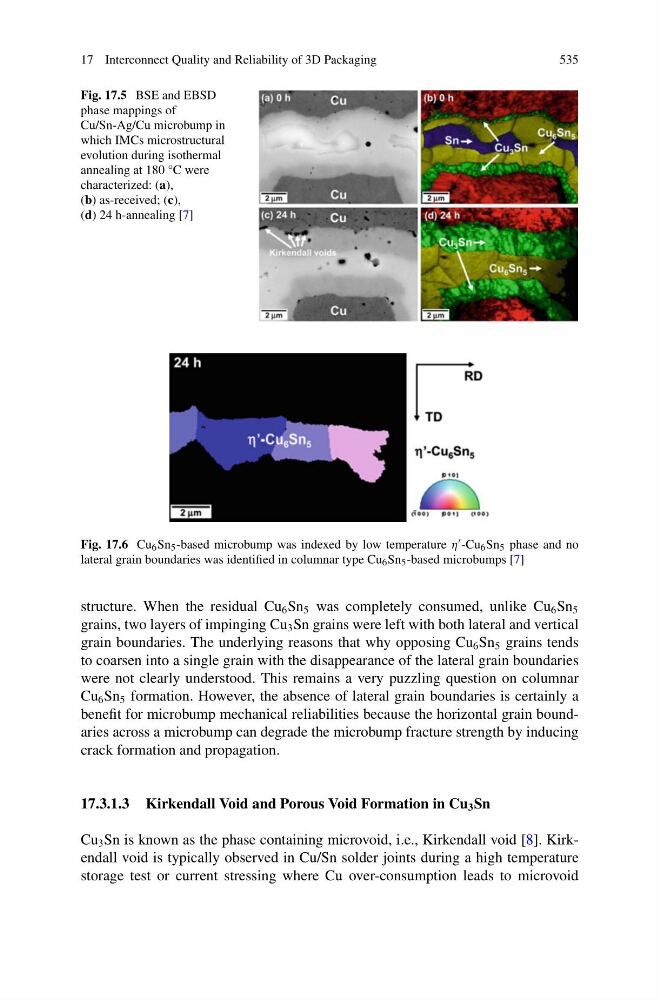
Fig. 17.5 BSE and EBSD
phase mappings of
Cu/Sn-Ag/Cu microbump in
which IMCs microstructural
evolution during isothermal
annealing at 180 °C were
characterized: (a),
(b) as-received; (c),
(d) 24 h-annealing [7]
Fig. 17.6 Cu 6 Sn 5 -based microbump was indexed by low temperature η -Cu 6 Sn 5 phase and no
lateral grain boundaries was identified in columnar type Cu 6 Sn 5 -based microbumps [7]
structure. When the residual Cu 6 Sn 5 was completely consumed, unlike Cu 6 Sn 5
grains, two layers of impinging Cu 3 Sn grains were left with both lateral and vertical
grain boundaries. The underlying reasons that why opposing Cu 6 Sn 5 grains tends
to coarsen into a single grain with the disappearance of the lateral grain boundaries
were not clearly understood. This remains a very puzzling question on columnar
Cu 6 Sn 5 formation. However, the absence of lateral grain boundaries is certainly a
benefit for microbump mechanical reliabilities because the horizontal grain boundaries across a microbump can degrade the microbump fracture strength by inducing
crack formation and propagation.
17.3.1.3 Kirkendall Void and Porous Void Formation in Cu 3 Sn
Cu 3 Sn is known as the phase containing microvoid, i.e., Kirkendall void [8]. Kirkendall void is typically observed in Cu/Sn solder joints during a high temperature
storage test or current stressing where Cu over-consumption leads to microvoid
535
Fig. 17.5 BSE and EBSD
phase mappings of
Cu/Sn-Ag/Cu microbump in
which IMCs microstructural
evolution during isothermal
annealing at 180 °C were
characterized: (a),
(b) as-received; (c),
(d) 24 h-annealing [7]
Fig. 17.6 Cu 6 Sn 5 -based microbump was indexed by low temperature η -Cu 6 Sn 5 phase and no
lateral grain boundaries was identified in columnar type Cu 6 Sn 5 -based microbumps [7]
structure. When the residual Cu 6 Sn 5 was completely consumed, unlike Cu 6 Sn 5
grains, two layers of impinging Cu 3 Sn grains were left with both lateral and vertical
grain boundaries. The underlying reasons that why opposing Cu 6 Sn 5 grains tends
to coarsen into a single grain with the disappearance of the lateral grain boundaries
were not clearly understood. This remains a very puzzling question on columnar
Cu 6 Sn 5 formation. However, the absence of lateral grain boundaries is certainly a
benefit for microbump mechanical reliabilities because the horizontal grain boundaries across a microbump can degrade the microbump fracture strength by inducing
crack formation and propagation.
17.3.1.3 Kirkendall Void and Porous Void Formation in Cu 3 Sn
Cu 3 Sn is known as the phase containing microvoid, i.e., Kirkendall void [8]. Kirkendall void is typically observed in Cu/Sn solder joints during a high temperature
storage test or current stressing where Cu over-consumption leads to microvoid