

516
P. Vianco and M. Neilsen
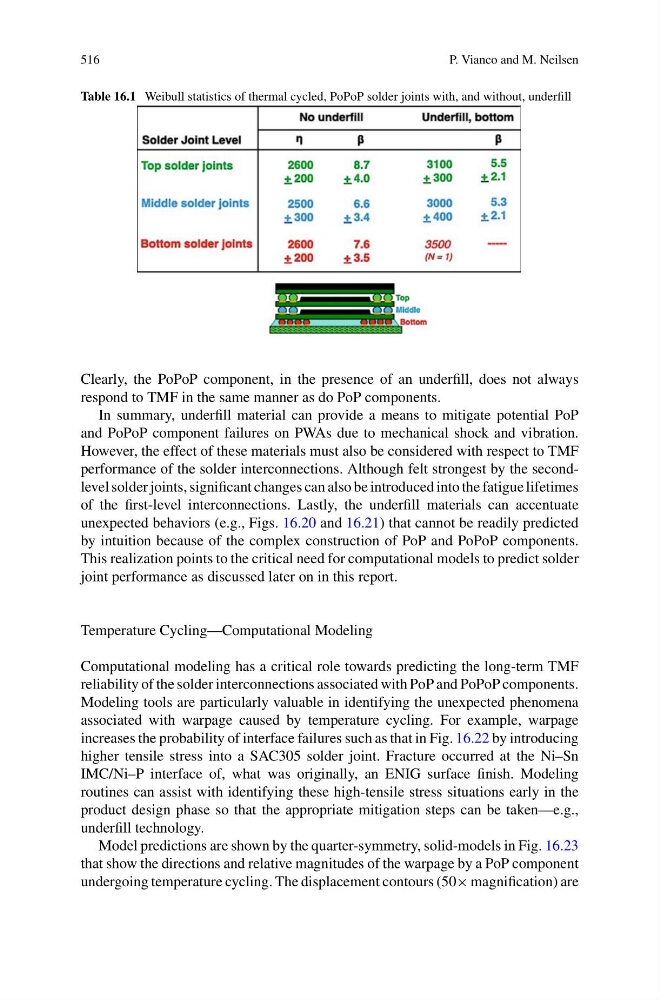
Table 16.1 Weibull statistics of thermal cycled, PoPoP solder joints with, and without, underfill
Clearly, the PoPoP component, in the presence of an underfill, does not always
respond to TMF in the same manner as do PoP components.
In summary, underfill material can provide a means to mitigate potential PoP
and PoPoP component failures on PWAs due to mechanical shock and vibration.
However, the effect of these materials must also be considered with respect to TMF
performance of the solder interconnections. Although felt strongest by the secondlevel solder joints, significant changes can also be introduced into the fatigue lifetimes
of the first-level interconnections. Lastly, the underfill materials can accentuate
unexpected behaviors (e.g., Figs. 16.20 and 16.21) that cannot be readily predicted
by intuition because of the complex construction of PoP and PoPoP components.
This realization points to the critical need for computational models to predict solder
joint performance as discussed later on in this report.
Temperature Cycling—Computational Modeling
Computational modeling has a critical role towards predicting the long-term TMF
reliability of the solder interconnections associated with PoP and PoPoP components.
Modeling tools are particularly valuable in identifying the unexpected phenomena
associated with warpage caused by temperature cycling. For example, warpage
increases the probability of interface failures such as that in Fig. 16.22 by introducing
higher tensile stress into a SAC305 solder joint. Fracture occurred at the Ni–Sn
IMC/Ni–P interface of, what was originally, an ENIG surface finish. Modeling
routines can assist with identifying these high-tensile stress situations early in the
product design phase so that the appropriate mitigation steps can be taken—e.g.,
underfill technology.
Model predictions are shown by the quarter-symmetry, solid-models in Fig. 16.23
that show the directions and relative magnitudes of the warpage by a PoP component
undergoing temperature cycling. The displacement contours (50× magnification) are
P. Vianco and M. Neilsen
Table 16.1 Weibull statistics of thermal cycled, PoPoP solder joints with, and without, underfill
Clearly, the PoPoP component, in the presence of an underfill, does not always
respond to TMF in the same manner as do PoP components.
In summary, underfill material can provide a means to mitigate potential PoP
and PoPoP component failures on PWAs due to mechanical shock and vibration.
However, the effect of these materials must also be considered with respect to TMF
performance of the solder interconnections. Although felt strongest by the secondlevel solder joints, significant changes can also be introduced into the fatigue lifetimes
of the first-level interconnections. Lastly, the underfill materials can accentuate
unexpected behaviors (e.g., Figs. 16.20 and 16.21) that cannot be readily predicted
by intuition because of the complex construction of PoP and PoPoP components.
This realization points to the critical need for computational models to predict solder
joint performance as discussed later on in this report.
Temperature Cycling—Computational Modeling
Computational modeling has a critical role towards predicting the long-term TMF
reliability of the solder interconnections associated with PoP and PoPoP components.
Modeling tools are particularly valuable in identifying the unexpected phenomena
associated with warpage caused by temperature cycling. For example, warpage
increases the probability of interface failures such as that in Fig. 16.22 by introducing
higher tensile stress into a SAC305 solder joint. Fracture occurred at the Ni–Sn
IMC/Ni–P interface of, what was originally, an ENIG surface finish. Modeling
routines can assist with identifying these high-tensile stress situations early in the
product design phase so that the appropriate mitigation steps can be taken—e.g.,
underfill technology.
Model predictions are shown by the quarter-symmetry, solid-models in Fig. 16.23
that show the directions and relative magnitudes of the warpage by a PoP component
undergoing temperature cycling. The displacement contours (50× magnification) are