

16 Processing and Reliability of Solder Interconnections …
513
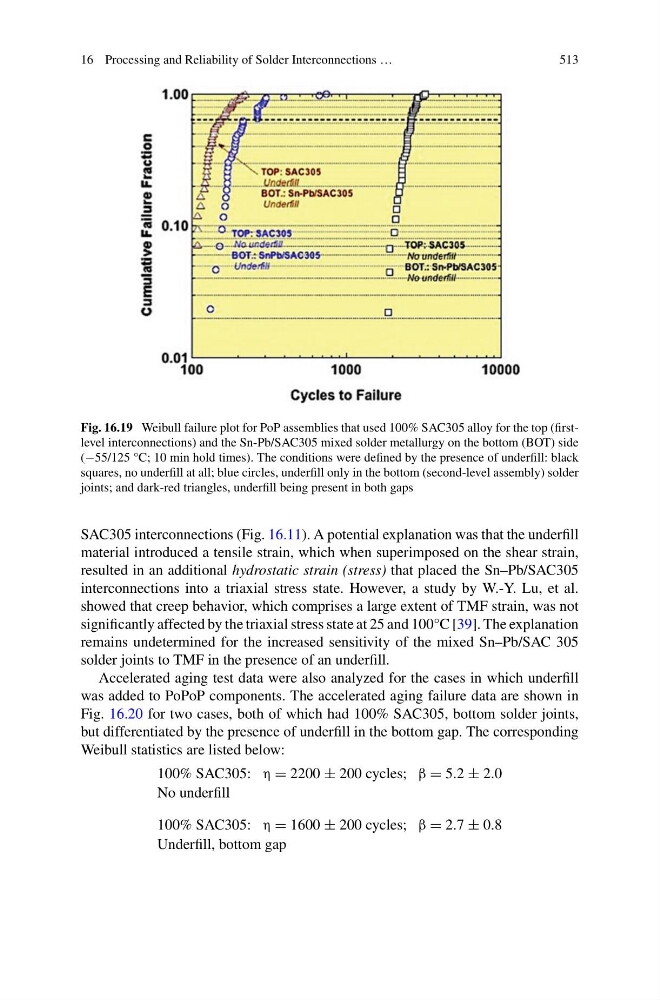
Fig. 16.19 Weibull failure plot for PoP assemblies that used 100% SAC305 alloy for the top (firstlevel interconnections) and the Sn-Pb/SAC305 mixed solder metallurgy on the bottom (BOT) side
(−55/125 °C; 10 min hold times). The conditions were defined by the presence of underfill: black
squares, no underfill at all; blue circles, underfill only in the bottom (second-level assembly) solder
joints; and dark-red triangles, underfill being present in both gaps
SAC305 interconnections (Fig. 16.11). A potential explanation was that the underfill
material introduced a tensile strain, which when superimposed on the shear strain,
resulted in an additional hydrostatic strain (stress) that placed the Sn–Pb/SAC305
interconnections into a triaxial stress state. However, a study by W.-Y. Lu, et al.
showed that creep behavior, which comprises a large extent of TMF strain, was not
significantly affected by the triaxial stress state at 25 and 100°C [39]. The explanation
remains undetermined for the increased sensitivity of the mixed Sn–Pb/SAC 305
solder joints to TMF in the presence of an underfill.
Accelerated aging test data were also analyzed for the cases in which underfill
was added to PoPoP components. The accelerated aging failure data are shown in
Fig. 16.20 for two cases, both of which had 100% SAC305, bottom solder joints,
but differentiated by the presence of underfill in the bottom gap. The corresponding
Weibull statistics are listed below:
100% SAC305: η = 2200 ± 200 cycles; β = 5.2 ± 2.0
No underfill
100% SAC305: η = 1600 ± 200 cycles; β = 2.7 ± 0.8
Underfill, bottom gap
513
Fig. 16.19 Weibull failure plot for PoP assemblies that used 100% SAC305 alloy for the top (firstlevel interconnections) and the Sn-Pb/SAC305 mixed solder metallurgy on the bottom (BOT) side
(−55/125 °C; 10 min hold times). The conditions were defined by the presence of underfill: black
squares, no underfill at all; blue circles, underfill only in the bottom (second-level assembly) solder
joints; and dark-red triangles, underfill being present in both gaps
SAC305 interconnections (Fig. 16.11). A potential explanation was that the underfill
material introduced a tensile strain, which when superimposed on the shear strain,
resulted in an additional hydrostatic strain (stress) that placed the Sn–Pb/SAC305
interconnections into a triaxial stress state. However, a study by W.-Y. Lu, et al.
showed that creep behavior, which comprises a large extent of TMF strain, was not
significantly affected by the triaxial stress state at 25 and 100°C [39]. The explanation
remains undetermined for the increased sensitivity of the mixed Sn–Pb/SAC 305
solder joints to TMF in the presence of an underfill.
Accelerated aging test data were also analyzed for the cases in which underfill
was added to PoPoP components. The accelerated aging failure data are shown in
Fig. 16.20 for two cases, both of which had 100% SAC305, bottom solder joints,
but differentiated by the presence of underfill in the bottom gap. The corresponding
Weibull statistics are listed below:
100% SAC305: η = 2200 ± 200 cycles; β = 5.2 ± 2.0
No underfill
100% SAC305: η = 1600 ± 200 cycles; β = 2.7 ± 0.8
Underfill, bottom gap