

512
P. Vianco and M. Neilsen
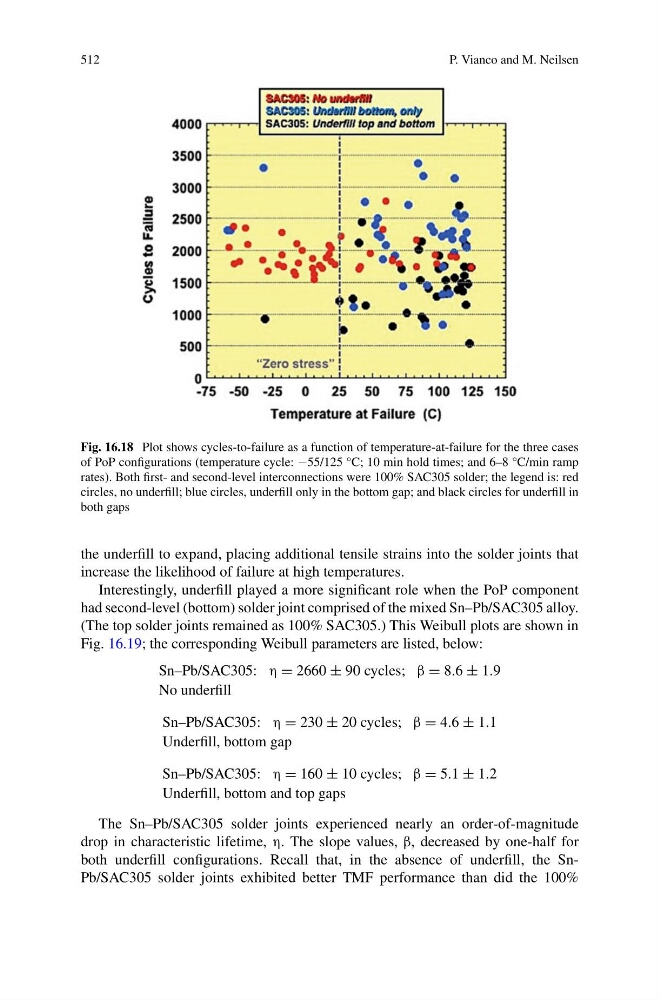
Fig. 16.18 Plot shows cycles-to-failure as a function of temperature-at-failure for the three cases
of PoP configurations (temperature cycle: −55/125 °C; 10 min hold times; and 6–8 °C/min ramp
rates). Both first- and second-level interconnections were 100% SAC305 solder; the legend is: red
circles, no underfill; blue circles, underfill only in the bottom gap; and black circles for underfill in
both gaps
the underfill to expand, placing additional tensile strains into the solder joints that
increase the likelihood of failure at high temperatures.
Interestingly, underfill played a more significant role when the PoP component
had second-level (bottom) solder joint comprised of the mixed Sn–Pb/SAC305 alloy.
(The top solder joints remained as 100% SAC305.) This Weibull plots are shown in
Fig. 16.19; the corresponding Weibull parameters are listed, below:
Sn–Pb/SAC305: η = 2660 ± 90 cycles; β = 8.6 ± 1.9
No underfill
Sn–Pb/SAC305: η = 230 ± 20 cycles; β = 4.6 ± 1.1
Underfill, bottom gap
Sn–Pb/SAC305: η = 160 ± 10 cycles; β = 5.1 ± 1.2
Underfill, bottom and top gaps
The Sn–Pb/SAC305 solder joints experienced nearly an order-of-magnitude
drop in characteristic lifetime, η. The slope values, β, decreased by one-half for
both underfill configurations. Recall that, in the absence of underfill, the SnPb/SAC305 solder joints exhibited better TMF performance than did the 100%
P. Vianco and M. Neilsen
Fig. 16.18 Plot shows cycles-to-failure as a function of temperature-at-failure for the three cases
of PoP configurations (temperature cycle: −55/125 °C; 10 min hold times; and 6–8 °C/min ramp
rates). Both first- and second-level interconnections were 100% SAC305 solder; the legend is: red
circles, no underfill; blue circles, underfill only in the bottom gap; and black circles for underfill in
both gaps
the underfill to expand, placing additional tensile strains into the solder joints that
increase the likelihood of failure at high temperatures.
Interestingly, underfill played a more significant role when the PoP component
had second-level (bottom) solder joint comprised of the mixed Sn–Pb/SAC305 alloy.
(The top solder joints remained as 100% SAC305.) This Weibull plots are shown in
Fig. 16.19; the corresponding Weibull parameters are listed, below:
Sn–Pb/SAC305: η = 2660 ± 90 cycles; β = 8.6 ± 1.9
No underfill
Sn–Pb/SAC305: η = 230 ± 20 cycles; β = 4.6 ± 1.1
Underfill, bottom gap
Sn–Pb/SAC305: η = 160 ± 10 cycles; β = 5.1 ± 1.2
Underfill, bottom and top gaps
The Sn–Pb/SAC305 solder joints experienced nearly an order-of-magnitude
drop in characteristic lifetime, η. The slope values, β, decreased by one-half for
both underfill configurations. Recall that, in the absence of underfill, the SnPb/SAC305 solder joints exhibited better TMF performance than did the 100%