

15 Die and Package Level Thermal and Thermal/Moisture Stresses …
457
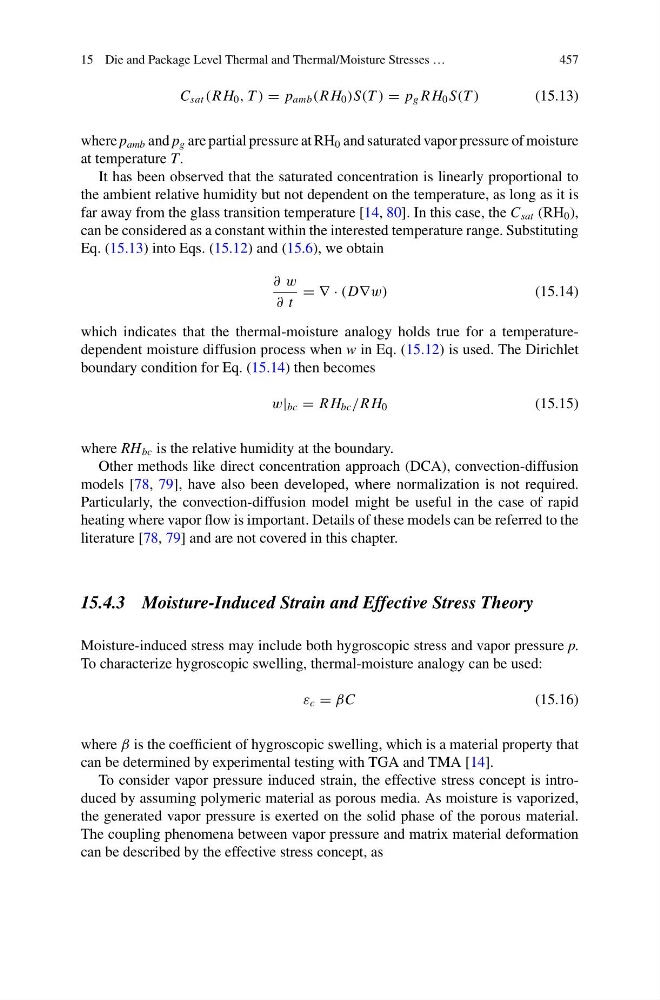
C sat (R H 0 , T ) = p amb (R H 0 )S(T ) = p g R H 0 S(T )
(15.13)
where p amb and p g are partial pressure at RH 0 and saturated vapor pressure of moisture
at temperature T.
It has been observed that the saturated concentration is linearly proportional to
the ambient relative humidity but not dependent on the temperature, as long as it is
far away from the glass transition temperature [14, 80]. In this case, the C sat (RH 0 ),
can be considered as a constant within the interested temperature range. Substituting
Eq. (15.13) into Eqs. (15.12) and (15.6), we obtain
∂ w
∂ t
= ∇ · (D∇w)
(15.14)
which indicates that the thermal-moisture analogy holds true for a temperaturedependent moisture diffusion process when w in Eq. (15.12) is used. The Dirichlet
boundary condition for Eq. (15.14) then becomes
w| bc = R H bc /R H 0
(15.15)
where RH bc is the relative humidity at the boundary.
Other methods like direct concentration approach (DCA), convection-diffusion
models [78, 79], have also been developed, where normalization is not required.
Particularly, the convection-diffusion model might be useful in the case of rapid
heating where vapor flow is important. Details of these models can be referred to the
literature [78, 79] and are not covered in this chapter.
15.4.3 Moisture-Induced Strain and Effective Stress Theory
Moisture-induced stress may include both hygroscopic stress and vapor pressure p.
To characterize hygroscopic swelling, thermal-moisture analogy can be used:
ε c = βC
(15.16)
where β is the coefficient of hygroscopic swelling, which is a material property that
can be determined by experimental testing with TGA and TMA [14].
To consider vapor pressure induced strain, the effective stress concept is introduced by assuming polymeric material as porous media. As moisture is vaporized,
the generated vapor pressure is exerted on the solid phase of the porous material.
The coupling phenomena between vapor pressure and matrix material deformation
can be described by the effective stress concept, as
457
C sat (R H 0 , T ) = p amb (R H 0 )S(T ) = p g R H 0 S(T )
(15.13)
where p amb and p g are partial pressure at RH 0 and saturated vapor pressure of moisture
at temperature T.
It has been observed that the saturated concentration is linearly proportional to
the ambient relative humidity but not dependent on the temperature, as long as it is
far away from the glass transition temperature [14, 80]. In this case, the C sat (RH 0 ),
can be considered as a constant within the interested temperature range. Substituting
Eq. (15.13) into Eqs. (15.12) and (15.6), we obtain
∂ w
∂ t
= ∇ · (D∇w)
(15.14)
which indicates that the thermal-moisture analogy holds true for a temperaturedependent moisture diffusion process when w in Eq. (15.12) is used. The Dirichlet
boundary condition for Eq. (15.14) then becomes
w| bc = R H bc /R H 0
(15.15)
where RH bc is the relative humidity at the boundary.
Other methods like direct concentration approach (DCA), convection-diffusion
models [78, 79], have also been developed, where normalization is not required.
Particularly, the convection-diffusion model might be useful in the case of rapid
heating where vapor flow is important. Details of these models can be referred to the
literature [78, 79] and are not covered in this chapter.
15.4.3 Moisture-Induced Strain and Effective Stress Theory
Moisture-induced stress may include both hygroscopic stress and vapor pressure p.
To characterize hygroscopic swelling, thermal-moisture analogy can be used:
ε c = βC
(15.16)
where β is the coefficient of hygroscopic swelling, which is a material property that
can be determined by experimental testing with TGA and TMA [14].
To consider vapor pressure induced strain, the effective stress concept is introduced by assuming polymeric material as porous media. As moisture is vaporized,
the generated vapor pressure is exerted on the solid phase of the porous material.
The coupling phenomena between vapor pressure and matrix material deformation
can be described by the effective stress concept, as