

458
L. Chen et al.
σ i j = σ
kk − pδ i j
(15.17)
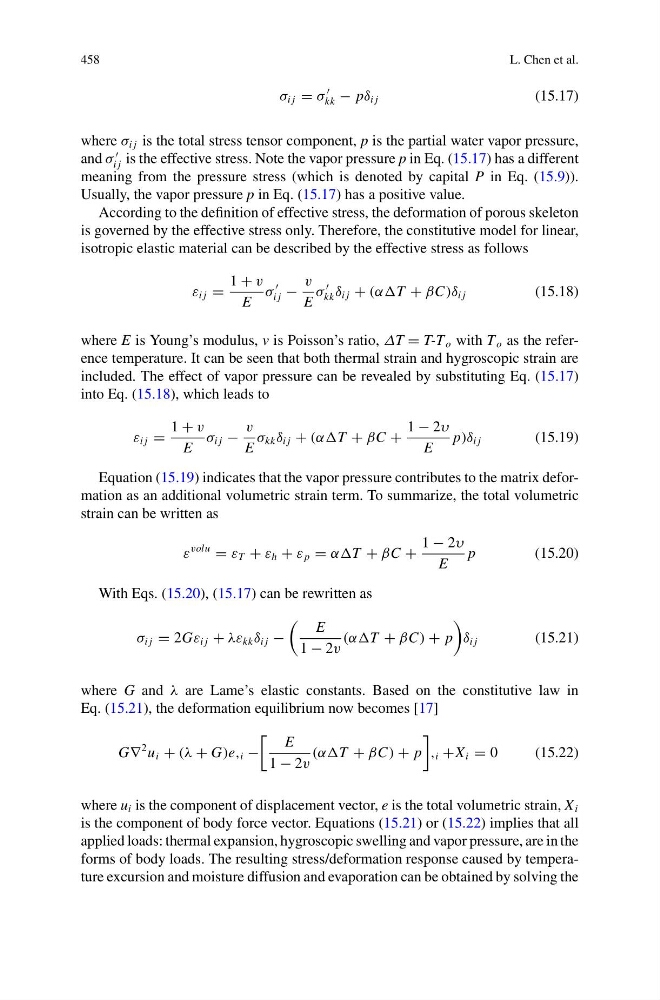
where σ i j is the total stress tensor component, p is the partial water vapor pressure,
and σ
i j is the effective stress. Note the vapor pressure p in Eq. (15.17) has a different
meaning from the pressure stress (which is denoted by capital P in Eq. (15.9)).
Usually, the vapor pressure p in Eq. (15.17) has a positive value.
According to the definition of effective stress, the deformation of porous skeleton
is governed by the effective stress only. Therefore, the constitutive model for linear,
isotropic elastic material can be described by the effective stress as follows
ε i j =
1 + v
E
σ
i j −
v
E
σ
kk δ i j + (ααT + βC)δ i j
(15.18)
where E is Young’s modulus, v is Poisson’s ratio, ΔT = T-T o with T o as the reference temperature. It can be seen that both thermal strain and hygroscopic strain are
included. The effect of vapor pressure can be revealed by substituting Eq. (15.17)
into Eq. (15.18), which leads to
ε i j =
1 + v
E
σ i j −
v
E
σ kk δ i j + (ααT + βC +
1 − 2υ
E
p)δ i j
(15.19)
Equation (15.19) indicates that the vapor pressure contributes to the matrix deformation as an additional volumetric strain term. To summarize, the total volumetric
strain can be written as
ε
volu
= ε T + ε h + ε p = ααT + βC +
1 − 2υ
E
p
(15.20)
With Eqs. (15.20), (15.17) can be rewritten as
σ i j = 2Gε i j + λε kk δ i j −
E
1 − 2v
(ααT + βC) + p
δ i j
(15.21)
where G and λ are Lame’s elastic constants. Based on the constitutive law in
Eq. (15.21), the deformation equilibrium now becomes [17]
G∇
2 u i + (λ + G)e, i −
E
1 − 2v
(ααT + βC) + p
, i +X i = 0
(15.22)
where u i is the component of displacement vector, e is the total volumetric strain, X i
is the component of body force vector. Equations (15.21) or (15.22) implies that all
applied loads: thermal expansion, hygroscopic swelling and vapor pressure, are in the
forms of body loads. The resulting stress/deformation response caused by temperature excursion and moisture diffusion and evaporation can be obtained by solving the
L. Chen et al.
σ i j = σ
kk − pδ i j
(15.17)
where σ i j is the total stress tensor component, p is the partial water vapor pressure,
and σ
i j is the effective stress. Note the vapor pressure p in Eq. (15.17) has a different
meaning from the pressure stress (which is denoted by capital P in Eq. (15.9)).
Usually, the vapor pressure p in Eq. (15.17) has a positive value.
According to the definition of effective stress, the deformation of porous skeleton
is governed by the effective stress only. Therefore, the constitutive model for linear,
isotropic elastic material can be described by the effective stress as follows
ε i j =
1 + v
E
σ
i j −
v
E
σ
kk δ i j + (ααT + βC)δ i j
(15.18)
where E is Young’s modulus, v is Poisson’s ratio, ΔT = T-T o with T o as the reference temperature. It can be seen that both thermal strain and hygroscopic strain are
included. The effect of vapor pressure can be revealed by substituting Eq. (15.17)
into Eq. (15.18), which leads to
ε i j =
1 + v
E
σ i j −
v
E
σ kk δ i j + (ααT + βC +
1 − 2υ
E
p)δ i j
(15.19)
Equation (15.19) indicates that the vapor pressure contributes to the matrix deformation as an additional volumetric strain term. To summarize, the total volumetric
strain can be written as
ε
volu
= ε T + ε h + ε p = ααT + βC +
1 − 2υ
E
p
(15.20)
With Eqs. (15.20), (15.17) can be rewritten as
σ i j = 2Gε i j + λε kk δ i j −
E
1 − 2v
(ααT + βC) + p
δ i j
(15.21)
where G and λ are Lame’s elastic constants. Based on the constitutive law in
Eq. (15.21), the deformation equilibrium now becomes [17]
G∇
2 u i + (λ + G)e, i −
E
1 − 2v
(ααT + βC) + p
, i +X i = 0
(15.22)
where u i is the component of displacement vector, e is the total volumetric strain, X i
is the component of body force vector. Equations (15.21) or (15.22) implies that all
applied loads: thermal expansion, hygroscopic swelling and vapor pressure, are in the
forms of body loads. The resulting stress/deformation response caused by temperature excursion and moisture diffusion and evaporation can be obtained by solving the