

456
L. Chen et al.
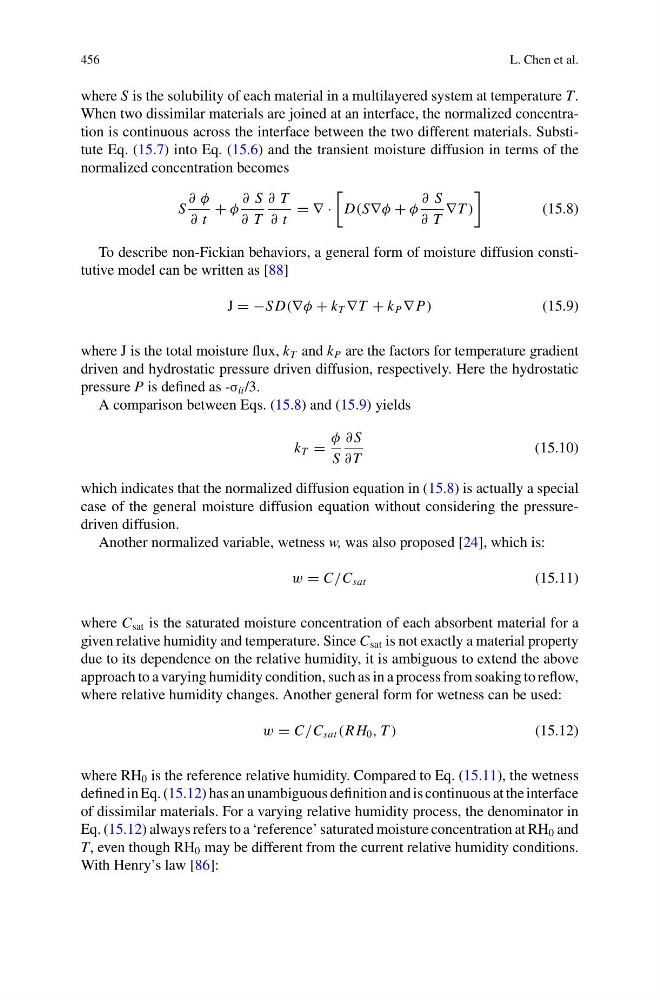
where S is the solubility of each material in a multilayered system at temperature T.
When two dissimilar materials are joined at an interface, the normalized concentration is continuous across the interface between the two different materials. Substitute Eq. (15.7) into Eq. (15.6) and the transient moisture diffusion in terms of the
normalized concentration becomes
S
∂ φ
∂ t
+ φ
∂ S
∂ T
∂ T
∂ t
= ∇ ·
D(S∇φ + φ
∂ S
∂ T
∇T )
(15.8)
To describe non-Fickian behaviors, a general form of moisture diffusion constitutive model can be written as [88]
J = −S D(∇φ + k T ∇T + k P ∇ P)
(15.9)
where J is the total moisture flux, k T and k P are the factors for temperature gradient
driven and hydrostatic pressure driven diffusion, respectively. Here the hydrostatic
pressure P is defined as -σ ii /3.
A comparison between Eqs. (15.8) and (15.9) yields
k T =
φ
S
∂ S
∂ T
(15.10)
which indicates that the normalized diffusion equation in (15.8) is actually a special
case of the general moisture diffusion equation without considering the pressuredriven diffusion.
Another normalized variable, wetness w, was also proposed [24], which is:
w = C/C sat
(15.11)
where C sat is the saturated moisture concentration of each absorbent material for a
given relative humidity and temperature. Since C sat is not exactly a material property
due to its dependence on the relative humidity, it is ambiguous to extend the above
approach to a varying humidity condition, such as in a process from soaking to reflow,
where relative humidity changes. Another general form for wetness can be used:
w = C/C sat (R H 0 , T )
(15.12)
where RH 0 is the reference relative humidity. Compared to Eq. (15.11), the wetness
defined in Eq. (15.12) has an unambiguous definition and is continuous at the interface
of dissimilar materials. For a varying relative humidity process, the denominator in
Eq. (15.12) always refers to a ‘reference’ saturated moisture concentration at RH 0 and
T, even though RH 0 may be different from the current relative humidity conditions.
With Henry’s law [86]:
L. Chen et al.
where S is the solubility of each material in a multilayered system at temperature T.
When two dissimilar materials are joined at an interface, the normalized concentration is continuous across the interface between the two different materials. Substitute Eq. (15.7) into Eq. (15.6) and the transient moisture diffusion in terms of the
normalized concentration becomes
S
∂ φ
∂ t
+ φ
∂ S
∂ T
∂ T
∂ t
= ∇ ·
D(S∇φ + φ
∂ S
∂ T
∇T )
(15.8)
To describe non-Fickian behaviors, a general form of moisture diffusion constitutive model can be written as [88]
J = −S D(∇φ + k T ∇T + k P ∇ P)
(15.9)
where J is the total moisture flux, k T and k P are the factors for temperature gradient
driven and hydrostatic pressure driven diffusion, respectively. Here the hydrostatic
pressure P is defined as -σ ii /3.
A comparison between Eqs. (15.8) and (15.9) yields
k T =
φ
S
∂ S
∂ T
(15.10)
which indicates that the normalized diffusion equation in (15.8) is actually a special
case of the general moisture diffusion equation without considering the pressuredriven diffusion.
Another normalized variable, wetness w, was also proposed [24], which is:
w = C/C sat
(15.11)
where C sat is the saturated moisture concentration of each absorbent material for a
given relative humidity and temperature. Since C sat is not exactly a material property
due to its dependence on the relative humidity, it is ambiguous to extend the above
approach to a varying humidity condition, such as in a process from soaking to reflow,
where relative humidity changes. Another general form for wetness can be used:
w = C/C sat (R H 0 , T )
(15.12)
where RH 0 is the reference relative humidity. Compared to Eq. (15.11), the wetness
defined in Eq. (15.12) has an unambiguous definition and is continuous at the interface
of dissimilar materials. For a varying relative humidity process, the denominator in
Eq. (15.12) always refers to a ‘reference’ saturated moisture concentration at RH 0 and
T, even though RH 0 may be different from the current relative humidity conditions.
With Henry’s law [86]: