

442
L. Chen et al.
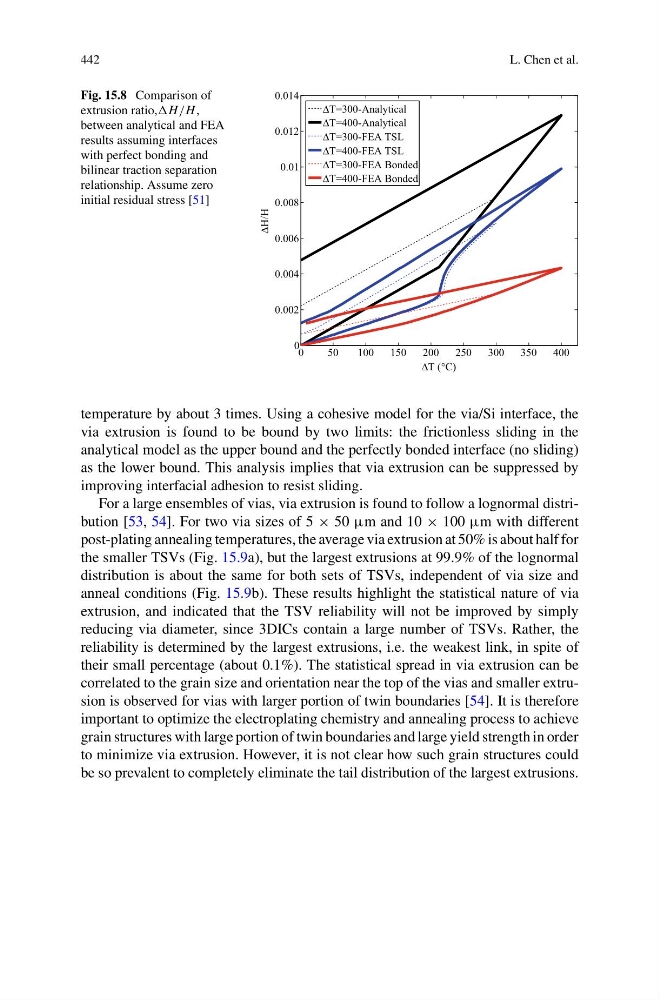
Fig. 15.8 Comparison of
extrusion ratio, ,
between analytical and FEA
results assuming interfaces
with perfect bonding and
bilinear traction separation
relationship. Assume zero
initial residual stress [51]
0
50
100
150
200
250
300
350
400
0
0.002
0.004
0.006
0.008
0.01
0.012
0.014
ΔT (°C)
ΔH/H
ΔT=300-Analytical
ΔT=400-Analytical
ΔT=300-FEA TSL
ΔT=400-FEA TSL
ΔT=300-FEA Bonded
ΔT=400-FEA Bonded
temperature by about 3 times. Using a cohesive model for the via/Si interface, the
via extrusion is found to be bound by two limits: the frictionless sliding in the
analytical model as the upper bound and the perfectly bonded interface (no sliding)
as the lower bound. This analysis implies that via extrusion can be suppressed by
improving interfacial adhesion to resist sliding.
For a large ensembles of vias, via extrusion is found to follow a lognormal distribution [53, 54]. For two via sizes of 5 × 50 μm and 10 × 100 μm with different
post-plating annealing temperatures, the average via extrusion at 50% is about half for
the smaller TSVs (Fig. 15.9a), but the largest extrusions at 99.9% of the lognormal
distribution is about the same for both sets of TSVs, independent of via size and
anneal conditions (Fig. 15.9b). These results highlight the statistical nature of via
extrusion, and indicated that the TSV reliability will not be improved by simply
reducing via diameter, since 3DICs contain a large number of TSVs. Rather, the
reliability is determined by the largest extrusions, i.e. the weakest link, in spite of
their small percentage (about 0.1%). The statistical spread in via extrusion can be
correlated to the grain size and orientation near the top of the vias and smaller extrusion is observed for vias with larger portion of twin boundaries [54]. It is therefore
important to optimize the electroplating chemistry and annealing process to achieve
grain structures with large portion of twin boundaries and large yield strength in order
to minimize via extrusion. However, it is not clear how such grain structures could
be so prevalent to completely eliminate the tail distribution of the largest extrusions.
L. Chen et al.
Fig. 15.8 Comparison of
extrusion ratio, ,
between analytical and FEA
results assuming interfaces
with perfect bonding and
bilinear traction separation
relationship. Assume zero
initial residual stress [51]
0
50
100
150
200
250
300
350
400
0
0.002
0.004
0.006
0.008
0.01
0.012
0.014
ΔT (°C)
ΔH/H
ΔT=300-Analytical
ΔT=400-Analytical
ΔT=300-FEA TSL
ΔT=400-FEA TSL
ΔT=300-FEA Bonded
ΔT=400-FEA Bonded
temperature by about 3 times. Using a cohesive model for the via/Si interface, the
via extrusion is found to be bound by two limits: the frictionless sliding in the
analytical model as the upper bound and the perfectly bonded interface (no sliding)
as the lower bound. This analysis implies that via extrusion can be suppressed by
improving interfacial adhesion to resist sliding.
For a large ensembles of vias, via extrusion is found to follow a lognormal distribution [53, 54]. For two via sizes of 5 × 50 μm and 10 × 100 μm with different
post-plating annealing temperatures, the average via extrusion at 50% is about half for
the smaller TSVs (Fig. 15.9a), but the largest extrusions at 99.9% of the lognormal
distribution is about the same for both sets of TSVs, independent of via size and
anneal conditions (Fig. 15.9b). These results highlight the statistical nature of via
extrusion, and indicated that the TSV reliability will not be improved by simply
reducing via diameter, since 3DICs contain a large number of TSVs. Rather, the
reliability is determined by the largest extrusions, i.e. the weakest link, in spite of
their small percentage (about 0.1%). The statistical spread in via extrusion can be
correlated to the grain size and orientation near the top of the vias and smaller extrusion is observed for vias with larger portion of twin boundaries [54]. It is therefore
important to optimize the electroplating chemistry and annealing process to achieve
grain structures with large portion of twin boundaries and large yield strength in order
to minimize via extrusion. However, it is not clear how such grain structures could
be so prevalent to completely eliminate the tail distribution of the largest extrusions.