

15 Die and Package Level Thermal and Thermal/Moisture Stresses …
441
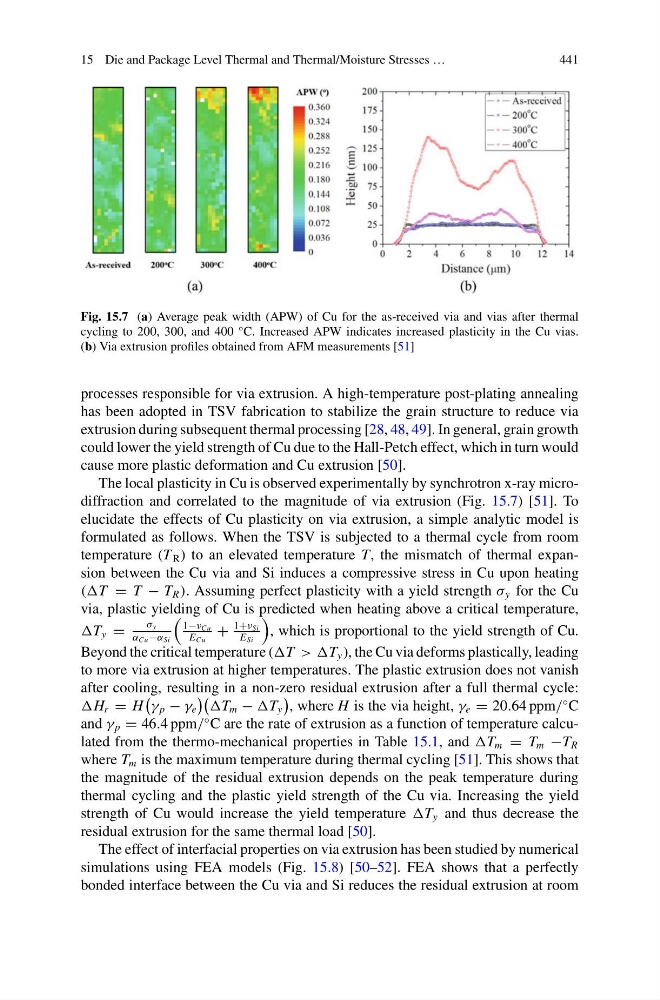
Fig. 15.7 (a) Average peak width (APW) of Cu for the as-received via and vias after thermal
cycling to 200, 300, and 400 °C. Increased APW indicates increased plasticity in the Cu vias.
(b) Via extrusion profiles obtained from AFM measurements [51]
processes responsible for via extrusion. A high-temperature post-plating annealing
has been adopted in TSV fabrication to stabilize the grain structure to reduce via
extrusion during subsequent thermal processing [28, 48, 49]. In general, grain growth
could lower the yield strength of Cu due to the Hall-Petch effect, which in turn would
cause more plastic deformation and Cu extrusion [50].
The local plasticity in Cu is observed experimentally by synchrotron x-ray microdiffraction and correlated to the magnitude of via extrusion (Fig. 15.7) [51]. To
elucidate the effects of Cu plasticity on via extrusion, a simple analytic model is
formulated as follows. When the TSV is subjected to a thermal cycle from room
temperature (T R ) to an elevated temperature T, the mismatch of thermal expansion between the Cu via and Si induces a compressive stress in Cu upon heating
((T = T − T R ). Assuming perfect plasticity with a yield strength σ y for the Cu
via, plastic yielding of Cu is predicted when heating above a critical temperature,
T y =
σ y
α Cu −α Si
1−ν Cu
E Cu
+
1+ν Si
E Si
, which is proportional to the yield strength of Cu.
Beyond the critical temperature (T > >T y ), the Cu via deforms plastically, leading
to more via extrusion at higher temperatures. The plastic extrusion does not vanish
after cooling, resulting in a non-zero residual extrusion after a full thermal cycle:
H r = H
γ p − γ e
T m − T y
, where H is the via height, γ e = 20.64 ppm/
◦ C
and γ p = 46.4 ppm/
◦ C are the rate of extrusion as a function of temperature calculated from the thermo-mechanical properties in Table 15.1, and T m = T m −T R
where T m is the maximum temperature during thermal cycling [51]. This shows that
the magnitude of the residual extrusion depends on the peak temperature during
thermal cycling and the plastic yield strength of the Cu via. Increasing the yield
strength of Cu would increase the yield temperature T y and thus decrease the
residual extrusion for the same thermal load [50].
The effect of interfacial properties on via extrusion has been studied by numerical
simulations using FEA models (Fig. 15.8) [50–52]. FEA shows that a perfectly
bonded interface between the Cu via and Si reduces the residual extrusion at room
441
Fig. 15.7 (a) Average peak width (APW) of Cu for the as-received via and vias after thermal
cycling to 200, 300, and 400 °C. Increased APW indicates increased plasticity in the Cu vias.
(b) Via extrusion profiles obtained from AFM measurements [51]
processes responsible for via extrusion. A high-temperature post-plating annealing
has been adopted in TSV fabrication to stabilize the grain structure to reduce via
extrusion during subsequent thermal processing [28, 48, 49]. In general, grain growth
could lower the yield strength of Cu due to the Hall-Petch effect, which in turn would
cause more plastic deformation and Cu extrusion [50].
The local plasticity in Cu is observed experimentally by synchrotron x-ray microdiffraction and correlated to the magnitude of via extrusion (Fig. 15.7) [51]. To
elucidate the effects of Cu plasticity on via extrusion, a simple analytic model is
formulated as follows. When the TSV is subjected to a thermal cycle from room
temperature (T R ) to an elevated temperature T, the mismatch of thermal expansion between the Cu via and Si induces a compressive stress in Cu upon heating
((T = T − T R ). Assuming perfect plasticity with a yield strength σ y for the Cu
via, plastic yielding of Cu is predicted when heating above a critical temperature,
T y =
σ y
α Cu −α Si
1−ν Cu
E Cu
+
1+ν Si
E Si
, which is proportional to the yield strength of Cu.
Beyond the critical temperature (T > >T y ), the Cu via deforms plastically, leading
to more via extrusion at higher temperatures. The plastic extrusion does not vanish
after cooling, resulting in a non-zero residual extrusion after a full thermal cycle:
H r = H
γ p − γ e
T m − T y
, where H is the via height, γ e = 20.64 ppm/
◦ C
and γ p = 46.4 ppm/
◦ C are the rate of extrusion as a function of temperature calculated from the thermo-mechanical properties in Table 15.1, and T m = T m −T R
where T m is the maximum temperature during thermal cycling [51]. This shows that
the magnitude of the residual extrusion depends on the peak temperature during
thermal cycling and the plastic yield strength of the Cu via. Increasing the yield
strength of Cu would increase the yield temperature T y and thus decrease the
residual extrusion for the same thermal load [50].
The effect of interfacial properties on via extrusion has been studied by numerical
simulations using FEA models (Fig. 15.8) [50–52]. FEA shows that a perfectly
bonded interface between the Cu via and Si reduces the residual extrusion at room