

14 Fundamentals of Advanced Materials …
427
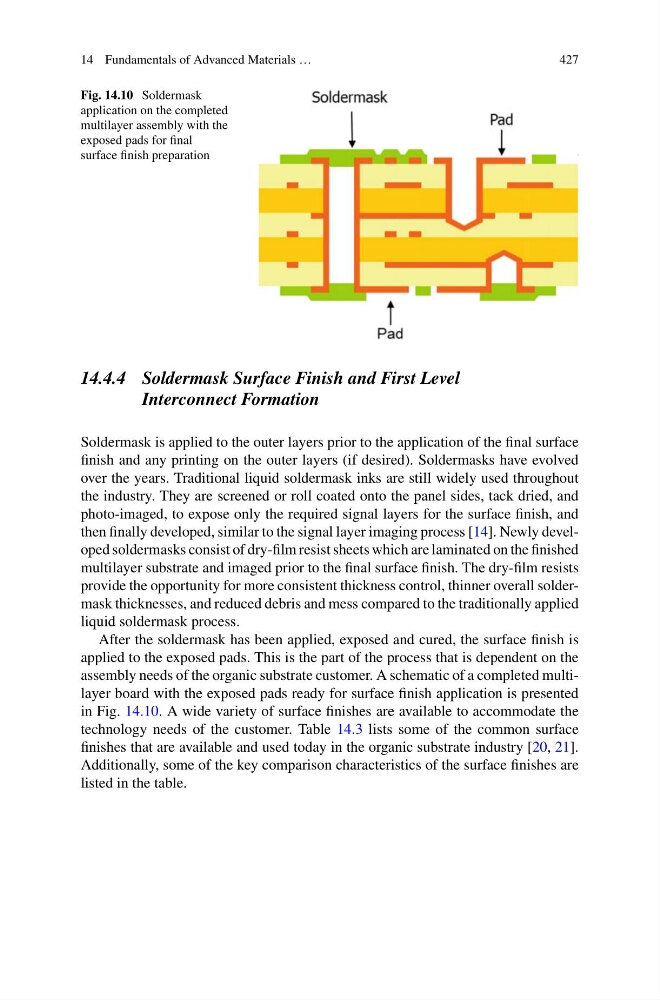
Fig. 14.10 Soldermask
application on the completed
multilayer assembly with the
exposed pads for final
surface finish preparation
14.4.4 Soldermask Surface Finish and First Level
Interconnect Formation
Soldermask is applied to the outer layers prior to the application of the final surface
finish and any printing on the outer layers (if desired). Soldermasks have evolved
over the years. Traditional liquid soldermask inks are still widely used throughout
the industry. They are screened or roll coated onto the panel sides, tack dried, and
photo-imaged, to expose only the required signal layers for the surface finish, and
then finally developed, similar to the signal layer imaging process [14]. Newly developed soldermasks consist of dry-film resist sheets which are laminated on the finished
multilayer substrate and imaged prior to the final surface finish. The dry-film resists
provide the opportunity for more consistent thickness control, thinner overall soldermask thicknesses, and reduced debris and mess compared to the traditionally applied
liquid soldermask process.
After the soldermask has been applied, exposed and cured, the surface finish is
applied to the exposed pads. This is the part of the process that is dependent on the
assembly needs of the organic substrate customer. A schematic of a completed multilayer board with the exposed pads ready for surface finish application is presented
in Fig. 14.10. A wide variety of surface finishes are available to accommodate the
technology needs of the customer. Table 14.3 lists some of the common surface
finishes that are available and used today in the organic substrate industry [20, 21].
Additionally, some of the key comparison characteristics of the surface finishes are
listed in the table.
427
Fig. 14.10 Soldermask
application on the completed
multilayer assembly with the
exposed pads for final
surface finish preparation
14.4.4 Soldermask Surface Finish and First Level
Interconnect Formation
Soldermask is applied to the outer layers prior to the application of the final surface
finish and any printing on the outer layers (if desired). Soldermasks have evolved
over the years. Traditional liquid soldermask inks are still widely used throughout
the industry. They are screened or roll coated onto the panel sides, tack dried, and
photo-imaged, to expose only the required signal layers for the surface finish, and
then finally developed, similar to the signal layer imaging process [14]. Newly developed soldermasks consist of dry-film resist sheets which are laminated on the finished
multilayer substrate and imaged prior to the final surface finish. The dry-film resists
provide the opportunity for more consistent thickness control, thinner overall soldermask thicknesses, and reduced debris and mess compared to the traditionally applied
liquid soldermask process.
After the soldermask has been applied, exposed and cured, the surface finish is
applied to the exposed pads. This is the part of the process that is dependent on the
assembly needs of the organic substrate customer. A schematic of a completed multilayer board with the exposed pads ready for surface finish application is presented
in Fig. 14.10. A wide variety of surface finishes are available to accommodate the
technology needs of the customer. Table 14.3 lists some of the common surface
finishes that are available and used today in the organic substrate industry [20, 21].
Additionally, some of the key comparison characteristics of the surface finishes are
listed in the table.