

14 Fundamentals of Advanced Materials …
409
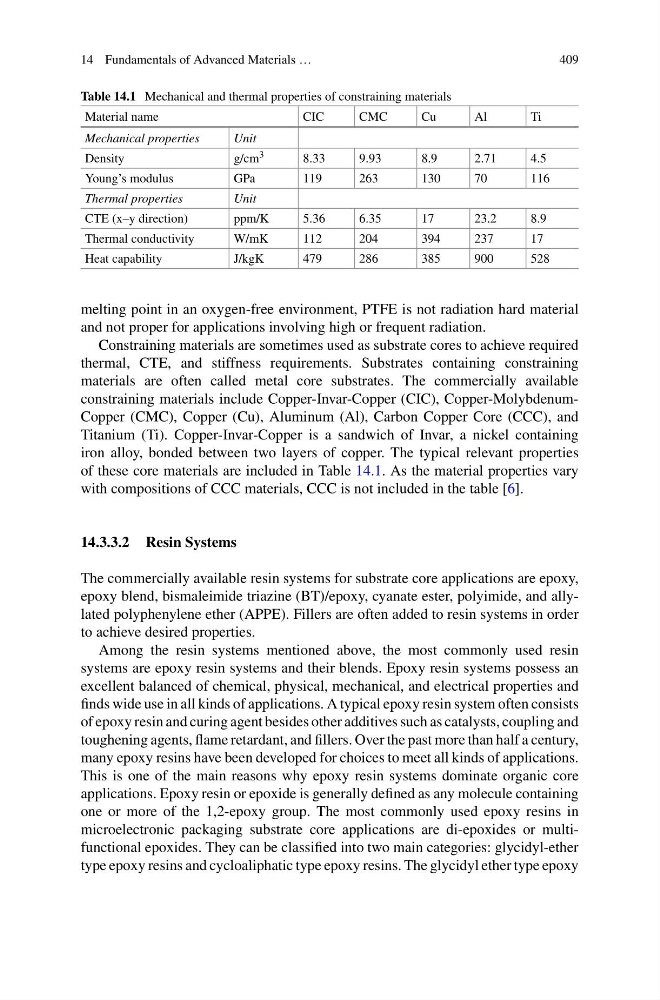
Table 14.1 Mechanical and thermal properties of constraining materials
Material name
CIC
CMC
Cu
Al
Ti
Mechanical properties
Unit
Density
g/cm 3
8.33
9.93
8.9
2.71
4.5
Young’s modulus
GPa
119
263
130
70
116
Thermal properties
Unit
CTE (x–y direction)
ppm/K
5.36
6.35
17
23.2
8.9
Thermal conductivity
W/mK
112
204
394
237
17
Heat capability
J/kgK
479
286
385
900
528
melting point in an oxygen-free environment, PTFE is not radiation hard material
and not proper for applications involving high or frequent radiation.
Constraining materials are sometimes used as substrate cores to achieve required
thermal, CTE, and stiffness requirements. Substrates containing constraining
materials are often called metal core substrates. The commercially available
constraining materials include Copper-Invar-Copper (CIC), Copper-MolybdenumCopper (CMC), Copper (Cu), Aluminum (Al), Carbon Copper Core (CCC), and
Titanium (Ti). Copper-Invar-Copper is a sandwich of Invar, a nickel containing
iron alloy, bonded between two layers of copper. The typical relevant properties
of these core materials are included in Table 14.1. As the material properties vary
with compositions of CCC materials, CCC is not included in the table [6].
14.3.3.2 Resin Systems
The commercially available resin systems for substrate core applications are epoxy,
epoxy blend, bismaleimide triazine (BT)/epoxy, cyanate ester, polyimide, and allylated polyphenylene ether (APPE). Fillers are often added to resin systems in order
to achieve desired properties.
Among the resin systems mentioned above, the most commonly used resin
systems are epoxy resin systems and their blends. Epoxy resin systems possess an
excellent balanced of chemical, physical, mechanical, and electrical properties and
finds wide use in all kinds of applications. A typical epoxy resin system often consists
of epoxy resin and curing agent besides other additives such as catalysts, coupling and
toughening agents, flame retardant, and fillers. Over the past more than half a century,
many epoxy resins have been developed for choices to meet all kinds of applications.
This is one of the main reasons why epoxy resin systems dominate organic core
applications. Epoxy resin or epoxide is generally defined as any molecule containing
one or more of the 1,2-epoxy group. The most commonly used epoxy resins in
microelectronic packaging substrate core applications are di-epoxides or multifunctional epoxides. They can be classified into two main categories: glycidyl-ether
type epoxy resins and cycloaliphatic type epoxy resins. The glycidyl ether type epoxy
409
Table 14.1 Mechanical and thermal properties of constraining materials
Material name
CIC
CMC
Cu
Al
Ti
Mechanical properties
Unit
Density
g/cm 3
8.33
9.93
8.9
2.71
4.5
Young’s modulus
GPa
119
263
130
70
116
Thermal properties
Unit
CTE (x–y direction)
ppm/K
5.36
6.35
17
23.2
8.9
Thermal conductivity
W/mK
112
204
394
237
17
Heat capability
J/kgK
479
286
385
900
528
melting point in an oxygen-free environment, PTFE is not radiation hard material
and not proper for applications involving high or frequent radiation.
Constraining materials are sometimes used as substrate cores to achieve required
thermal, CTE, and stiffness requirements. Substrates containing constraining
materials are often called metal core substrates. The commercially available
constraining materials include Copper-Invar-Copper (CIC), Copper-MolybdenumCopper (CMC), Copper (Cu), Aluminum (Al), Carbon Copper Core (CCC), and
Titanium (Ti). Copper-Invar-Copper is a sandwich of Invar, a nickel containing
iron alloy, bonded between two layers of copper. The typical relevant properties
of these core materials are included in Table 14.1. As the material properties vary
with compositions of CCC materials, CCC is not included in the table [6].
14.3.3.2 Resin Systems
The commercially available resin systems for substrate core applications are epoxy,
epoxy blend, bismaleimide triazine (BT)/epoxy, cyanate ester, polyimide, and allylated polyphenylene ether (APPE). Fillers are often added to resin systems in order
to achieve desired properties.
Among the resin systems mentioned above, the most commonly used resin
systems are epoxy resin systems and their blends. Epoxy resin systems possess an
excellent balanced of chemical, physical, mechanical, and electrical properties and
finds wide use in all kinds of applications. A typical epoxy resin system often consists
of epoxy resin and curing agent besides other additives such as catalysts, coupling and
toughening agents, flame retardant, and fillers. Over the past more than half a century,
many epoxy resins have been developed for choices to meet all kinds of applications.
This is one of the main reasons why epoxy resin systems dominate organic core
applications. Epoxy resin or epoxide is generally defined as any molecule containing
one or more of the 1,2-epoxy group. The most commonly used epoxy resins in
microelectronic packaging substrate core applications are di-epoxides or multifunctional epoxides. They can be classified into two main categories: glycidyl-ether
type epoxy resins and cycloaliphatic type epoxy resins. The glycidyl ether type epoxy