

336
K.-L. Lin
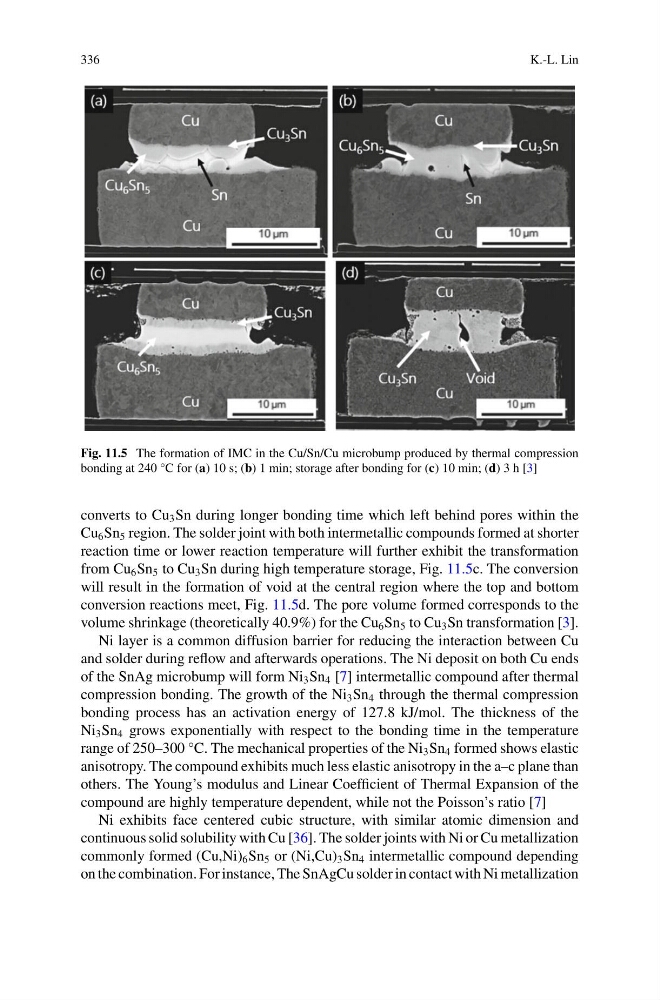
Fig. 11.5 The formation of IMC in the Cu/Sn/Cu microbump produced by thermal compression
bonding at 240 °C for (a) 10 s; (b) 1 min; storage after bonding for (c) 10 min; (d) 3 h [3]
converts to Cu 3 Sn during longer bonding time which left behind pores within the
Cu 6 Sn 5 region. The solder joint with both intermetallic compounds formed at shorter
reaction time or lower reaction temperature will further exhibit the transformation
from Cu 6 Sn 5 to Cu 3 Sn during high temperature storage, Fig. 11.5c. The conversion
will result in the formation of void at the central region where the top and bottom
conversion reactions meet, Fig. 11.5d. The pore volume formed corresponds to the
volume shrinkage (theoretically 40.9%) for the Cu 6 Sn 5 to Cu 3 Sn transformation [3].
Ni layer is a common diffusion barrier for reducing the interaction between Cu
and solder during reflow and afterwards operations. The Ni deposit on both Cu ends
of the SnAg microbump will form Ni 3 Sn 4 [7] intermetallic compound after thermal
compression bonding. The growth of the Ni 3 Sn 4 through the thermal compression
bonding process has an activation energy of 127.8 kJ/mol. The thickness of the
Ni 3 Sn 4 grows exponentially with respect to the bonding time in the temperature
range of 250–300 °C. The mechanical properties of the Ni 3 Sn 4 formed shows elastic
anisotropy. The compound exhibits much less elastic anisotropy in the a–c plane than
others. The Young’s modulus and Linear Coefficient of Thermal Expansion of the
compound are highly temperature dependent, while not the Poisson’s ratio [7]
Ni exhibits face centered cubic structure, with similar atomic dimension and
continuous solid solubility with Cu [36]. The solder joints with Ni or Cu metallization
commonly formed (Cu,Ni) 6 Sn 5 or (Ni,Cu) 3 Sn 4 intermetallic compound depending
on the combination. For instance, The SnAgCu solder in contact with Ni metallization
K.-L. Lin
Fig. 11.5 The formation of IMC in the Cu/Sn/Cu microbump produced by thermal compression
bonding at 240 °C for (a) 10 s; (b) 1 min; storage after bonding for (c) 10 min; (d) 3 h [3]
converts to Cu 3 Sn during longer bonding time which left behind pores within the
Cu 6 Sn 5 region. The solder joint with both intermetallic compounds formed at shorter
reaction time or lower reaction temperature will further exhibit the transformation
from Cu 6 Sn 5 to Cu 3 Sn during high temperature storage, Fig. 11.5c. The conversion
will result in the formation of void at the central region where the top and bottom
conversion reactions meet, Fig. 11.5d. The pore volume formed corresponds to the
volume shrinkage (theoretically 40.9%) for the Cu 6 Sn 5 to Cu 3 Sn transformation [3].
Ni layer is a common diffusion barrier for reducing the interaction between Cu
and solder during reflow and afterwards operations. The Ni deposit on both Cu ends
of the SnAg microbump will form Ni 3 Sn 4 [7] intermetallic compound after thermal
compression bonding. The growth of the Ni 3 Sn 4 through the thermal compression
bonding process has an activation energy of 127.8 kJ/mol. The thickness of the
Ni 3 Sn 4 grows exponentially with respect to the bonding time in the temperature
range of 250–300 °C. The mechanical properties of the Ni 3 Sn 4 formed shows elastic
anisotropy. The compound exhibits much less elastic anisotropy in the a–c plane than
others. The Young’s modulus and Linear Coefficient of Thermal Expansion of the
compound are highly temperature dependent, while not the Poisson’s ratio [7]
Ni exhibits face centered cubic structure, with similar atomic dimension and
continuous solid solubility with Cu [36]. The solder joints with Ni or Cu metallization
commonly formed (Cu,Ni) 6 Sn 5 or (Ni,Cu) 3 Sn 4 intermetallic compound depending
on the combination. For instance, The SnAgCu solder in contact with Ni metallization