

310
S. Lee
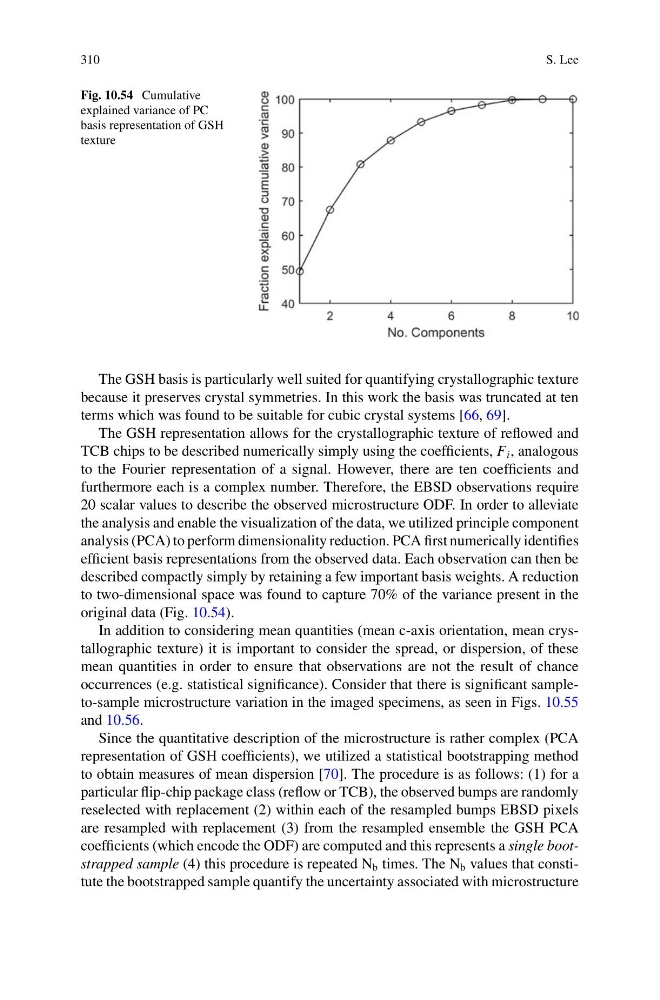
Fig. 10.54 Cumulative
explained variance of PC
basis representation of GSH
texture
The GSH basis is particularly well suited for quantifying crystallographic texture
because it preserves crystal symmetries. In this work the basis was truncated at ten
terms which was found to be suitable for cubic crystal systems [66, 69].
The GSH representation allows for the crystallographic texture of reflowed and
TCB chips to be described numerically simply using the coefficients, F i , analogous
to the Fourier representation of a signal. However, there are ten coefficients and
furthermore each is a complex number. Therefore, the EBSD observations require
20 scalar values to describe the observed microstructure ODF. In order to alleviate
the analysis and enable the visualization of the data, we utilized principle component
analysis (PCA) to perform dimensionality reduction. PCA first numerically identifies
efficient basis representations from the observed data. Each observation can then be
described compactly simply by retaining a few important basis weights. A reduction
to two-dimensional space was found to capture 70% of the variance present in the
original data (Fig. 10.54).
In addition to considering mean quantities (mean c-axis orientation, mean crystallographic texture) it is important to consider the spread, or dispersion, of these
mean quantities in order to ensure that observations are not the result of chance
occurrences (e.g. statistical significance). Consider that there is significant sampleto-sample microstructure variation in the imaged specimens, as seen in Figs. 10.55
and 10.56.
Since the quantitative description of the microstructure is rather complex (PCA
representation of GSH coefficients), we utilized a statistical bootstrapping method
to obtain measures of mean dispersion [70]. The procedure is as follows: (1) for a
particular flip-chip package class (reflow or TCB), the observed bumps are randomly
reselected with replacement (2) within each of the resampled bumps EBSD pixels
are resampled with replacement (3) from the resampled ensemble the GSH PCA
coefficients (which encode the ODF) are computed and this represents a single bootstrapped sample (4) this procedure is repeated N b times. The N b values that constitute the bootstrapped sample quantify the uncertainty associated with microstructure
S. Lee
Fig. 10.54 Cumulative
explained variance of PC
basis representation of GSH
texture
The GSH basis is particularly well suited for quantifying crystallographic texture
because it preserves crystal symmetries. In this work the basis was truncated at ten
terms which was found to be suitable for cubic crystal systems [66, 69].
The GSH representation allows for the crystallographic texture of reflowed and
TCB chips to be described numerically simply using the coefficients, F i , analogous
to the Fourier representation of a signal. However, there are ten coefficients and
furthermore each is a complex number. Therefore, the EBSD observations require
20 scalar values to describe the observed microstructure ODF. In order to alleviate
the analysis and enable the visualization of the data, we utilized principle component
analysis (PCA) to perform dimensionality reduction. PCA first numerically identifies
efficient basis representations from the observed data. Each observation can then be
described compactly simply by retaining a few important basis weights. A reduction
to two-dimensional space was found to capture 70% of the variance present in the
original data (Fig. 10.54).
In addition to considering mean quantities (mean c-axis orientation, mean crystallographic texture) it is important to consider the spread, or dispersion, of these
mean quantities in order to ensure that observations are not the result of chance
occurrences (e.g. statistical significance). Consider that there is significant sampleto-sample microstructure variation in the imaged specimens, as seen in Figs. 10.55
and 10.56.
Since the quantitative description of the microstructure is rather complex (PCA
representation of GSH coefficients), we utilized a statistical bootstrapping method
to obtain measures of mean dispersion [70]. The procedure is as follows: (1) for a
particular flip-chip package class (reflow or TCB), the observed bumps are randomly
reselected with replacement (2) within each of the resampled bumps EBSD pixels
are resampled with replacement (3) from the resampled ensemble the GSH PCA
coefficients (which encode the ODF) are computed and this represents a single bootstrapped sample (4) this procedure is repeated N b times. The N b values that constitute the bootstrapped sample quantify the uncertainty associated with microstructure